Opening The Rift
therift
© 2026 The Rift. All Rights Reserved.
Logistic chaos in Asian Games despite tripling budget re-emphasizes need for decentralized, joint organization of international sports events
The current model of mega sports events places immense burdens on host cities, leading to chaos, displacement, and financial strain.

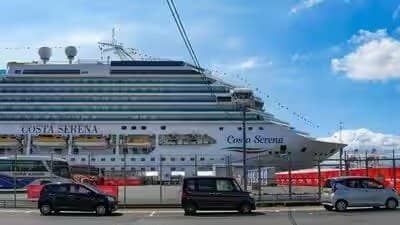
Costa Serena Cruise Ship housing Aisan Games athletes at Nagoya Port, Japan. (PTI Photo)
Key Takeaways
1 of 3
Automatically generated. Read full article for complete context.
Athletes and sportsmen assembling for the 20th Asian GamesAsiadA pancontinental multi-sport event held every four years among athletes from all over Asia. It is the second-largest multi-sport event after the Olympic Games. in Aichi-Nagoya were not prepared for the chaotic reception awaiting them in Japan, a country generally known for great efficiency and punctuality. They were probably prepared for shipping container huts for stay but not for the shortage of beds and even food, the same room being allocated to more than one person, lack of essential transport, and long waiting hours, in some cases leading to participants missing training and practice. This has happened despite the reported tripling of the budget compared to the original estimate of around 90 billion yen.
This has once again drawn attention to an aspect of international sports events which this writer has emphasized repeatedly—whether it is the Olympic GamesThe OlympicsLeading international multi-sport events, encompassing Summer and Winter Games, where thousands of athletes from around the world participate in a variety of competitions., Asian Games or other such events, it is better to organize them in a decentralized way together by several countries so that both the burden and the honors can be shared, contributing to better organization and higher internationalism in keeping with the spirit of the games. In addition, it will be possible to significantly reduce problems such as displacement and high economic burden that have troubled the organizers of several such events in the past.
At a time when most of the discussion was about who would win more medals, on the margins of the Paris Olympic Games in 2024, several social groups intensified efforts to prevent the eviction of more and more people. RDLMRevers de la Médaille (The Flip Side of the Medal)A collective of over 80 different organizations in France that advocates for the rights of vulnerable populations, particularly in the context of major events like the Olympic Games., a collective of over 80 different organizations, alleged that thousands of the most vulnerable people including homeless and migrant individuals had already been evicted in a number of different actions. The number was likely around 12,500. This collective released a 78 page report titled ‘One year of Social Cleansing’. These social organizations also made efforts to ensure that essential services and needs of the most vulnerable people were not neglected amidst the big games. Earlier, there were protests by environmental groups against the proposed felling of trees in Paris as part of efforts to speed up the redevelopment for the Olympic Games.
Previous Olympic Games also saw controversies relating to adverse impacts on greenery, settlements of weaker sections and overall development priorities of host cities. People raised questions like: why should spaces meant for housing for weaker sections and greenery be used up for constructing an excessive number of sports stadiums and facilities, for which there may be little use after the big games are over within a few days.
Before the 2024 event was awarded to Paris, there were withdrawals by Boston, Rome, Hamburg, and Budapest due to reasons relating to economic and social costs. In the case of 1976 Games, Denver withdrew even after the city had been officially selected, paving the way for Montreal to emerge as host.
One reason for this relates to high costs. Recent Olympics have seen cost escalations ranging from 75% to 360%.
While the Olympic spectacle rolls on, an increasingly important issue is the mounting pressure on host cities, with many people complaining about these big events disrupting priorities. The host city may end up giving up more essential projects and priorities in favor of huge stadiums and other sports complexes, which are likely to remain underutilized later.
There have been protest movements in several cities hosting Olympics and other major sports events (like the Asian Games and the Commonwealth Games). Such voices of protest and opposition were very much there in Tokyo (2020), and what is more, we can already hear them in the context of the Los Angeles Olympics (2028) as concerns relating to high costs and temporary displacement of vulnerable groups are being cited.
According to the Centre on Housing Rights and Evictions, Geneva, nearly 1.5 million people were displaced for the Beijing Olympics (2008), preceded by nearly half this number in Seoul. The Asian Games and Commonwealth Games have also led to complaints of significant evictions and corruption. The London Olympics in 2012 led to the cancellation of an important low-income housing project.
Excessive punishment was inflicted on Beijing protestors. In the case of the Mexico Olympics, student protesters faced police firing, resulting in 30 deaths.
The cost of Tokyo Olympics ultimately more than doubled. The Montreal Olympics in 1976 led to debts, and these debts could only be fully paid back three decades later, leading to its major stadiums being renamed ‘the big owes’ instead of ‘the big ones’.
Another concern is that the concentration of too many sports and events within a very short span of about two or three weeks makes it difficult for sports enthusiasts to really give proper attention to all of them. Too much appears to be happening at the same time and too quickly. The Tokyo Olympics, involving about 11,000 athletes competing in 339 events of 41 sports, were over in just 17 days.
To avoid all these problems, the International Olympics Committee has already taken some decisions from time to time, including organizing the Winter Olympics in a different year from the main Summer Olympics. However, these reforms do not go far enough, and the main Summer Olympics is itself too massive an event for a single place and concentrated within too short a time.
Hence, there is a clear need to spread this once-in-four-years event of the Summer Olympics and Paralympics across about 40 countries or so, representing all continents. While one country can be the lead venue, responsible for perhaps one-tenth of the overall sports events, its responsibilities for all the various sports should be shared by perhaps about 40 other countries in all parts of the world. This way it can become much more of an all-world event. Costs will be shared. The burden of financial costs and management will not be too heavy on any one country, even if more events are added.
At the same time, the main Olympics can be spread throughout the Olympic year, depending upon the most appropriate season of the various host countries. Hence sports enthusiasts will have much more to look forward to enjoying throughout the year, instead of having too many sports concentrated in just two to three weeks when they cannot truly get the full flavor of over 300 events.
In this way, the Olympic Games can become more representative and participative world events while reducing costs. When the scale of the event is much smaller, it becomes easier to avoid evictions and displacements. In addition, a clause requiring the minimization of social and ecological costs can be written into agreements with all countries hosting diverse Olympic events, with certain dos and don’ts being worked out by a team of experts and monitored by special teams. This may well be the way forward to reducing problems and increasing enjoyment of the Olympic Games.
At what stage such reforms will be introduced, starting from which Olympics, can be worked out in consultation with various involved parties once the reforms are agreed upon in principle.
Somewhat similar reform proposals can also be extended to other mega sports events, including the Asian Games, wherever these may be relevant.
These reforms can reduce the burden for a single host while simultaneously increasing the enjoyment of sports enthusiasts.
Disclaimer:The views and opinions expressed in this article are those of the author(s) and do not necessarily reflect the official policy or position of The Rift.