Opening The Rift
therift
© 2026 The Rift. All Rights Reserved.
No Seat at the Table: Why Disabled Indians Remain Absent from Parliament
Persons with disabilities meet every criterion that logic dictates: a large community, centuries of exclusion, and no representation at all in the legislature

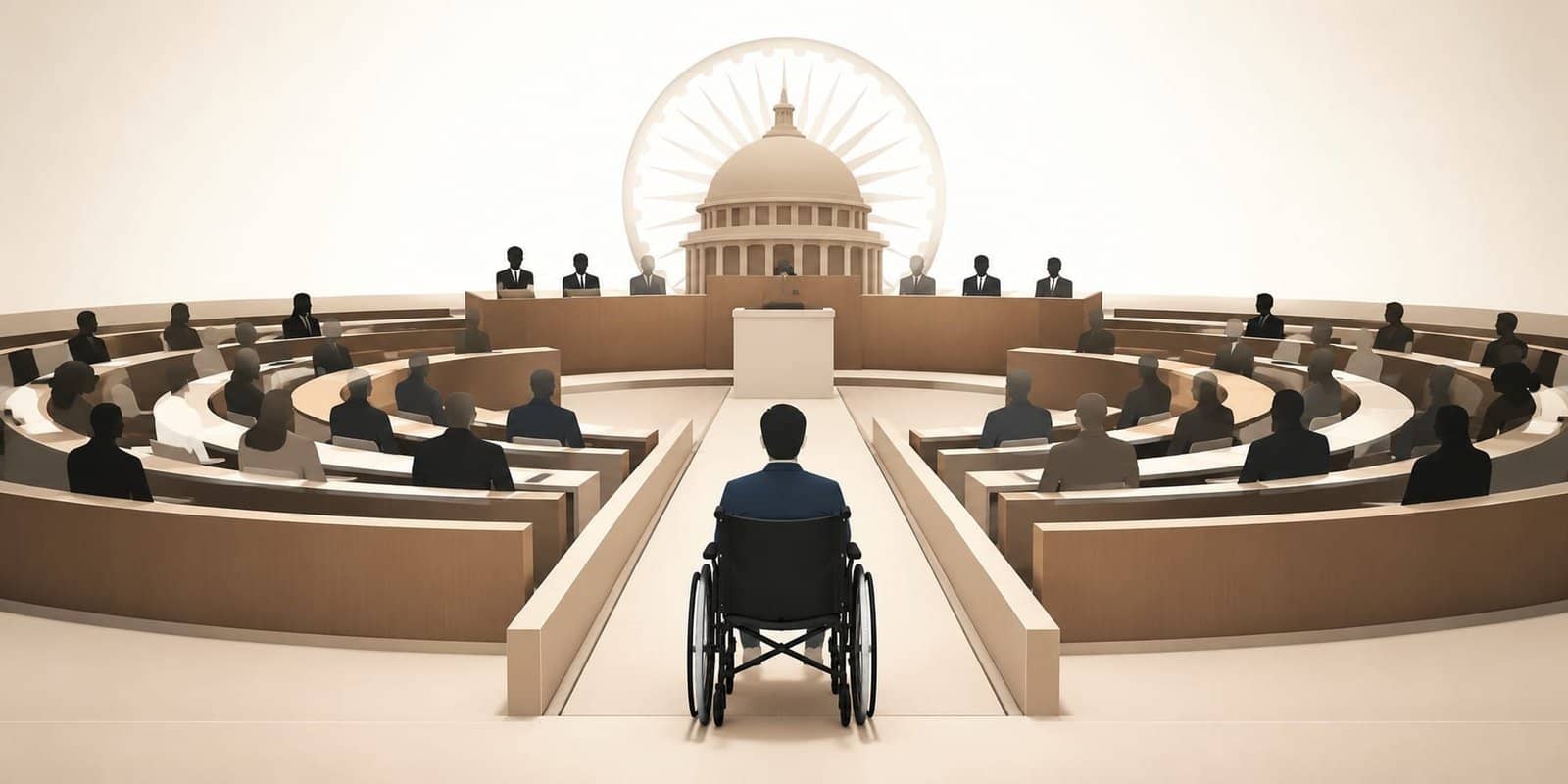
(Representative Image)
Key Takeaways
1 of 3
Automatically generated. Read full article for complete context.
Every election season, volunteers move tens of thousands of disabled Indians to polling booths, give them Braille ballot papersAccessible VotingBallot papers printed with raised dots, allowing visually impaired individuals to read and mark their votes independently., and take pride in counting them amongst the electors. One thing that does not happen often is the reverse of that: a wheelchair being rolled up to the podium of the candidate, who holds a ticket in hand and a political symbol behind his name. India’s 2.68 crore persons with disabilities, 2.21 percent of India’s population, as per the 2011 Census, participate heavily in voting but do not win elections.
This disparity is no mere coincidence; it is the outcome of a long-term practice wherein the country views disability purely as a welfare issue, not a political identity.
Charity Paradigm of Disability
For much of post-independence India, the discourse on disability has been one of charity, pity, or cure. This has been the case despite many attempts by disability activist and researcher Anita Ghai to counter this paradigm of disability. For Ghai, the problem of disability lies not in a person’s body, but in the structures around them. The inability to access a lift, a ramp, or a ballot paper in Braille constitutes a large part of ‘disability,’ while what remains is an ‘impairment.’
A constituency nobody courts
Go through the organizational structure of any Indian political party and you will see a wing of women, another of youth, and maybe even a separate cell for farmers. But there is no wing dedicated to disabled members. This is so because the parties already have an idea of who will get elected. Candidates who can walk from door-to-door, who can climb onto the stage, and who can speak louder than a crowd are chosen.
This has resulted in a strange kind of imbalance. Discussion of disability policy—accessibility ramps, technological aids, inclusive schooling, and independent living has always been common in Indian politics. However, those who would benefit from these policies have not often been around to participate in them. As a movement, there is a clear slogan to articulate this dynamic in disability politics internationally: “nothing about us without us.” Nothing about disabled Indians takes place in the legislature without them.
“Nothing about us without us,” a slogan that starkly contradicts the manner in which Indian disability policy is made.
Welfare isn’t the same as power.
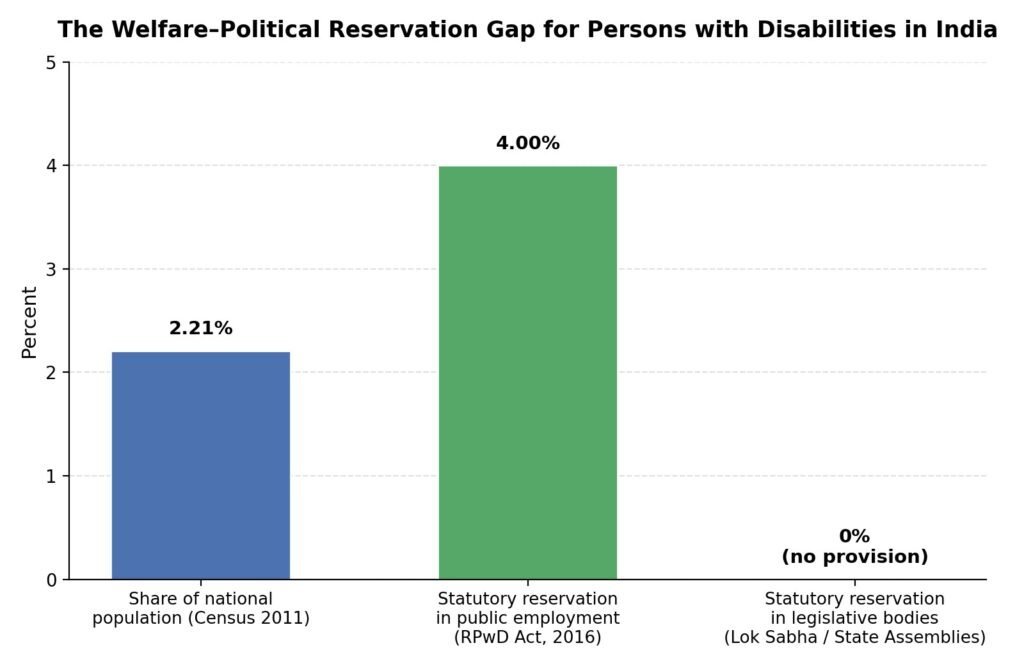
On paper, India is not lacking. The Rights of Persons with Disabilities (RPwD) Act, 2016Indian LegislationAn Act of the Parliament of India that replaced the Persons with Disabilities (Equal Opportunities, Protection of Rights and Full Participation) Act, 1995. It aims to ensure the rights and entitlements of persons with disabilities., requires that 4 percent of government jobs be reserved for individuals with benchmark disabilities, which is close to twice their proportion in the general population., which comes close to twice their proportion in the general population. However, an employment quota and a seat in the parliament do vastly different things. One helps someone earn a living. The other lets them help write the laws that decide who else gets to.
Line them up, and the discrepancy is impossible to ignore: 2.21 percent of India are disabled, 4 percent of government jobs are reserved for them, and 0 percent of seats in the Lok SabhaIndian ParliamentThe lower house of India’s bicameral Parliament, whose members are directly elected by the people. or any state assemblyIndian State LegislatureThe legislative body in each of the states and union territories of India, responsible for making laws for that specific region. are.
What Other Countries Have Tried
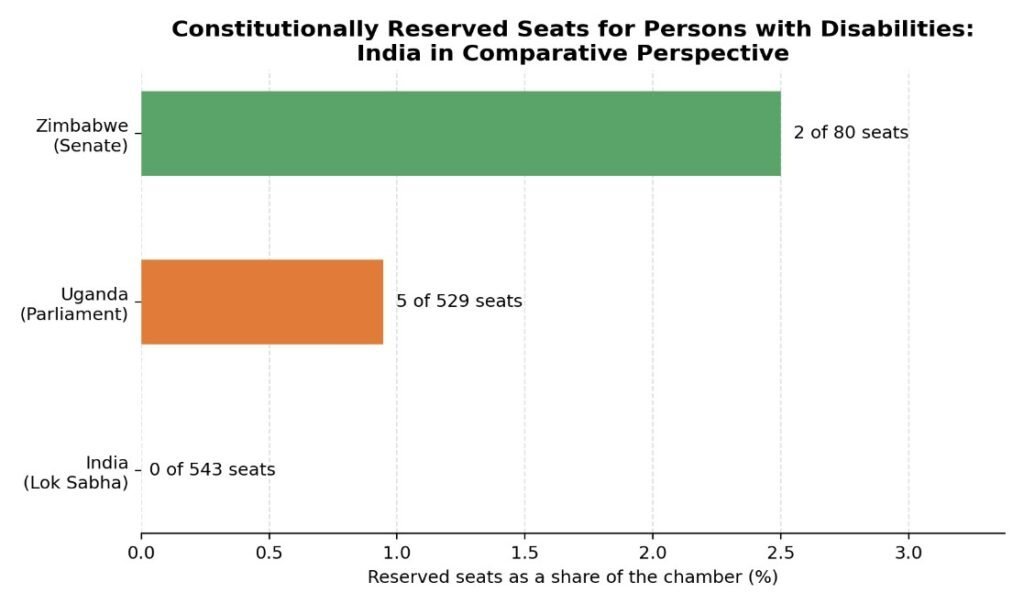
India is certainly not the only democracy to be faced with such issues. For example, the Constitution of Uganda mandates Parliament to create space for historically marginalized people, and Parliament responded by setting aside five of its 529 seats for people with disabilities, including at least one female member. In Zimbabwe, there are two reserved seats out of the total of 80 in its Senate for people with disabilities who are elected through an electoral collegeIndirect Election SystemA body of electors chosen by a larger group (e.g., disability organizations) who formally cast votes for the election of a candidate to a particular office. consisting of disability organizations. Kenya, Rwanda, and Egypt have gone even further by providing for disability representation in their constitutions, rather than just a law that Parliament can easily change in the future.
While none of these systems are perfect, reserved seats tend to lose power and significance over time, and criticism on these grounds is widespread in all these countries. They do demonstrate one thing that India’s Parliament has not yet recognized: namely, that a legislature can provide space for people with disabilities without dire consequences.
However, there are moves afoot in India towards a solution, though not yet at a national level. In Tamil Nadu, a law has been enacted whereby people with disabilities have been nominated to more than 20,000 local bodies, from panchayatsLocal Self-GovernanceThe system of local self-governance in rural India, forming the lowest tier of administration. to municipal corporationsUrban Local GovernanceUnits of local self-governance in urban areas of India, responsible for civic administration.. That is a move in the right direction. It was done only after campaigners showed that only 35 disabled people had been elected to urban local bodies in the state on their own merit. Nomination thus becomes a viable solution when the electoral process has consistently failed the community.
The Actual Question
However, it may seem like a matter that can be brushed aside as a narrow interest group’s issue, to be addressed at a later time. The reality, however, is far different. India recognizes, in principle at least, that certain communities need to be granted special seats because they have been excluded for centuries; that is precisely why reservations for SC and STReserved Categories in IndiaAcronyms for Scheduled Castes and Scheduled Tribes, historically disadvantaged communities in India for whom reservations are provided in education, employment, and legislative bodies. are there in Parliament. Persons with disabilities meet every criterion that logic dictates: a large community, centuries of exclusion, and no representation at all in the legislature.
Nobody seriously disputes that disabled Indians deserve a place in politics. The harder question, one India continues to avoid, is why, seventy-five years into its democracy, that place still doesn’t exist. A country that lets its disabled citizens vote but not govern hasn’t finished building its democracy. It has only finished half of it.
Disclaimer:The views and opinions expressed in this article are those of the author(s) and do not necessarily reflect the official policy or position of The Rift.