Opening The Rift
therift
© 2026 The Rift. All Rights Reserved.
Pakistan: A Fatal Spectrum of Gender-Based Violence
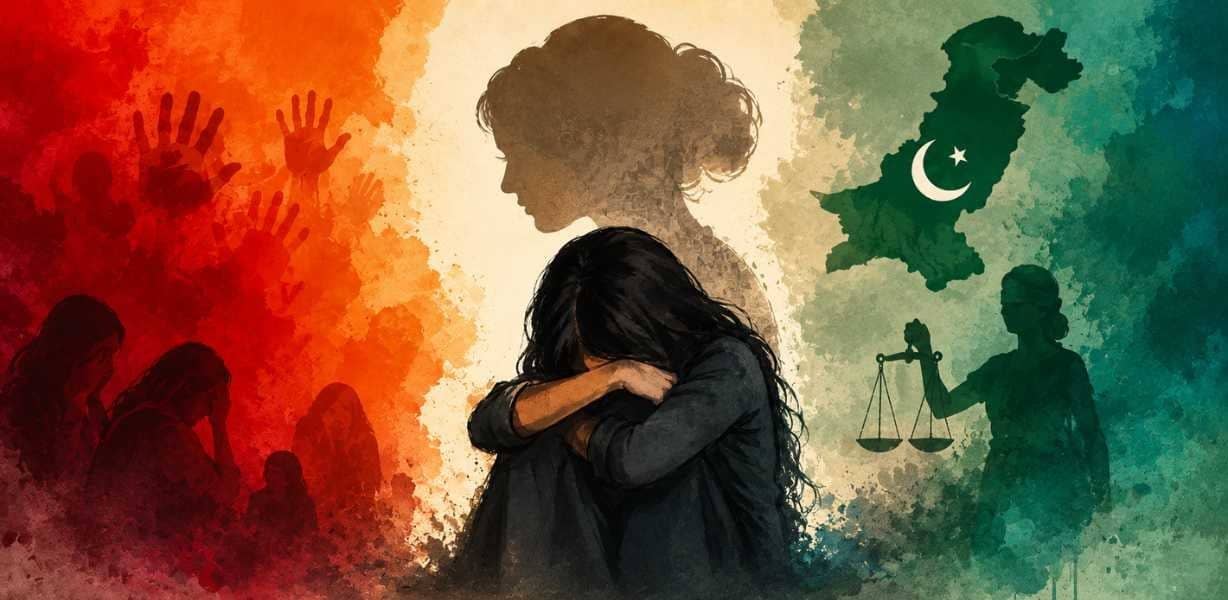
Gender-based violence in Pakistan is not limited to isolated crimes. It is part of a wider system of social control over women’s bodies, mobility, sexuality, and choices.

Key Takeaways
1 of 3
Automatically generated. Read full article for complete context.
Gender-based violence in Pakistan is not limited to isolated crimes. It is part of a wider system of social control over women’s bodies, mobility, sexuality, and choices. In many cases, violence begins when women exercise autonomy. Saying “no” to forced marriage, rejecting unwanted attention, demanding separation, choosing a partner, or resisting emotional control can be seen as rebellion against patriarchal authorityPatriarchyA social system in which men hold primary power and predominate in roles of political leadership, moral authority, social privilege and control of property.. In such contexts, refusal is often interpreted as dishonour. Violence then becomes a method of punishment. This makes gender-based violence not only a criminal issue, but also a structural and political issue rooted in patriarchy, silence, and unequal power.
Silent Femicide
The scale of violence against women in Pakistan remains deeply concerning. According to the Pakistan Demographic and Health Survey(PDHS– 2017–18), 28 percent of women aged 15–49 have experienced physical violence, while 6 percent have experienced sexual violence. Around 34 percent of ever-married women have faced spousal physical, sexual, or emotional violence. Five percent reported spousal sexual violence. These figures show that violence is embedded within domestic and social life. Yet the visible numbers tell only part of the story. Around 56 percent of women who experienced physical or sexual violence did not seek help or speak to anyone. Fear, economic dependency, social shame, weak institutional trust, and lack of psycho-social support often keep survivors silent. This silence hides abuse. Child marriage remains another form of structural violence. PDHS data shows that 18 percent of girls aged 20–24 were married before 18, while 3.6 percent were married before 15. Such marriages reduce education and increase health risks, including anemia, malnutrition, early pregnancy, prolonged labour, obstetric fistulaObstetric FistulaA severe medical condition in which a hole develops in the birth canal as a result of childbirth, often caused by prolonged labour without medical intervention., and maternal death. FemicideFemicideThe intentional murder of women or girls, specifically targeted because of their gender. also remains underreported. Many killings are disguised as suicides, accidents, or domestic conflicts. Weak documentation and family complicity make the real scale difficult to measure. This creates what can be understood as silent femicide.
28%
Women (15–49) experienced physical violence
34%
Ever-married women faced spousal violence
56%
Survivors who did not seek help or speak to anyone
The Honour Pretext
Honour-based violence in Pakistan is often framed as morality, but historically it is rooted in control, kinship, and patriarchal power. In tribal and feudal societies, women were often viewed as symbolic carriers of family honour. Their sexuality, mobility, marriage, and social behaviour became linked to male authority and community reputation. Over time, informal justice systems, feudal influence, and patriarchal kinship structures strengthened this idea that women’s autonomy could threaten collective honour. This violence appears in different regional forms. In Sindh, it is commonly known as Karo-KariKaro-KariA type of premeditated honour killing in Sindh where individuals are murdered for alleged extra-marital relations.. In Punjab, similar practices are referred to as Kala-KaliKala-KaliThe term used in Punjab referring to honour killings, functioning similarly to Karo-Kari.. In Khyber Pakhtunkhwa, terms such as Tor-ToraTor-ToraThe regional term for honour-based violence and killing used in Khyber Pakhtunkhwa. have been used, while in Balochistan, honour-related violence has been linked with SiyahkariSiyahkariA tribal custom in Balochistan involving the honour killing of men and women accused of illicit relationships. or Siyakari. Despite linguistic differences, the central logic remains the same: women are punished for perceived dishonour.
However, honour is often a cover for deeper structural control. Many cases involve forced marriage, inheritance disputes, land conflict, revenge, or resistance to patriarchal authority. Women may be targeted for choosing a spouse, seeking divorce, refusing marriage, or simply asserting autonomy. The persistence of Karo-Kari in Sindh reflects this deeply rooted violence. A recent case from Sukkur exposed this failure. Gulaan Bahro, a mother of two, reportedly fled to a police station at midnight after fearing for her life. She sought protection. Instead of meaningful safety, she was reportedly presented before the court the following day. There, she openly warned that “mujhe maar diya jayega.” Her fear was explicit. Her vulnerability was visible. Yet protection mechanisms failed. Roughly fifteen days later, news of her death emerged. She was allegedly killed by her husband despite earlier appeals for safety. This case reflects more than individual brutality. It reveals institutional collapse. Police intervention, court visibility, and shelter-based protection were unable to prevent violence. The public reaction also exposed a gendered irony. Reports around the case reflected victim-blaming attitudes, including the statement from her father that effectively suggested she should “face the consequences” of her actions. This reveals a deeper patriarchal double standard. Women are often morally punished for perceived social transgressions, while male violence frequently receives weaker social condemnation. When men commit harassment, assault, or sexual violence, the same language of honour and shame is rarely applied with equal force. This selective morality reflects structural inequality.
Digital Misogyny
Patriarchal violence has also moved into digital spaces. Social media has created visibility for women, but it has also expanded surveillance, stalking, and online misogyny. Digital harassment often mirrors offline gender control. The murder of 17-year-old TikTok and Instagram influencer Sana Yousaf became a powerful example of rejection-based violence. She was killed after rejecting unwanted attention from Umar HayatSentenced to DeathOn May 19, 2026, an Islamabad sessions court officially convicted Umar Hayat and sentenced him to death for the murder., who reportedly developed a one-sided obsession after online interactions. Police described the case as one of “repeated rejections.” This phrase carries sociological significance. It shows how refusal itself became the trigger. Reports suggested that Hayat travelled to Islamabad, attempted to meet her, and later entered her home, where she was shot after an argument. Her murder was witnessed by her mother and aunt. The case reignited national debate on women’s safety. Her father stated, “This verdict is not just for me as an individual; it is for the entire society.” He further added, “This is a lesson for all such criminals in society.” Digital rights activist Nighat Dad also explained the broader issue. She stated, “When young women assert boundaries or say no to romantic or sexual advances, it bruises the male ego.” She further warned that “This entitlement, when left unchecked by law, culture, and platforms, turns deadly.” This case demonstrates that digital misogyny is not separate from patriarchy. It is a modern extension of the same logic of entitlement, surveillance, and punishment.
Why Protection Fails
Pakistan has a stronger legal framework than before. Over the past two decades, laws have addressed rape, domestic violence, forced marriage, sexual harassment, deprivation of inheritance, and honour crimes. These reforms show institutional progress. Yet legal presence does not always ensure protection. Weak implementation remains a major barrier. Delayed investigations, poor survivor support, weak witness protection, and social pressure continue to undermine justice.
This failure is visible in the rising honour-based killings. According to the Human Rights Commission of Pakistan, 346 women were killed in 2024 in the name of honour, compared to 324 in 2023. This increase shows that law alone cannot transform deeply embedded patriarchal violence. Support systems also remain limited. Many women lack safe shelters, healthcare access, trauma support, digital safety, and legal awareness. Without trust in institutions, many survivors remain silent. Gender-based violence in Pakistan, therefore, exists on a continuum. It can begin with emotional control, forced marriage, online surveillance, or social restriction. It can escalate into domestic abuse, stalking, femicide, or honour killing. These are not isolated crimes. They are connected through patriarchy, impunity, and social silence.
Beyond Honour
Pakistan’s gender-based violence crisis must be understood as a fatal spectrum of structural inequality. Domestic abuse, child marriage, honour killings, digital harassment, rejection-based femicide, and institutional failure all reflect interconnected systems of control. The central issue is not honour. It is power. Cases like Gulaan Bahro and Sana Yousaf reveal two different but connected realities. One woman sought protection from within family violence. Another was punished for rejection and visibility. Both cases demonstrate how women’s autonomy can become dangerous under patriarchal systems. Breaking this cycle requires stronger law enforcement, survivor-centered protection, reliable reporting systems, digital safety measures, and social change that challenges gendered entitlement. Most importantly, women’s refusal, dignity, and independence must be treated as rights rather than threats. Only then can Pakistan move from a culture of silence and punishment toward justice, equality, and human rights.
Disclaimer:The views and opinions expressed in this article are those of the author(s) and do not necessarily reflect the official policy or position of The Rift.