Opening The Rift
therift
© 2026 The Rift. All Rights Reserved.
From Melghat to Balaghat The Unending Tragedy of Tribal Healthcare
From the Korkus of Melghat to the Baigas of Balaghat, these recurring tragedies across India’s tribal belt all point to the same systemic void vacant medical posts, remote geography, shrinking livelihoods, and broken trust between administration and community.

Key Takeaways
1 of 3
Automatically generated. Read full article for complete context.
What unfolded since June July in the dense forest belt of Baihar and Birsa talukas in Balaghat district, in eastern Madhya Pradesh, is not merely a case of an epidemic disease. It stands as a stark illustration of India’s health planning failing to reach the “last mile” at the grassroots, and of the neglect of a Particularly Vulnerable Tribal Group (PVTG). In remote villages bordering Kanha National Park Machurda, Adori, Bondari, Korka, Gatia, Konhimor, Kundeksa children of the Baiga and Gond communities burned with fever, red rashes broke out on their bodies, and some lost their lives, yet it took weeks for news of this to reach the administration. Only after the situation spiralled out of control by mid-August did the central government dispatch the National Joint Outbreak Response Team (NJORT) to Balaghat on August 12. Teams from the Indian Council of Medical Research (ICMR) in Jabalpur and the National Institute of Virology (NIV) in Pune tested blood and water samples. The survey, which initially covered just three villages, was expanded to nearly fifty; six mobile medical teams were deployed, and roughly twelve hundred children received supplementary measles-rubella vaccine doses. By the first week of September, the Union Health Ministry announced that no new measles cases had been recorded for seven consecutive days. In other words, the system finally moved but only after an inexcusable delay of a month and a half to two months, by which time many families had already lost their children.
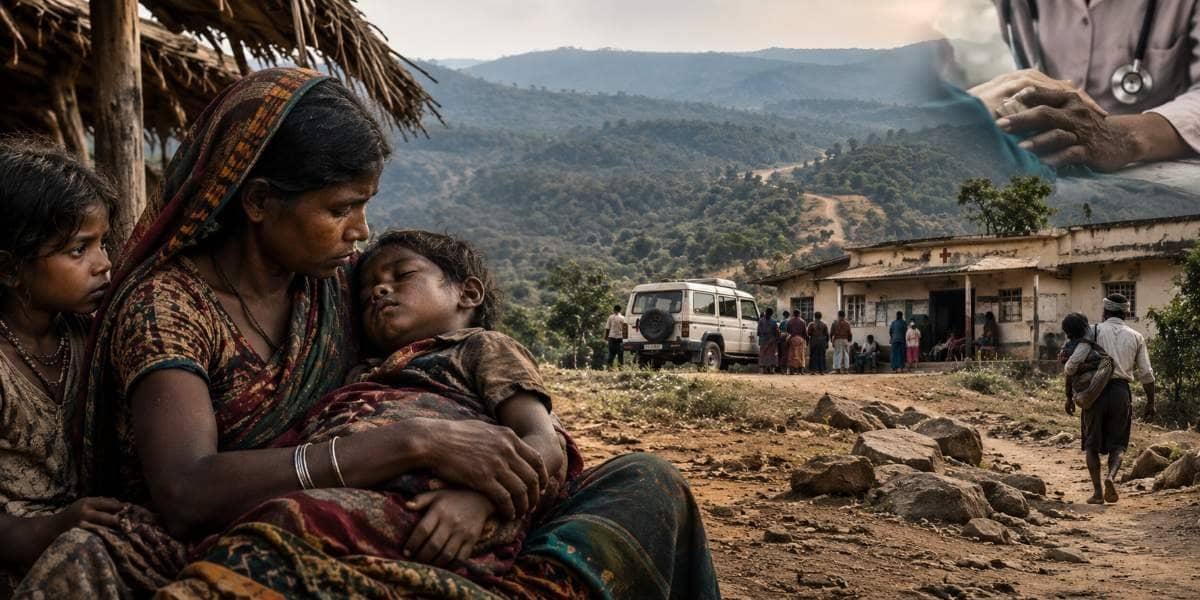
To understand the reality of the healthcare system in this part of Balaghat, one cannot simply look at how far the nearest hospital is. The closest primary health centre is fifteen kilometres from the village, while the district headquarters lies more than one hundred and twenty-five kilometres away. A seriously ill patient must first be taken from the primary centre to the block development hospital, then to the Baihar sub-division nearly seventy kilometres away and, if necessary, onward to the Balaghat district hospital. It isn’t hard to imagine how life-threatening such a journey through dense forest, muddy roads, and hilly terrain can be for a sick child. For a tribal family, the word “referral” effectively means “abandonment,” as one analytical note on this region observed. Since ambulances often cannot reach these remote hamlets at all, sick children frequently have to be carried down the hills in bamboo slings an extremely grim face of healthcare in modern India.
This Balaghat incident is not the first of its kind. In the Melghat region of Amravati district in Maharashtra, a chain of child deaths among the Korku tribal community has continued unbroken for three decades. Between 1992 and 1997, more than five thousand children were recorded to have died of malnutrition, triggering nationwide alarm. Judicial committees were subsequently formed, hundreds of voluntary organisations became active, and political parties raised their voices yet data that emerged through a Right to Information request in 2016 revealed that nearly six thousand mothers and children had died over six years. Experts such as Dr. Abhay Bang demonstrated through research that official figures are recorded at three to four times lower than the actual reality. Government officials in Melghat have repeatedly blamed the hilly terrain and the tribal communities’ “cultural customs” and the very same language is being heard again in Balaghat. The fact that four to five hundred children still die every year in Melghat, even three decades on, shows that a place once thrust into the spotlight as a “sensitive zone” offers no guarantee of lasting improvement. For Balaghat not to become a repeat of Melghat, thinking must move beyond temporary campaigns.
Rural health statistics reports presented to Parliament make plain the grim state of health infrastructure in tribal areas. Against a sanctioned requirement of four hundred and sixteen specialist doctors at Community Health Centres (CHCs) in Madhya Pradesh’s tribal regions, parliamentary responses record that only sixty-seven are actually in position meaning more than three hundred posts lie vacant. According to a report by Parliament’s Standing Committee on Social Justice and Empowerment, tribal areas across the country face a shortfall of more than twelve to thirteen hundred primary health centres, over two hundred and fifty community health centres, and more than six and a half thousand sub-centres with Madhya Pradesh accounting for the largest share of this gap. In Birsa taluka alone, nearly fifty ASHA worker posts reportedly remain vacant. These empty positions are not mere numbers; they represent the absence of a single hand to examine a feverish child in time, the absence of a single worker to remind families about vaccination. The statistics make clear just how remote the possibility is of a doctor, medicines, and an ambulance all being available simultaneously in one distant hamlet.
The traditional foods of the Baiga community are kodo and kutki millets coarse grains that are to a Baiga household what rice and roti are to an urban person. These “superfoods,” rich in iron and fibre and considered protective against diabetes and heart disease, are now eaten less and less by Baiga families themselves. One survey noted that tribal farmers grow kodo and kutki but carry them to market for sale, while depending themselves on government ration grain resulting in rising anaemia among women and malnutrition among children. Forest department restrictions have made it increasingly difficult for Baiga families, who depend on forest produce for their livelihood, to even enter the forest, while complaints have come in from several villages that supplementary nutrition has not been provided for six months. When land rights, forest access, and market standing all shrink together, the direct consequence falls on children’s bodily immunity turning even an ordinary viral illness into something life-threatening.
According to health workers, extremely low vaccination coverage is among the main reasons behind the severity of this outbreak. It has been observed that on the day of vaccination drives, many families leave for daily-wage labour in the forest, and instead take sick children to the local traditional healer. But to dismiss this as mere “ignorance” would be superficial. There is deep-rooted unease within the Baiga community around the permanent mark left by the BCG vaccine and around the fear of a foreign substance entering the body an unease that did not arise overnight but has built up over years of neglect and intermittent contact. If medical teams reach these villages only during a crisis, how is trust supposed to form? Tribal activists have also noted that doctors often fail to properly understand traditional ways of describing illness once patients reach a hospital. Linguistic and cultural distance proves just as decisive as geographical distance and unless that gap narrows, the same tragedy risks repeating itself at the next outbreak.
Ultimately, even the Madhya Pradesh High Court took note of these deaths. A public interest litigation filed by a lawyer, based on newspaper reports, cited the deaths of twenty-five Baiga children and drew the court’s attention to the infectious disease and the collapsed health infrastructure. However, the bench of Acting Chief Justice Vivek Rusia and Justice Pradeep Mittal declined to admit the petition on the basis of newspaper reports alone, directing the petitioner to visit the villages in person, verify the facts, and submit a detailed affidavit. Following this, the court sought a response from the state government. This process shows how difficult it is to hold the system accountable on the strength of news reports alone underlining just how important credible, locally verified documentation truly is.
The central government has run a separate development scheme for Particularly Vulnerable Tribal Groups since 2008, and more recently, under the Pradhan Mantri Janjati Adivasi Nyay Maha Abhiyan (PM-JANMAN), fifteen thousand crore rupees has been allocated over three years for housing, drinking water, health and nutrition, roads, and telecom connectivity. The scheme’s stated goal is full implementation, within PVTG settlements, of programmes such as Ayushman Bharat, the sickle cell elimination mission, tuberculosis elimination, and hundred per cent vaccination. Yet the Balaghat episode shows just how wide the gap is between a scheme existing on paper and actually reaching people. It was only six to seven weeks after the outbreak began that the national team was sent by which time many families had already lost their children. A scheme’s existence should never remain merely a paper guarantee; its implementation must be regular, sustained, and pre-emptive of crisis otherwise the label “vulnerable” ends up as nothing more than an administrative classification.
The deaths of Baiga children in Balaghat cannot be reduced to a simple equation of any single virus, bacterium, or malnutrition. From the Korkus of Melghat to the Baigas of Balaghat, these recurring tragedies across India’s tribal belt all point to the same systemic void vacant medical posts, remote geography, shrinking livelihoods, and broken trust between administration and community. Until these root causes are given lasting policy priority, and not merely attention during moments of crisis, such outbreaks will keep recurring, and each time the blame will be shifted onto “remote areas” and “traditional customs.” The question that remains is simply this: will help reach the children next time before their deaths, or only after?