Opening The Rift
therift
© 2026 The Rift. All Rights Reserved.
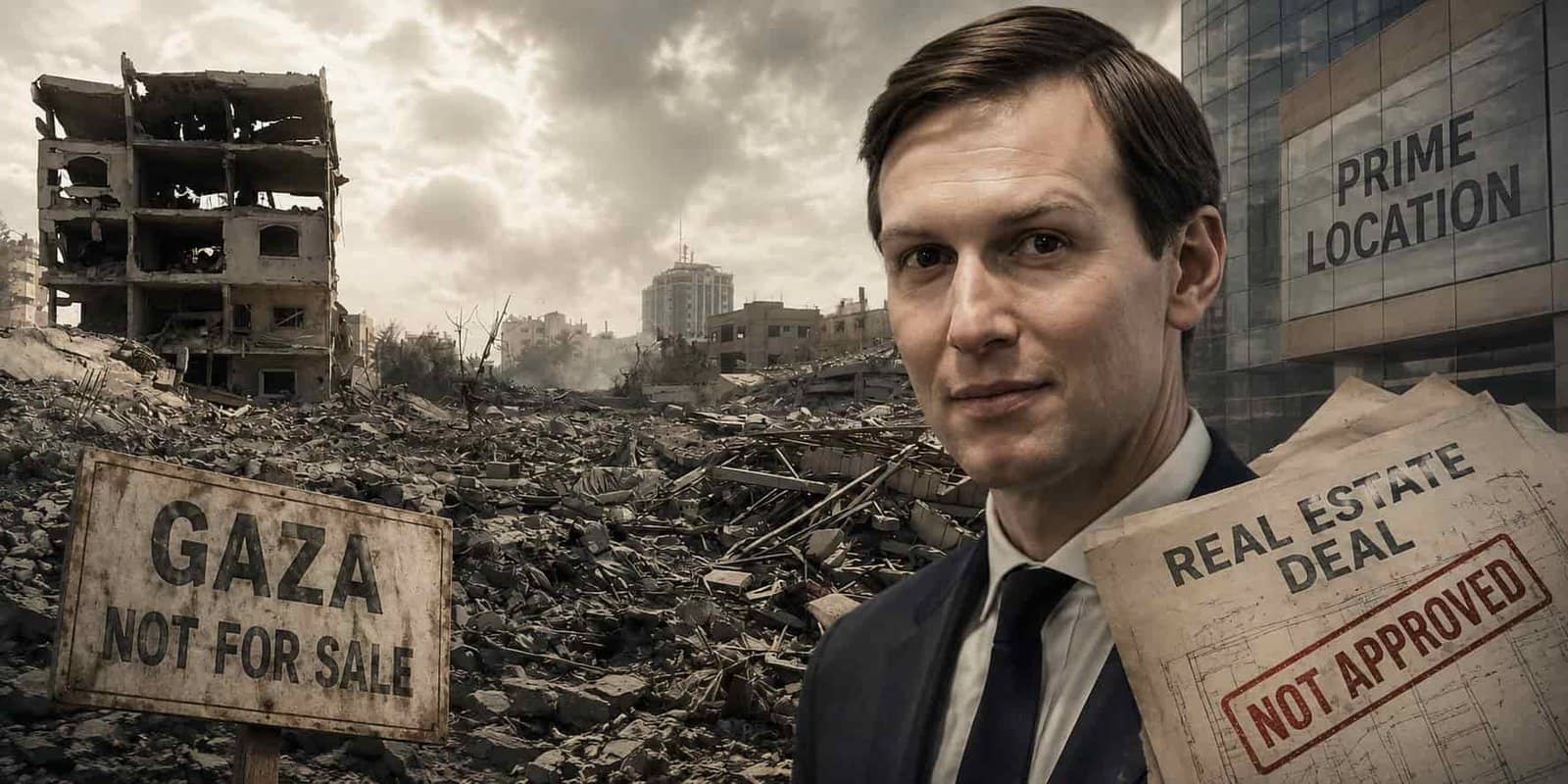
Gaza Is Not About Real Estate Transactions — Kushner Must Stay Home
If Kushner’s answer to Gaza is another real-estate deal, perhaps the most constructive role America can offer him is to keep him away from the negotiating table and safely at home, where he can sell buildings without attempting to sell a people’s future.
____
____

Key Takeaways
1 of 3
Automatically generated. Read full article for complete context.
There is something profoundly disturbing about the recurring attempt to approach Gaza through the vocabulary of real estate, investment and commercial development. Gaza is not an empty piece of waterfront waiting for a master plan. It is not a distressed property whose value can be restored through foreign capital, luxury construction and entrepreneurial imagination. Above all, it is not a business proposition. Gaza is a political question rooted in history, dispossession, occupation, resistance and the denial of Palestinian national and human rights. Any attempt to separate the territory from that history is not mediation. It is an evasion of the very reasons the conflict exists.
This is why the involvement of Jared Kushner should be treated with profound caution. Kushner’s reputation as a businessman and his experience in real estate may have given him confidence that difficult problems can be resolved by identifying interests, assigning values, negotiating transactions and producing a deal acceptable to the parties with sufficient incentives. Such an approach may occasionally work in property development. It cannot resolve a national question in which millions of people are contesting the political conditions under which they are expected to live.
The fundamental weakness of a transactional approach to Palestine is that it mistakes symptoms for causes. Gaza’s poverty is not the original problem. Its destruction is not the original problem. Its unemployment, devastated infrastructure, housing crisis and humanitarian dependence are not the original problem. These are consequences of a much deeper political history involving the Nakba of 1948, the displacement of Palestinians from their homes, the occupation that followed in 1967, the expansion of settlements, the fragmentation of Palestinian territory and the prolonged denial of Palestinian sovereignty and self-determination. To offer money for reconstruction while leaving that political architecture substantially untouched is to repair the walls while refusing to ask who destroyed the house and why.
This is precisely where the real-estate mentality becomes dangerous. A property developer looks at land in terms of potential: location, infrastructure, investment, accessibility, profitability and future returns. A political community looks at land differently. It carries memory, identity, ancestry, belonging and collective rights. Gaza is not merely territory. For Palestinians it is part of a homeland from which generations have been displaced, confined, expelled or prevented from returning. No economic package, however large, can erase that historical relationship.
freedom is not a commodity. A people cannot be expected to exchange political rights for development grants.
There is also a moral problem in the assumption that economic prosperity can compensate for political dispossession. The idea that Palestinians can be offered better housing, employment, investment, ports, commercial opportunities or reconstructed cities in exchange for surrendering fundamental political claims has appeared in different forms for years. It is essentially the proposition that material improvement can substitute for freedom. But freedom is not a commodity. A people cannot be expected to exchange political rights for development grants.
The same problem arises when the Palestinian population is treated as a humanitarian constituency rather than a political people. Humanitarian assistance is indispensable, particularly after the catastrophic destruction Gaza has experienced, but humanitarianism cannot become a substitute for justice. Feeding a population does not resolve the political circumstances that made it dependent on food aid. Rebuilding hospitals does not end the conditions under which they were destroyed. Constructing homes does not answer the question of whether Palestinians have the right to determine their own political future.
The Palestinians become objects of diplomacy rather than participants in it. Their grievances are converted into negotiating points, their political demands into obstacles and their historical claims into variables in a broader strategic calculation.
A durable settlement must therefore begin by listening to Palestinians rather than designing a future for them. This is one of the central failures of top-down diplomacy. The powerful actors assemble themselves around a table, discuss security, investment and regional arrangements, and then present their conclusions to the people whose lives will be most profoundly affected. The Palestinians become objects of diplomacy rather than participants in it. Their grievances are converted into negotiating points, their political demands into obstacles and their historical claims into variables in a broader strategic calculation.
That is not peace-making. It is political engineering.
The United States has repeatedly suffered from the consequences of this approach. Washington cannot simultaneously claim to be an honest broker while being perceived across much of the region as overwhelmingly aligned with Israel. The credibility of American mediation has consequently been weakened by the gap between its rhetoric about peace and its willingness to tolerate policies that Palestinians and much of the international community regard as incompatible with a just settlement.
Kushner’s previous approach to the Middle East illustrated the danger of placing economics before politics. The so-called “Peace to Prosperity” framework proposed during the Trump administration placed considerable emphasis on investment and economic development while failing to provide a credible political pathway capable of satisfying Palestinian aspirations for statehood, sovereignty and self-determination. The lesson should have been obvious: prosperity cannot be used as a substitute for political rights.
Kushner’s FBI background check identified questions about his family’s business, his foreign contacts, his foreign travel and meetings he had during the campaign, the sources said, declining to be more specific. (NBC News)
There is a deeper theoretical problem here. Conflict resolution requires addressing the structure of power that produces conflict. Transactional diplomacy instead tends to concentrate on bargaining between elites. It asks what each side will accept, what incentives can be offered and what concessions can be extracted. But conflicts involving colonial domination and national liberation cannot be reduced to symmetrical bargaining between equivalent parties. Where there is an enormous imbalance of military, economic and political power, a “deal” reached under pressure can institutionalise inequality rather than resolve it.
That is why the question of consent is so important. A settlement imposed upon Palestinians by Israel; the United States and Arab governments cannot become legitimate simply because it is presented as pragmatic. Nor can an agreement be negotiated without meaningful Palestinian participation acquire legitimacy because billions of dollars are attached to it. Peace requires political ownership by the people who must live with its consequences.
The more the international system tries to turn Palestine into an administrative or economic problem, the more powerfully the underlying political question returns.
There is also a lesson here for the wider Middle East. Regional governments may welcome economic reconstruction and investment, but they cannot permanently suppress the political and emotional significance of Palestine among their populations. The Palestinian question has endured precisely because successive attempts to bury it beneath diplomatic formulas, economic initiatives and temporary political arrangements have failed. The more the international system tries to turn Palestine into an administrative or economic problem, the more powerfully the underlying political question returns.
Gaza therefore needs reconstruction, but reconstruction must not become another mechanism for control. Its people need homes, schools, hospitals, water, electricity and functioning institutions, but they also need dignity, freedom and political agency. They need the ability to determine their own future rather than having that future designed in foreign capitals. Reconstruction must serve liberation and self-determination, not become compensation for their absence.
Gaza and the West Bank are not two separate real-estate projects. They are integral parts of the Palestinian national question.
The international community should also recognise that Gaza cannot be isolated from the wider Palestinian question. It is impossible to create a permanent solution for Gaza while leaving the West Bank under occupation, settlements expanding and Palestinians divided geographically and politically. Gaza and the West Bank are not two separate real-estate projects. They are integral parts of the Palestinian national question.
This is where Kushner’s instinct for the deal reaches its limits. A transaction requires assets, bargaining positions and parties willing to exchange one thing for another. Justice does not operate according to that logic. A dispossessed people cannot simply be offered a better price for accepting dispossession. A refugee cannot be told that an investment fund compensates for the loss of a home. A population living under occupation cannot be persuaded that economic opportunity makes political subordination acceptable.
The United States would therefore do better to abandon the fantasy that the Palestinian question can be solved by the cleverness of deal-makers. What is required is not another property-style negotiation but a fundamental reorientation of diplomacy towards international law, human rights, equality and Palestinian self-determination. Washington should engage all relevant Palestinian representatives rather than attempting to select convenient interlocutors, and it should recognise that Israel’s security cannot be constructed upon permanent Palestinian insecurity.
The future of Gaza must ultimately be decided by those who call it home, within a broader political settlement that addresses the rights of Palestinians and the legitimate security concerns of Israelis. Economic reconstruction can and must accompany that process, but it cannot replace it.
Kushner should therefore stay home, not because businessmen have nothing to contribute to diplomacy, but because Gaza does not need a property developer’s imagination imposed upon it. It needs political wisdom, historical understanding and an honest reckoning with injustice. The tragedy of Palestine is not that its real estate has been insufficiently developed. The tragedy is that an entire people have been denied the political conditions under which they can live freely and securely on their own land.
Gaza is not a beachfront opportunity. It is not an investment portfolio. It is not a blank canvas for someone else’s vision of prosperity.
It is home.
And home is not for sale.
Disclaimer:The views and opinions expressed in this article are those of the author(s) and do not necessarily reflect the official policy or position of The Rift.