Opening The Rift
therift
© 2026 The Rift. All Rights Reserved.
Himalayan Hazards: Understanding GLOFs and the Rising Risk
Himalayan communities need better science, stronger early-warning systems, resilient infrastructure and greater preparedness.

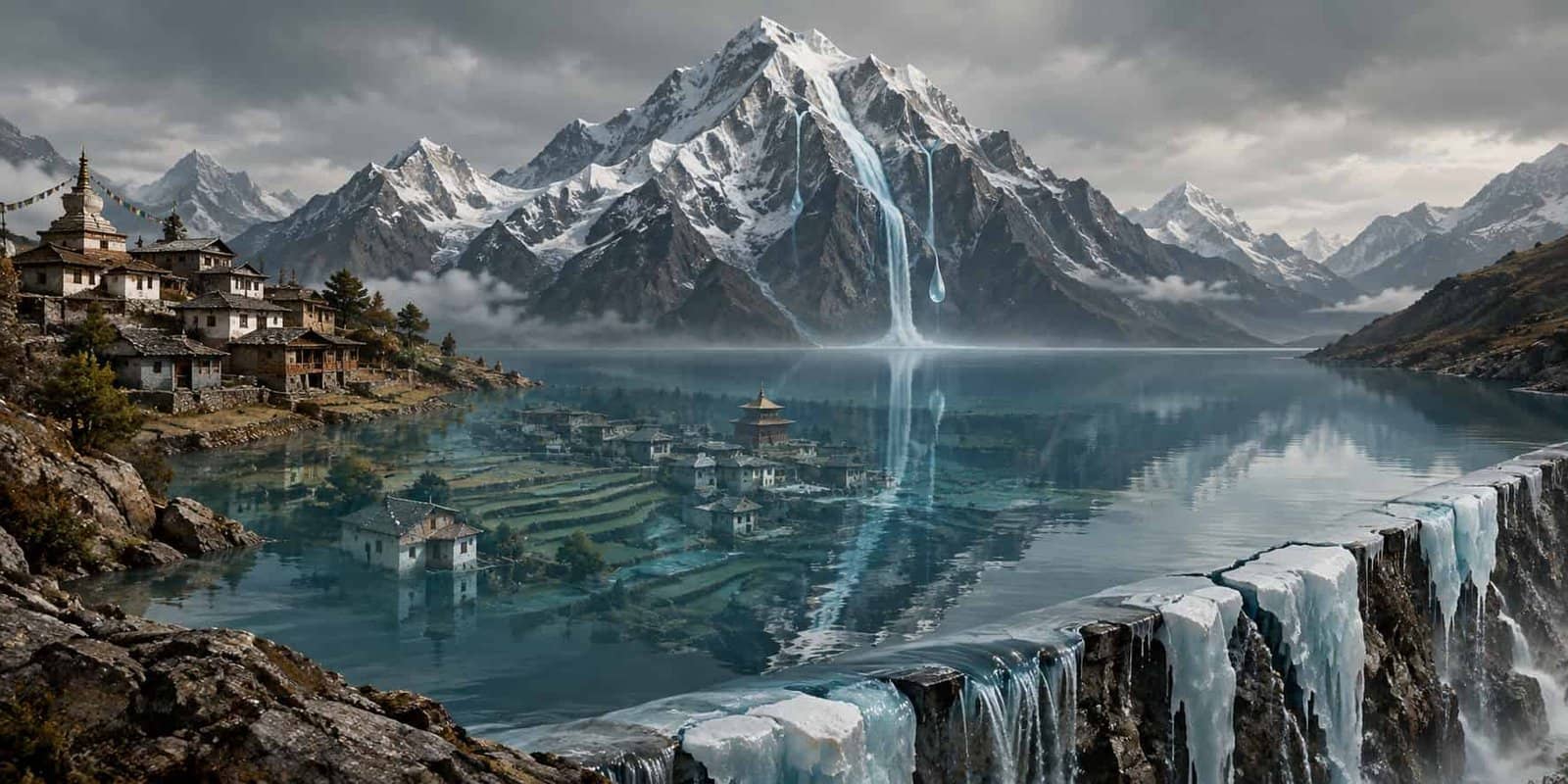
Representative Image
Key Takeaways
1 of 3
Automatically generated. Read full article for complete context.
The Himalayas are often described as the “Third Pole” because they contain some of the largest concentrations of snow and ice outside the polar region. These glaciers feed major rivers and support millions of people across South Asia. But as the climate changes, the same mountains are also becoming increasingly exposed to a different kind of danger sudden floods originating from glaciers, ice, unstable slopes, and high-altitude lakes.
Recent events in Nepal’s Rasuwa district have once again drawn attention to this risk. At the same time, the devastating cloudburst and flash flooding in Kishtwar, Jammu and Kashmir, in August 2025 showed how quickly extreme weather can turn into a major disaster in the Himalayan region.
What Exactly Is a GLOFGlacial Lake Outburst FloodA sudden release of water from a glacial lake, often caused by the collapse of a natural dam of ice, rock, or moraine.?
A Glacial Lake Outburst Flood, commonly called a GLOF, happens when water stored behind a natural barrier of ice, rock, sediment or moraineMoraineAccumulations of unconsolidated glacial debris (soil and rock) that occur in currently glaciated and formerly glaciated regions, deposited by a glacier. is suddenly released.
Glacial lakes develop as glaciers retreat. Melting snow gathers in the depressions that either exist beside or before the glacier and, in most instances, the lakes have their storage capacity defined by moraines, which are unconsolidated material deposited by the movement of glaciers.
Natural barriers differ from artificial ones in that they may not be stable and may collapse in response to any external stress or even sudden weather conditions, including earthquakes.
When such a dam breaks down, the resulting flood involves the movement of millions of cubic meters of water over a relatively short time. The flood may also carry boulders, mud, ice, trees, and other materials.
Why Is the Risk Growing?
A major factor behind this is the state of the Himalayan glaciers. With global warming, the glaciers are receding and shedding their ice cover. This results in excess water and, at times, the expansion of already existing glacial lakes. In some cases, the melting of the glaciers can also result in the formation of new lakes where ice once was.
More than 25,000 glacial lakes have been identified in the Hindu Kush Himalayas by the International Centre for Integrated Mountain Development (ICIMODInternational Centre for Integrated Mountain DevelopmentA regional intergovernmental learning and knowledge sharing centre serving the eight regional member countries of the Hindu Kush Himalayas.).
However, the danger is not simply about the number of lakes. The surrounding landscape is also changing. Thawing permafrostPermafrostGround (soil, rock, or sediment) that remains frozen for two or more consecutive years. Thawing permafrost can destabilize slopes. and melting ice can destabilise mountain slopes, increasing the possibility of rockfalls, landslides and avalanches. If one of these suddenly enters a glacial lake, it can displace water, creating a powerful flood wave.
This means a single disaster can involve several processes at once—glacier melt, slope failure, avalanche, lake displacement, and downstream flooding.
Nepal Has Seen the Danger Before
Nepal has experienced GLOFs for decades. ICIMOD has recorded more than 90 GLOFs in Nepal since the early 1920s.
One recent example was the August 2024 flood in the Thame Valley in the Everest region. ICIMOD’s subsequent study found that a rock avalanche entered a glacial lake and triggered a chain reaction involving two glacial lakes. An estimated 459,000 cubic metres of water was released, while flood debris travelled around 80 kilometres downstream. The event destroyed homes and infrastructure and displaced residents.
The Thame disaster demonstrated an important point: the danger does not always come from a giant lake. A relatively smaller lake can still become extremely destructive when combined with unstable slopes, avalanches and other geological factors.
But Was Rasuwa a GLOF?
The latest flooding in Nepal’s Rasuwa district has brought the question of GLOFs back into focus.
However, the flooding of the Bhote Koshi River system occurred on August 26, 2026, due to an incident that took place upstream of the Bhote Koshi on the Tibetan side of the border. The impact of the flood was catastrophic in locations such as Timure, Rasuwagadhi, and Syabrubesi.
The cause of this phenomenon is yet to be determined. So far, assumptions point to a possible ice or rock avalanche that could block a river and release a rush of water.
Therefore, it is important not to describe the Rasuwa disaster as a confirmed GLOF before scientific investigations are complete. The available evidence points to a high-altitude, glacier-related or ice-rock-related event, but the precise chain of events remains under investigation.
This distinction matters because Himalayan disasters can have multiple triggers. An ice avalanche may block a river, create a temporary lake and then cause a sudden outburst. In another situation, an avalanche entering an existing glacial lake may produce the flood. Understanding the exact mechanism is essential for improving early-warning systems.
What Happened in Kishtwar?
Himalayan risk is not limited to GLOFs.
In August 2025, Kishtwar district in Jammu and Kashmir witnessed a devastating cloudburst and subsequent flooding in the Chositi area. The event caused widespread destruction and loss of life, while rescue operations were complicated by difficult terrain, damaged connectivity, and bad weather. The Union government reported that at least 53 bodies had been recovered by August 16, while officials warned that more people could still be buried or swept away.
The Kishtwar disaster was reported as a cloudburst and flash-flood event, not as a confirmed GLOF. This is an important distinction.
Yet it belongs to the same broader Himalayan risk picture. Mountain communities can face several hazards at the same time: cloudbursts, flash floods, landslides, avalanches, glacier-related floods, and unstable slopes.
A warming climate can intensify some of these processes, while settlements, roads, bridges, pilgrimage routes, and hydropower infrastructure increasingly occupy vulnerable mountain corridors.
The lesson from Kishtwar is therefore not that every Himalayan flood is a GLOF. Rather, it is that the region needs stronger preparedness for a range of rapidly developing hazards.
Melting Glaciers
Glaciers are sensitive indicators of climate change. Rising temperatures accelerate ice loss and alter the amount and timing of meltwater entering mountain valleys.
As glaciers retreat, they may leave behind unstable landscapes and growing lakes. ICIMOD has warned that the Hindu Kush Himalaya is experiencing rapid glacier mass loss and an expansion in glacial lakes.
This does not mean every expanding lake will eventually burst. Most glacial lakes do not cause disasters. The concern is that a small number of unstable lakes can pose serious risks to downstream communities.
Unstable Natural Dams
Another major concern is the nature of the barriers holding glacial lakes. Moraine dams are made of loose material such as rocks, gravel, and sediment. They can be weakened by erosion, rising water pressure, and external impacts.
An avalanche or landslide falling into a lake can suddenly displace water. In other cases, seepage or erosion can weaken the natural dam until it collapses.
The resulting flood can move with enormous force, carrying not only water but also large quantities of sediment and debris.
A Growing Threat to Mountain Communities
The people most exposed are often those living along river valleys. Mountain communities depend on rivers for drinking water, agriculture, tourism, transport and hydropower. Unfortunately, the same valleys provide natural pathways for sudden floods.
The warning time can be extremely short. A flood originating tens of kilometres upstream can settle before residents have enough time to understand what is happening. This is why monitoring and early-warning systems are becoming increasingly important.
Satellite imagery can help scientists identify changes in glaciers and lakes. Ground-based sensors can monitor water levels and weather conditions. River gauges can detect sudden changes downstream. Communication systems can then deliver warnings to communities before the flood reaches vulnerable areas.
The Way Forward
The Himalayan region cannot prevent every natural hazard, but it can reduce the number of lives and livelihoods placed in danger.
First, potentially dangerous glacial lakes need regular monitoring. Second, at-risk valleys must have early warning systems. Third, the people must be trained in how to react fast in case there is a warning. Fourth, the construction of roads, bridges, and hydropower stations must take into account the changing mountain risks.
Disaster preparedness should also extend beyond individual countries. Rivers and mountain systems do not follow political boundaries. A flood originating in a high-altitude area can cross borders within hours, as the recent Rasuwa event has demonstrated.
The Himalayas are changing, and the risks are changing with them. GLOFs are only one part of the picture. Cloudbursts, landslides, avalanches, glacier collapses and flash floods can interact in complex ways.
The experience of Nepal’s Thame flood, the latest Rasuwa disaster and the devastating Kishtwar cloudburst all point towards the same broader lesson: Himalayan communities need better science, stronger early-warning systems, resilient infrastructure and greater preparedness.
The goal should not be to create fear around the mountains. It should be to understand them better. The Himalayas will continue to provide water, livelihoods and natural resources to millions. Protecting the people who live among these mountains requires recognising that a changing climate is also changing the hazards they face.
Disclaimer:The views and opinions expressed in this article are those of the author(s) and do not necessarily reflect the official policy or position of The Rift.