Opening The Rift
therift
© 2026 The Rift. All Rights Reserved.
Argument for Inclusive Electoral Minority Representation: The Case for Substantive Equality
The systematic and demonstrable underrepresentation of a community constituting approximately 14% of the Indian population in legislative bodies constitutes, in combination, a violation of democratic basic structure as informed by binding India’s international obligations.

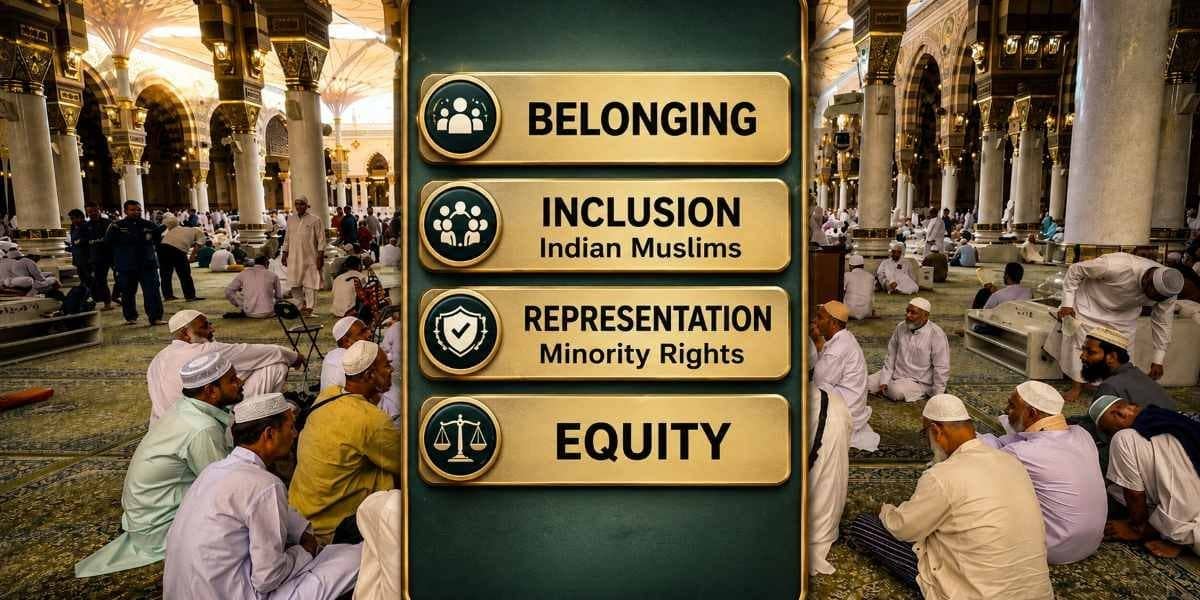
Image | Representative Only
Key Takeaways
1 of 3
Automatically generated. Read full article for complete context.
Part-1
DCDeccan ChronicleAn Indian English-language daily newspaper. of June 19 reports the Supreme Court has held that the right to walk on a footpath is a fundamental right, observing it was strange that society had failed to focus on recognizing and securing this right. It said that was an “enforceable duty” (meaning of the State). Extrapolating, it follows that the right to political participation should equally be a higher fundamental right. If it is a duty of the State, it ought to be justiciable as well.
The argument for enhanced Muslim legislative representation in India need not be constructed on the contested terrain of religious reservation alone. A more durable and jurisprudentially coherent position emerges when domestic constitutional doctrine is read alongside India’s binding obligations under international human rights law. The two bodies of law are not merely parallel: they are (subject to later caveats on inconsistency, occupied field, and non-self-executing treaties) mutually reinforcing, and India’s own courts have increasingly treated international treaty norms as interpretive tools of constitutional significance.
The foundation is from Vishakha & Ors. v. State of Rajasthan (1997), where the Supreme Court held that “in the absence of domestic law occupying the field, the contents of international conventions and norms are significant for the purpose of interpretation of the guarantee of gender equality…under Articles 14, 15, 19(1)(g) and 21 of the Constitution.” The Court treated India’s obligations under the Convention on the Elimination of All Forms of Discrimination Against Women (CEDAW) as a direct interpretative source for constitutional rights. The same method can perhaps be deployed here: where constitutional text is silent or ambiguous on the precise scope of political inclusion for minorities, international treaty obligations can be roped in to occupy that space.
“The right to participate in public affairs is not discharged by mere formal access to the ballot: it requires meaningful and effective participation by all sections of the citizenry.”
India’s binding treaty obligations include the International Covenant on Civil and Political Rights (ICCPR) to which India acceded on 10 April 1979, bringing its provisions within the ambit of India’s legally binding international commitments. Two articles of ICCPR of direct relevance are Article 25 which guarantees every citizen the right and opportunity, “without any of the distinctions mentioned in article 2 and without unreasonable restrictions,” to take part in the conduct of public affairs, to vote and be elected, and to have equal access to public service. The Human Rights Committee’s General Comment No. 25 (CCPR/C/21/Rev.1/Add.7, 1996) interprets this provision expansively: the right to participate in public affairs is not discharged by mere formal access to the ballot: it requires meaningful and effective participation by all sections of the citizenry. Where political parties, acting as the structural gatekeepers to legislative candidature, systematically exclude a substantial section of the population, the resulting legislative composition fails the standard of “genuine” elections in which voters can freely express their will.
Article 27 of ICCPR provides that “in those States in which ethnic, religious or linguistic minorities exist, persons belonging to such minorities shall not be denied the right…to profess and practise their own religion or to use their own language.” The Human Rights Committee’s General Comment No. 23 extends this provision beyond its facial cultural and religious guarantee: it recognises positive obligations upon States to create conditions in which minority rights can in fact be enjoyed, not merely in formal law but in substantive political reality. Effective political participation is, on this reading, a condition precedent to the meaningful enjoyment of minority cultural and religious rights under Article 27.
India is also a State party to the International Convention on the Elimination of All Forms of Racial Discrimination (ICERD). Article 5(c) of the Convention requires States parties to prohibit and eliminate racial discrimination in the enjoyment of “political rights, in particular the right to participate in elections (to vote and to stand for election) on the basis of universal and equal suffrage, to take part in the Government as well as in the conduct of public affairs at any level.” The CERD Committee’s General Recommendation XX on Article 5 reiterates that the Convention obliges States parties to guarantee the enjoyment of civil and political rights “without racial discrimination,” requiring attention to structural, not merely formal, barriers. Racial discrimination would include religious discrimination.
Critically, CERD General Recommendation XXIII (1997) on indigenous and minority peoples articulates the obligation to “ensure that members of indigenous peoples have equal rights in respect of effective participation in public life and that no decisions directly relating to their rights and interests are taken without their informed consent.” South Africa’s Muslims are 2%, yet are mandatorily consulted and no legislation passed without their consent. Note the consent also is qualified: it is informed consent. While directed principally at indigenous peoples, the Committee has extended this logic to religious and ethnic minorities, requiring States to examine whether their political structures in effect produce exclusion.
The 1992 UN Declaration on the Rights of Persons Belonging to National or Ethnic, Religious and Linguistic Minorities (GA Res. 47/135, 1992), though non-binding as a treaty instrument, articulates with normative authority that minorities have “the right to participate effectively in decisions on the national and, where appropriate, regional level concerning the minority to which they belong.” Participation must be “effective,” meaning that minority representatives must “truly represent their communities.” The ruling dispensation cannot pick who represents any minority. That minority must decide who it trusts. The Declaration, as a UN General Assembly resolution interpreting and elaborating the ICCPR framework, constitutes significant evidence of customary international law norms on political inclusion.
Articles 51 and 253 creating a Constitutional gateway and mechanism for bringing these obligations into domestic constitutional adjudication is established. Article 51(c) of the Constitution directs the State to “endeavour to foster respect for international law and treaty obligations in the dealings of organised peoples with one another.” Article 253 vests Parliament with power to legislate “for implementing any treaty, agreement or convention with any other country or countries or any decision made at any international conference.”
Legal Framework for Minority Inclusion
ICCPRInternational Covenant on Civil and Political RightsBinding treaty obligating meaningful democratic participation by minorities.
Vishakha v. State of RajasthanVishakha v. State of Rajasthan (1997)Treated international conventions as interpretative tools where domestic law is silent.
Article 51Article 51(c)Directs the State to foster respect for international law and treaty obligations.
Indra SawhneyIndra SawhneyRecognised that structural inequalities require substantive equality beyond formal neutrality.
Article 25 (ICCPR)Article 25 (ICCPR)Guarantees the right to vote and take part in public affairs without unreasonable restrictions.
CEDAWCEDAWDirect interpretative source for the constitutional guarantee of gender equality.
Kesavananda BharatiKesavananda Bharati v. State of Kerala (1973)Treated democracy as a component of the Constitution’s basic structure.
Article 14 & 15Articles 14 & 15Equal protection and prohibition of discrimination, requiring substantive equality.
1992 UN Declaration1992 UN Minorities DeclarationMinority representatives must truly represent their communities for effective participation.
Article 253Article 253Vests Parliament with power to legislate for implementing international treaties.
Pradeep Kumar BiswasPradeep Kumar Biswas (2002)Extended definition of State to bodies performing public functions substantially financed by State.
Article 27 (ICCPR)Article 27 (ICCPR)Obligates States to create conditions where minority rights can be enjoyed in substantive reality.
ICERDICERDRequires States to eliminate racial discrimination in political rights and elections.
Navtej Singh JoharNavtej Singh Johar v. Union of India (2018)Treated international obligations as reinforcing substantive equality under Articles 14, 15, and 21.
Article 21Article 21Right to life and personal liberty, interpreted with international treaty norms.
Article 5(c) (ICERD)Article 5(c) (ICERD)Obliges States to eliminate discrimination in elections, focusing on structural barriers.
ADR & PUCL v. UoIADR, PUCL v. Union of IndiaHeld that democracy requires informed participation and meaningful representation of all groups.
Article 12Article 12Defines “State” including other authorities performing public functions.
Kuldip NayarKuldip NayarDeveloped substantive doctrine for meaningful representation in a democracy.
Article 19(1)(c)Article 19(1)(c)Freedom of association; imposes structural accountability on public electoral functions.
Babita PuniyaMinistry of Defence v. Babita Puniya (2020)Recognised that structural inequalities producing unequal outcomes attract constitutional scrutiny.
Article 19(1)(g)Article 19(1)(g)Right to practice profession, interpreted alongside CEDAW for gender equality.
NALSANALSA v. Union of India (2014)Treated international obligations as reinforcing the substantive equality mandate.
Article 324Article 324Powers of the Election Commission; relates to mandatory publication of representation audits.
Article 331 & 333Articles 331 & 333Encoded a constitutional recognition that numerical democracy may fail to secure representation.
VISUALS BY THE RIFT
The Supreme Court in Vishakha treated Article 51, read with the Directive Principles, as constituting a constitutional bridge enabling international norms to be used as interpretative aids even in the absence of implementing legislation. More recently, the Court in cases such as National Legal Services Authority v. Union of India (2014) and Navtej Singh Johar v. Union of India (2018) has treated India’s international obligations as reinforcing the substantive equality mandate of Articles 14, 15, and 21. This method is now sufficiently settled to be treated as a constitutionally available tool in the present context.
“Structural political exclusion is not merely a policy failure but a constitutional anomaly. It cannot exist.”
From democratic participation to structural inclusion is part of the basic structure dimension. The Supreme Court has treated democracy as a component of the Constitution’s basic structure since Kesavananda Bharati v. State of Kerala (1973). In Association for Democratic Reforms, PUCL v. Union of India, and Kuldip Nayar, the Court developed this into a substantive doctrine: democracy requires not merely formal electoral mechanisms but informed participation and meaningful representation of all significant social groups. The international treaty framework under Articles 25 and 27 of the ICCPR dovetails into this constitutional understanding. Where domestic basic structure doctrine recognises “democracy” as an unamendable constitutional value, and where India’s treaty obligations under the ICCPR define democracy to require effective participation by minorities, there arises a convergent constitutional imperative: structural political exclusion is not merely a policy failure but a constitutional anomaly. It cannot exist.
The convergence may be articulated as follows: the basic structure of the Constitution requires genuine, effective democratic participation as an inalienable constitutional value. India’s obligations under Articles 25 and 27 of the ICCPR, which are binding and which the Constitution itself, through Articles 51 and 253, requires the State to honour, elaborate that this participation must be substantive, not merely formal, and must extend to all significant minority communities. The systematic and demonstrable underrepresentation of a community constituting approximately 14% of the Indian population in legislative bodies constitutes, in combination, a violation of democratic basic structure as informed by binding India’s international obligations.
“Political parties that systematically fail to nominate minority candidates are, through their private gatekeeping function, producing a state-sanctioned discriminatory outcome.”
India’s substantive equality jurisprudence, developed in Indra Sawhney, Navtej Singh Johar, and Secretary, Ministry of Defence v. Babita Puniya (2020), recognises that Article 14′s guarantee of equal protection and Article 15’s prohibition of discrimination are not satisfied by formal neutrality. Structural and historical conditions that produce unequal outcomes attract constitutional scrutiny. When this domestic doctrine is read alongside ICERD Article 5(c)’s obligation to guarantee political participation without discrimination, the argument that emerges is that political parties that systematically fail to nominate minority candidates are, through their private gatekeeping function, producing a state-sanctioned discriminatory outcome that the State is obligated under both domestic and international law to address.
Let me clarify this does not fall foul of the Indra Sawhney rule against religion-based reservations. It operates at a different level: it argues that the State’s failure to regulate the discriminatory candidate-selection practices of political parties that exercise what are effectively public functions, is itself unconstitutional. Since participation must be “effective,” and minority representatives must “truly represent their communities,” the minority must decide who may represent it. This is consistent with the “state action” doctrine as it has evolved in Indian constitutional law following Pradeep Kumar Biswas v. Indian Institute of Chemical Biology (2002), which extended the definition of “other authority” under Article 12 to bodies performing public functions substantially financed by the State. Since electoral bonds were a state-enabled funding source for political parties, and also because political parties perform public functions the discriminatory practice by any party of excluding Muslims (brazenly even saying they do it because they do not need the Muslim vote) is a sufficiently clear violation meriting disqualification of the offending political party itself from participation in the election. That however would require a fairly operating non-partisan Election Commission.
Then there is the internal party democracy argument and its international law reinforcement aspect to be noted. Of practical relevance is mandatory internal democracy in political parties which gains force when read with international law. Article 25 of the ICCPR, as interpreted by General Comment No. 25, requires that restrictions on the right to stand for election must be “objective and reasonable.” A candidate-selection process in which party leadership unilaterally determines nominees, with no structural requirement of demographic consideration, and specifically excludes Muslims, fails this standard. The Human Rights Committee has noted that States must ensure that candidate selection processes themselves do not operate as unreasonable restrictions on the right to stand for election.
A proceeding framed around this argument could, in jurisdictions where the Courts are pro-active and unlikely to feel the pressure to exercise judicial restraint, seek (a) mandatory publication by the Election Commission of annual representation audits under Article 324, comparing each party’s candidate demographics against the Census; (b) judicial recognition that Article 19(1)(c) (freedom of association), when read with India’s ICCPR obligations, imposes structural accountability requirements on political parties exercising a public electoral function; (c) directions requiring recognised national and State parties to establish elected minority wings (note mention above of “effective” participation and those who “truly represent” their communities, not handpicked yes-sayers of the party), transparent nomination procedures, and candidate selection committees with audited demographic reporting.
Importantly, this relief is framed not as religious reservation but as institutional transparency and democratic accountability, a terrain on which the Court has historically been receptive, and which avoids the secularism barrier that would defeat a direct quota claim which the BJP always leverages.
“Purely numerical democracy may fail to secure representation for every stakeholder… democratic architecture must be designed to prevent the structural silencing of substantial communities.”
The Anglo-Indian precedent highlights Constitutional approach of inclusion. The former Articles 331 and 333, now repealed by the Constitution (104th Amendment) Act, 2019, encoded a constitutional recognition that purely numerical democracy may fail to secure representation for every stakeholder. While those provisions addressed a numerically small community, their underlying principle is broad: democratic legitimacy depends on inclusion. Read against India’s ICCPR obligations and the 1992 UN Minorities Declaration’s requirement of “effective” minority participation, this principle acquires international law reinforcement capacity. A court adjudicating a PIL in this domain need not recreate Article 331 judicially. It may, however, recognise the underlying constitutional value, now confirmed by India’s treaty commitments, that democratic architecture must be designed to prevent the structural silencing of substantial communities.
The argument may be re-stated as follows: the Constitution, as interpreted through its basic structure doctrine and international treaty obligations under Articles 25 and 27 of the ICCPR, Article 5(c) of the ICERD, and the 1992 UN Declaration on Minorities, does not merely guarantee formal electoral access. It requires the creation of conditions under which all substantial communities can participate effectively in legislative decision-making. Political parties, as the constitutional gatekeepers to legislative office, exercise a function of public character. Where they systematically produce legislative compositions that bear no reasonable relationship to the demographic reality of the Indian polity, they generate a structural democratic deficit that the State is obligated, under both domestic and international law, to address through institutional mechanisms.
This position is analytically distinct from a claim for religious quotas, resistant to the Indra Sawhney 50% cap objection, aligned with the Court’s own democratic-participation jurisprudence, and grounded in binding treaty obligations that Indian courts are constitutionally directed to respect. In my view it represents the most sophisticated and judicially viable path toward meaningful minority legislative inclusion in the current narrative. Also, it positions the argument squarely within the “global conversation” on substantive democracy rather than the narrower, domestically always successfully contested frame of communal representation and, given a proactive judicial approach alongside a non-partisan Election Commission, is the viable answer to attempted politico-administrative marginalisation of Muslims in India.
The relief sought is not communal religion-based reservation. It is founded on the State’s constitutional accountability for the democratic process: the deepening, not distortion, of Indian pluralist democracy waits. And watches.
Jai Hind
Disclaimer:The views and opinions expressed in this article are those of the author(s) and do not necessarily reflect the official policy or position of The Rift.
*Minority RightsElectoral ReformICCPRICERDIndia ConstitutionInternational LawPolitical Representation