Opening The Rift
therift
© 2026 The Rift. All Rights Reserved.
Inclusive Protection vs. Exclusivist Destruction: Bollards in America, Bulldozers in India
A state that invests in bollards to prevent violence values life. A state that deploys bulldozers to raze the historic and sacred spaces of its minority citizens has abandoned the idea of justice.

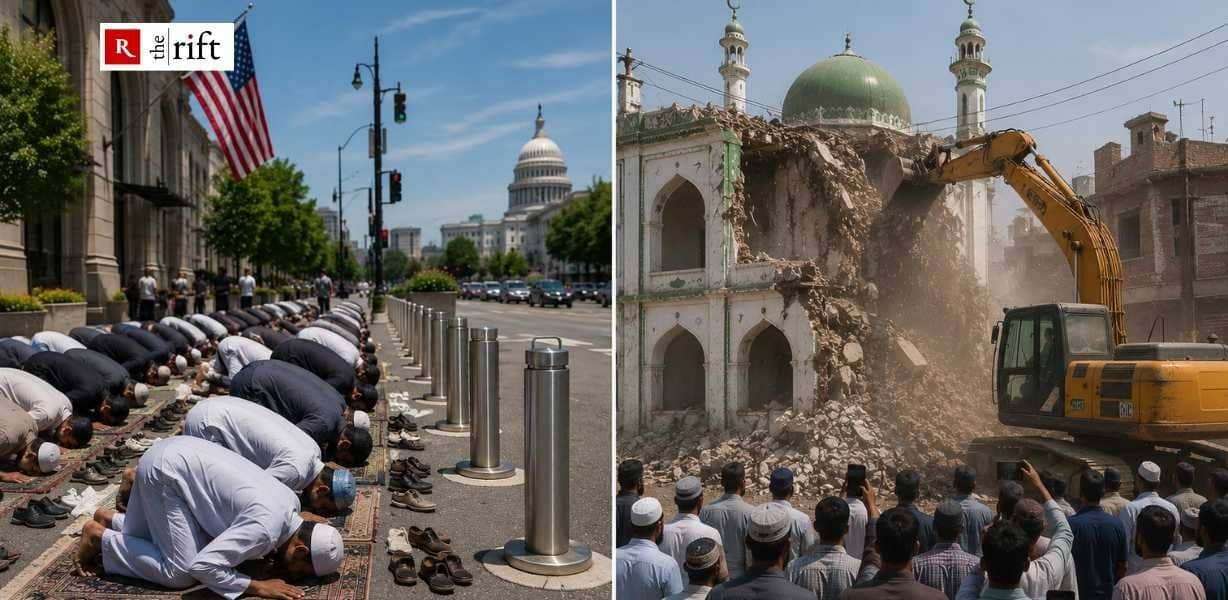
Image | Representative Only
Key Takeaways
1 of 3
Automatically generated. Read full article for complete context.
In the United States, the discourse surrounding houses of worship has shifted toward a sobering reality: the necessity of “hardening” sanctuaries against the rising tide of targeted violence. As Jewish leaders, Islamic associations, and bipartisan lawmakers lobby for a $1 billion federal investment in the Nonprofit Security Grant Program (NSGP)Nonprofit Security Grant Program (NSGP)A US federal program that provides funding to non-profit organizations and religious institutions to enhance their physical security against potential attacks., their goal is foundational to a free society. They are not merely asking for door locks, bollards, and security cameras; they are arguing that the state bears an affirmative obligation to ensure that no citizen, regardless of faith, is forced to choose between spiritual life and physical safety.
This inclusive, proactive American approach stands in sharp moral contrast to the systematic demolition and targeting of mosques and madrasas increasingly witnessed in India. While one democracy grapples with the logistics of protecting the congregant, the other appears increasingly invested in the erasure of the institution itself.
The push by the Jewish Federations of North America and Islamic advocacy groups such as the Council on American-Islamic Relations (CAIR)Council on American-Islamic Relations (CAIR)A prominent Muslim civil liberties and advocacy organization in the United States. recognizes a fundamental truth: a society that cannot protect its places of worship has failed its democratic mandate. Representative Gottheimer’s cry, “My parishioners are scared,” encapsulates the anxiety of a pluralistic nation reckoning with the vulnerability of its most sacred spaces. By pursuing federal funding to secure houses of worship, these groups assert that religious practice is an essential component of the American social fabric, one that requires state-supported reinforcement in times of peril.
The Indian landscape, by contrast, is increasingly defined by the aggressive demolition of religious minority structures. Where the American model seeks to provide funds to strengthen defenses, the Indian administrative model is alleged to often deploy the machinery of the state to bypass due process and look away as mobs level the structures themselves. The destruction of mosques and the targeting of madrasas under the guise of “anti-encroachment” or “urban planning” is nothing but a profound betrayal of India’s constitutional soul.
The incidents are not hypothetical. They are documented, dated, and devastating.
July 31, 2023
Nuh, Haryana
Over 300 Muslim homes and businesses razed following communal clashes.
Jan 30, 2024
Mehrauli, New Delhi
600-year-old Masjid Akhonji, adjoining madrasa, and graveyard razed by DDA.
Feb 8, 2024
Haldwani, Uttarakhand
Mosque and madrasa demolished; protests met with live fire resulting in 6 deaths and 250+ injured.
October 2024
Chandousi, Sambhal, UP
“Rizaye Mustafa” mosque and 34 adjoining homes demolished.
Nov 24, 2024
Sambhal, UP
Survey of Shahi Jama Masjid degenerates into clashes (4 killed, 30+ police injured). District-wide demolitions follow.
Jan 4, 2026
Salempur Salar, Sambhal, UP
Government bulldozers level a mosque and a madrasa.
January 30, 2024, Mehrauli, New Delhi. At 6 a.m., squads of the Delhi Development Authority (DDA)Delhi Development Authority (DDA)A civic planning authority responsible for developing and managing land in the National Capital Territory of Delhi. arrived without prior notice at Masjid Akhonji, a mosque standing for over 600 years in the Mehrauli area of South Delhi, and razed it to the ground along with an adjoining madrasa and graveyard, claiming the structures were encroachments on forest land.
The Delhi High Court, hearing an urgent petition filed by the Delhi Waqf BoardWaqf BoardA statutory body responsible for managing and protecting Islamic charitable endowments (Waqf) properties., subsequently asked the DDA to explain why no notice was served before the demolition, and directed the authority to maintain the status quo on the land.
The Indian American Muslim CouncilIndian American Muslim Council (IAMC)An advocacy group based in the US dedicated to safeguarding India’s pluralist and tolerant ethos. condemned the act as “an attempt to erase rich Muslim heritage,” noting that the demolition took place without any prior notice, in blatant disregard of a six-century-old religious and cultural legacy. IAMC has been called biased by India, but regardless, when things said have the ring of truth… the source loses relevance.
February 8, 2024, Haldwani, Uttarakhand. Local authorities deployed bulldozers to demolish a mosque and madrasa in the Malik ka Bagicha locality of the Banbhoolpura area, declaring them illegal structures not recorded in government registers. The demolition triggered widespread protests among residents who contended that both structures had stood for nearly twenty years and that a court hearing on the matter was due on February 14. Authorities responded to the protests with live fire, tear gas, and baton charges; six people were killed and over 250 were injured. A curfew was imposed and internet services were suspended across the district.
July 31, 2023, Nuh, Haryana. Following communal clashes on July 31, in which a Hindu religious procession was attacked, the Haryana state government launched a sweeping demolition drive across Nuh district targeting the properties of Muslim residents and shopkeepers. Over 300 Muslim homes and businesses were razed.
The Punjab and Haryana High Court, in a pointed intervention, questioned whether the demolition drive was limited exclusively to properties of “a particular community” and demanded to know whether an “exercise of ethnic cleansing” was being conducted.
The demolition drive paused only after the High Court’s intervention; the structures razed included residential homes, market stalls, and properties in the vicinity of a mosque.
November 24, 2024, Sambhal, Uttar Pradesh. A local court ordered a survey of the 16th-century Shahi Jama Masjid, a protected Mughal-era monument under the Archaeological Survey of India, on the basis of a petition alleging that the mosque was constructed over the ruins of a Hindu temple.
A second survey on November 24 degenerated into violent clashes in which four people were killed and over 30 police personnel were injured.
In the weeks that followed, the Uttar Pradesh administration conducted a district-wide demolition drive against over two dozen shops and homes adjoining the mosque and a graveyard, and on January 4, 2026, government bulldozers levelled a mosque and a madrasa in Salempur Salar village, 12 km from Sambhal town.
By that point, over a dozen Islamic sites in Sambhal district had been razed in fourteen months since the survey triggered the first wave of violence.
October 2024, Chandousi village, Sambhal, Uttar Pradesh. The “Rizaye Mustafa” mosque and 34 adjoining homes were demolished by authorities who declared them illegal, further inflaming allegations of selective targeting of Muslim religious sites.
These incidents are not isolated aberrations. The United States Commission on International Religious Freedom (USCIRF)USCIRFAn independent, bipartisan US federal government commission that monitors the universal right to freedom of religion or belief abroad., in its October 2024 Country Update on India, documented how “throughout 2024, individuals have been killed, beaten, and lynched by vigilante groups, religious leaders have been arbitrarily arrested, and homes and places of worship have been demolished,” calling these events “particularly severe violations of religious freedom.” That body too has been called biased by India, but regardless, when things said have the ring of truth…
The body apparently recommended that the US designate India as a “Country of Particular Concern.” Separately, a civil society report on hate speech in India recorded a 74.4% increase in hate speech incidents targeting religious minorities between 2023 and 2024, rising from 668 to 1,165 documented events.
Article 25Article 25 of the Constitution of IndiaGuarantees all persons the freedom of conscience and the right to freely profess, practice, and propagate religion. of the Constitution of India guarantees the right to freedom of conscience and the right to freely profess, practice, and propagate religion. The Supreme Court has itself affirmed that the Places of Worship (Special Provisions) Act, 1991Places of Worship Act, 1991An Indian law that prohibits the conversion of any place of worship and ensures the maintenance of its religious character as it existed on August 15, 1947., which freezes the religious character of places of worship as they stood on August 15, 1947, forms part of the basic structure of the Constitution. When the state facilitates the destruction of such places, it renders these constitutional guarantees hollow rhetoric.
Notably, in December 2024, the Supreme Court went so far as to bar all trial courts from registering fresh suits against places of worship and from ordering any survey of disputed religious structures, signaling that unregulated judicial and executive action against minority religious sites imperils the constitutional principles of secularism and rule of law.
The systematic demolition of properties, often carried out with bulldozer-led impunity, defies the Rule of Law itself. In its landmark judgment of November 13, 2024, in *In Re: Directions in the Matter of Demolition of Structures*, a bench of Justices B.R. Gavai and K.V. Viswanathan declared such arbitrary demolitions unconstitutional, characterizing them as “collective punishment” and holding that the executive cannot act as judge, declare an accused guilty, and demolish their property.
The Court issued binding guidelines mandating a minimum 15-day written notice to the owner or occupier before any demolition, a personal hearing, and a video-recorded demolition report, with non-compliance amounting to contempt of court.
Earlier, in Olga Tellis v. Bombay Municipal Corporation (1985), the Supreme Court had established that deprivation of life and property under Article 21Article 21 of the Constitution of IndiaStates that no person shall be deprived of his life or personal liberty except according to procedure established by law. must follow procedure established by law, a principle directly violated by the summary extra-judicial demolitions described above.
Yet, despite these clear judicial mandates, the Uttar Pradesh government was censured as recently as March 31, 2025, and directed to pay Rs 10 lakh to each aggrieved homeowner for razing homes without due process.
India is also a signatory to the International Covenant on Civil and Political Rights (ICCPR)ICCPRA multilateral treaty adopted by the UN General Assembly that commits its parties to respect the civil and political rights of individuals, including freedom of religion.. Article 18 explicitly protects the right to freedom of religion, including the freedom to establish and maintain places of worship. By permitting or participating in the destruction of religious structures, India places itself in clear tension with its international commitments to protect the rights of religious minorities.
The disparity is stark. In one instance, a government is urged to fund the hardening of a synagogue or mosque so that a child in a preschool or a worshipper at prayer remains safe. In another, the government has, in documented cases across Delhi, Uttarakhand, Haryana, and Uttar Pradesh, been the architect of the very vulnerability that the American program seeks to mitigate.
To watch American Jewish and Muslim leaders unite to demand federal protection for all houses of worship is to see pluralistic thinking at its best. To witness, simultaneously, the demolition of mosques and the intimidation of madrasas in India is to see the descent into sectarian majoritarianism that the Supreme Court itself condemned in its November 2024 judgment as conduct carrying “the intimidating image of a bulldozer destroying a building” and conjuring “lawlessness where power prevails.”
A state that invests in bollards to prevent violence values life. A state that deploys bulldozers to raze the historic and sacred spaces of its minority citizens has abandoned the idea of justice.
India’s constitutional framework, fortified by Article 25, the Places of Worship Act of 1991, and successive Supreme Court rulings, already contains the architecture of protection.
The question that remains is whether those entrusted with power will choose to build with it or demolish against it.
If India genuinely aspires to stand as a beacon of democracy, its greatness will be measured not by how efficiently it can dismantle minority faith, but by how courageously it protects it. Until that shifts, the inclusive vision demonstrated by American advocacy for religious security remains a distant, aspirational light.
Jai Hind
Disclaimer:The views and opinions expressed in this article are those of the author(s) and do not necessarily reflect the official policy or position of The Rift.