Opening The Rift
therift
© 2026 The Rift. All Rights Reserved.
India’s Geopolitical Tightrope: The Cost of the US-Iran Conflict
From failing to condemn US strikes to freezing funds for the Chabahar port, India’s response to the US-Iran conflict contrasts jarringly with its ferocious domestic politics. Has New Delhi surrendered its strategic autonomy?

Source: PMO India (@PMOIndia) via X/Twitter
Key Takeaways
1 of 3
Automatically generated. Read full article for complete context.
The US-Iran conflict has placed India on a geopolitical tightrope, but New Delhi’s recent diplomatic contortions look less like a balancing act and more like an anxious scramble. The contrast is jarring: a government that projects ferocious, unyielding strength in its domestic politics is currently broadcasting a profound timidity on the international stage, apparently willing to sabotage decades of hard-won strategic autonomy to appease Washington.
On March 2, 2026, the strategic landscape of the Middle East shifted violently. US and Israeli military forces launched coordinated, allegedly illegal strikes against Iran, accompanied by President Donald Trump’s demand for an “unconditional surrender.” For New Delhi, this is an immediate, interlocking crisis that threatens energy security, the diaspora, and India’s standing in the Global South. Yet, the Modi government’s response has felt remarkably inadequate for a nation claiming the mantle of “Vishwaguru.”
The Timing of the Tel Aviv Visit
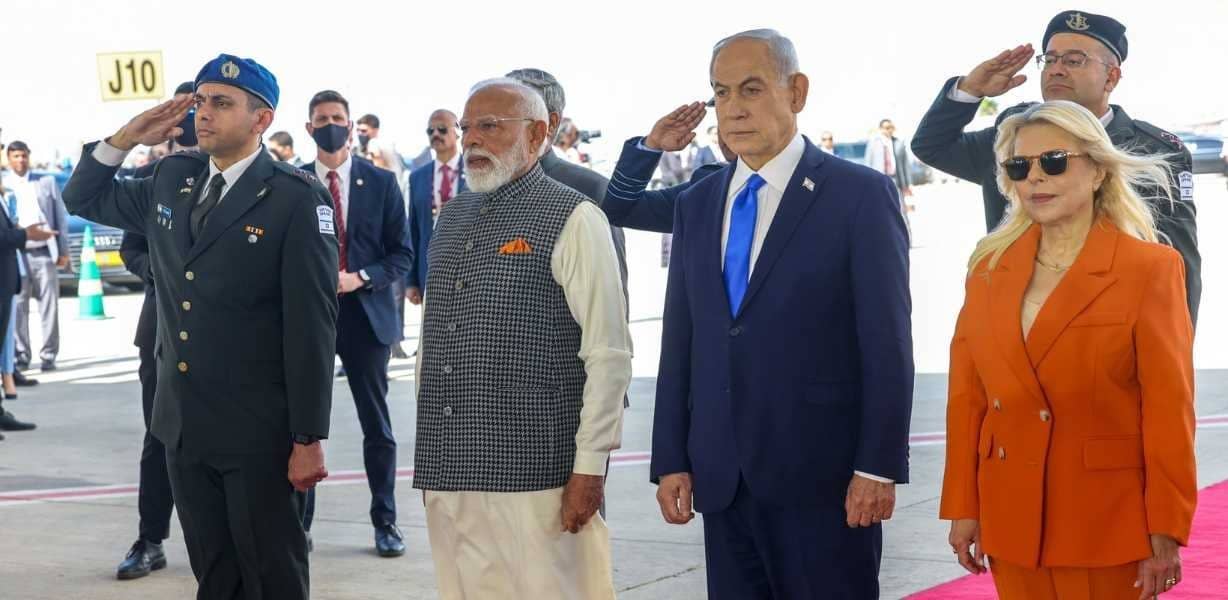
What makes the current posture particularly glaring is the sequence of events immediately preceding the escalation. Prime Minister Narendra Modi visited Israel just before the strikes on Tehran commenced. The timing of this visit has raised profoundly uncomfortable questions across the diplomatic corps. Was this a catastrophic failure of intelligence and scheduling, or a calculated display of solidarity right before a polarizing escalation?
The optics of the Prime Minister embracing Israeli leadership hours before bombs dropped on Iranian soil have made India’s subsequent, muted calls for “de-escalation” ring entirely hollow.
Furthermore, the visit was surprising for an entirely different, highly sensitive reason. Just prior to the trip, Modi was constantly in focus after his name purportedly appeared in the recently unsealed Epstein file. These documents reportedly alleged that he danced at one of the associated events. While these severe allegations remain entirely unverified, the international media cycle had locked onto the spectacle. The sudden, high-profile diplomatic trip to Israel served, intentionally or otherwise, to violently shift the narrative away from those embarrassing, albeit allegedly unproven, associations and back to hard geopolitics. It worked as a domestic distraction, but at what international cost?
The Diplomatic Retreat
This diplomatic timidity extended to basic protocol following one of the conflict’s most shocking developments. When Iranian state media confirmed on March 1, 2026, that Supreme Leader Ayatollah Ali Khamenei had been assassinated in the strikes, the global response was immediate. Yet, India did not officially condemn the killing of a sitting head of state.
Instead of a high-level statement from the Prime Minister or the External Affairs Minister, New Delhi waited four remarkably long days. Finally, on March 5, India dispatched Foreign Secretary Vikram Misri to sign a condolence book at the Iranian Embassy in New Delhi. Sending a bureaucrat, rather than a political leader, to silently sign a book nearly a week after the assassination of the Supreme Leader of a historically friendly nation is not a diplomatic oversight. It is a calculated, glaring insult designed to signal distance to Washington while technically maintaining minimum bilateral protocol.
This deliberate silence on the initial aggression makes the asymmetry of India’s subsequent condemnations all the more revealing. Following the US and Israeli strikes against Iran, South Block chose to maintain a calculated ambiguity. India chose not to condemn the attack in unequivocal terms, instead issuing generalized statements advocating for “dialogue and diplomacy,” carefully avoiding assigning direct blame to Washington or Tel Aviv.
However, when Iran launched retaliatory drone and missile strikes targeting Gulf countries hosting American military bases, India’s tone shifted dramatically. Prime Minister Modi immediately engaged in phone conversations with the leaders of the UAE, Saudi Arabia, Bahrain, and Qatar, explicitly condemning the attacks and conveying India’s unwavering solidarity. While the concern for the nearly one crore Indian citizens living and working in the Gulf is legitimate and pressing, the stark contrast in diplomatic rhetoric is unmistakable. India will unequivocally condemn Iranian retaliation, but it will not explicitly name or condemn the instigating American and Israeli aggression.
This selective outrage has drawn sharp, sustained criticism from the opposition. The Congress party accused the government of a “betrayal of India’s values, principles, concerns and interests.” This is not merely partisan bickering; it reflects a genuine, growing fear that the government is abandoning its traditional role as a principled, independent voice of the Global South.
The Chabahar Surrender
The most concrete evidence of India’s retreat, however, is found not in diplomatic statements, but in a ledger. India’s Union Budget for 2026-27 has allocated zero funds for the Chabahar Port project in Iran. This is a staggering reversal. The previous year’s budget included an allocation of ₹400 crore in revised estimates for the port.
This decision, made amid escalating tensions between Washington and Tehran and the looming expiration of a US sanctions waiver on April 26, tells the whole story. The Chabahar Port is not just a commercial venture; it is an active 10-year contract and India’s vital strategic bypass around Pakistan to access Central Asia and Afghanistan. By freezing the budget to avoid running afoul of American sanctions, New Delhi has effectively acknowledged that Washington now has veto power over India’s most critical Eurasian infrastructure project.
The economic fallout of the broader conflict only compounds this strategic surrender. A significant portion of India’s crude oil imports pass through the Strait of Hormuz, a maritime chokepoint now entirely destabilized. The immediate consequence of the February strikes was a sharp spike in oil prices. India is absorbing direct economic damage while systematically dismantling its own geopolitical leverage in the region.
The Illusion of Strength
The current dispensation in New Delhi built its domestic brand on muscular nationalism, projecting an image of an India that bends to no foreign power. Yet, when confronted with hard pressure from the United States and Israel, the government seems to be cowering on the international stage.
Strategic autonomy was India’s most valuable foreign policy asset, built painfully over decades by successive administrations. It allowed New Delhi to navigate the Cold War, maintain defense ties with Russia, and court the West without becoming a client state. The current crisis suggests that this autonomy has not just been eroded; it is being actively dismantled. New Delhi is discovering that ferocity at home cannot mask timidity abroad, and that you cannot claim to be a “Vishwaguru” while waiting for permission to speak.
Disclaimer:The views and opinions expressed in this article are those of the author(s) and do not necessarily reflect the official policy or position of The Rift.