Opening The Rift
therift
© 2026 The Rift. All Rights Reserved.
India US Trade Deal Farm Impact: Who Pays the Real Price
Modi’s $500 billion trade deal with Trump opens India’s agricultural markets to subsidized American produce. With farmer protests escalating and Parliament silent, the cost falls on those who were never consulted.
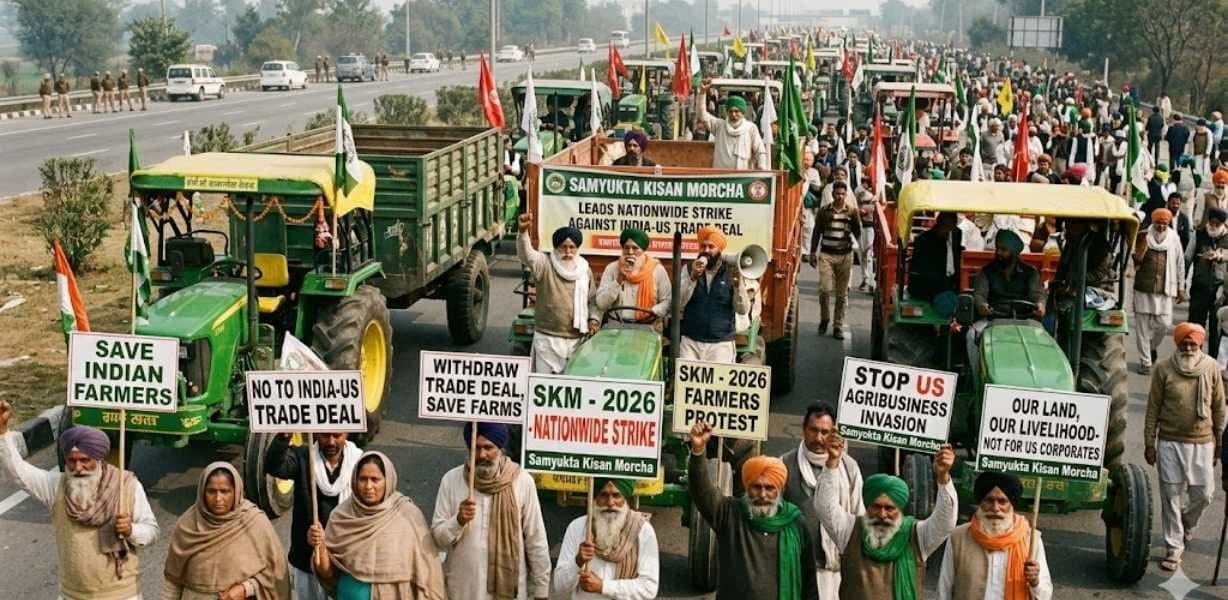
AI Generated | Only Illustrative
Quick Summary
India US trade deal farm impact is not a hypothetical risk.
The India US trade deal farm impact is structural: it introduces subsidized American produce into a market where 42 percent of the workforce depends on agriculture for survival.
The India US trade deal farm impact will not be measured in trade balances.
Automatically generated. Read the full article for complete context.
India US trade deal farm impact is not a hypothetical risk. It is already being contested in fields, on highways, and in Parliament. On February 2, 2026, Narendra Modi and Donald Trump announced what the White House called a “historic trade deal,” a sweeping bilateral agreement in which the US slashed effective tariffs on Indian goods from a peak of 50 percent down to 18 percent, scrapped the punitive 25 percent surcharge imposed over India’s Russian oil purchases, and in return secured India’s commitment to purchase $500 billion worth of American energy, agriculture, coal, and technology products.
The headline number stabilized markets. The Sensex rallied. The rupee firmed. And then the agricultural provisions leaked, and the other India showed up.
What the Deal Surrenders
India agreed to significantly reduce or eliminate tariffs on American agricultural products, including dairy, poultry, soybean oil, processed foods, and animal feed products like red sorghum. The India US trade deal farm impact is structural: it introduces subsidized American produce into a market where 42 percent of the workforce depends on agriculture for survival. American farmers receive roughly $30 billion annually in federal subsidies. Indian farmers receive stagnant minimum support prices, rising input costs, and the promise of reforms that never arrive.
The asymmetry is not subtle. When subsidized soybean oil from Iowa competes with mustard oil pressed in Rajasthan, the outcome is not determined by efficiency. It is determined by which government spends more to protect its farmers. That contest was decided before the agreement was signed.
The Revolt
On February 12, the Samyukta Kisan Morcha, the umbrella body that led the 2020-21 farmer protests against the three farm laws, staged a nationwide strike. Rahul Gandhi met with 17 farmer unions and called the deal a “death warrant for farmers and MSMEs.” Bloomberg reported that India’s major farmer group had revolted. SKM has demanded the removal of Commerce Minister Piyush Goyal and announced tractor marches across Punjab, Haryana, Rajasthan, and Madhya Pradesh for March 10. In Haryana, farmers burned effigies of Modi and Trump.
The mobilization follows a tested escalation model: village meetings to district protests to highway blockades. The parliamentary session opening March 9 will be the first formal arena of confrontation.
The Strategic Logic and Its Flaw
The government’s defence is macroeconomic. India needed to avert Trump’s tariff regime, which threatened an $80 billion export basket. Chatham House described the approach as “strategic hedging”: yield on agriculture to protect technology, pharmaceuticals, and services.
That calculus is defensible on a spreadsheet. It is less defensible in a village in Madhya Pradesh where a cotton farmer earning 40,000 rupees a year is being asked to absorb the cost of a geopolitical bargain negotiated between two billionaires. The deal also commits India to reduce or halt Russian oil purchases, shifting procurement to American and potentially Venezuelan sources. Energy sovereignty, like agricultural sovereignty, is being traded for tariff relief.
The full text of the agreement has not been released publicly. The government has declined to table it in Parliament before the session opens. SKM and opposition parties have demanded its publication as a precondition for any debate. The refusal to disclose is itself a form of governance: you cannot contest what you are not allowed to read.
The India US trade deal farm impact will not be measured in trade balances. It will be measured in the spring harvest, when American soybean oil arrives at Indian ports at prices no smallholder can match. The deal was sold as a shield. For 600 million people who live on agriculture, it looks more like a door thrown open from the inside.