Opening The Rift
therift
© 2026 The Rift. All Rights Reserved.
Judicial Acquittals Unconstitutional State Action & Recompense Accountability
The convergence of executive demolitions and subsequent judicial acquittals highlights profound constitutional violations, demanding immediate and robust institutional correction.

Key Takeaways
1 of 3
Automatically generated. Read full article for complete context.
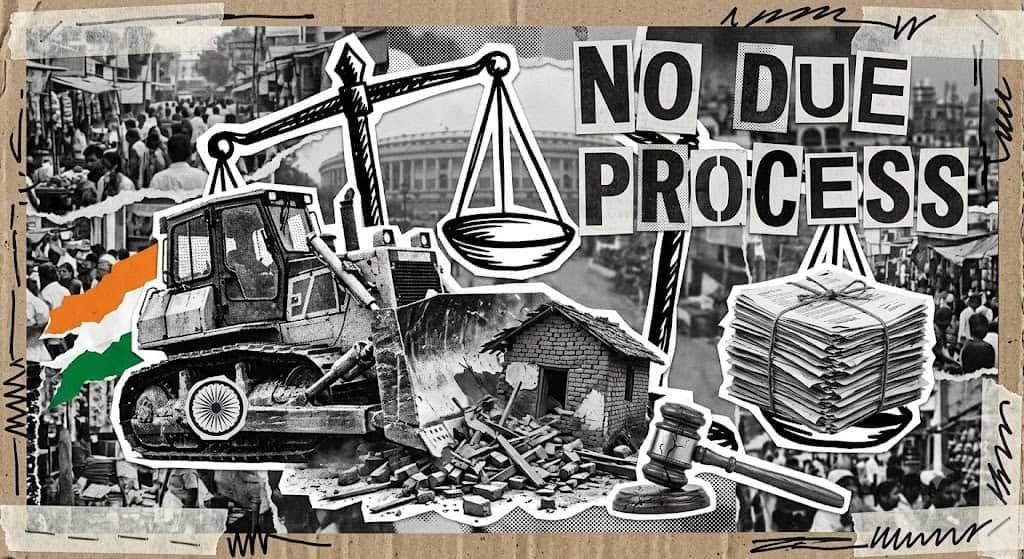
A social media image highlights a significant intersection of criminal jurisprudence, executive action, and constitutional accountability in India.
The Incident and Executive Action (2022) : Following the Khargone riots in 2022, the then Madhya Pradesh Home Minister, Narottam Mishra, ordered the demolition of homes belonging to individuals accused of involvement in the violence.
Judicial Resolution (2026) : After spending four years behind bars, 11 Muslim men were formally acquitted by the court, which found them innocent of the charges against them.
Jurisprudential and Institutional Implications
The sequence of events depicted in the case raises critical questions regarding the administration of justice and the separation of powers :
Pretrial Detention and Liberty : The confinement of individuals for four years prior to a judicial finding of innocence underscores structural challenges within the criminal justice system regarding the protection of personal liberty under Article 21 of the Constitution of India.
Executive Demolitions vs. Due Process : The use of punitive executive actions, such as property demolitions prior to judicial adjudication or conviction, bypasses the established tenets of natural justice and judicial trial.
State Accountability and Compensation : The subsequent exoneration of the accused individuals highlights the legal and moral imperative for institutional accountability, particularly concerning state compensation for wrongful incarceration and arbitrary executive penalties.
The convergence of executive demolitions (such as those executed in the Khargone riots aftermath) and subsequent judicial acquittals highlights profound constitutional violations. When analyzed through the lens of Indian constitutional law, several foundational guarantees and judicial authorities come to the forefront :
1 Constitutional Guarantees
Right to Equality and Prohibition of Arbitrariness (Article 14) :
Executive action that selectively targets properties based on unproven accusations violates the equality code and the prohibition against arbitrary state action. State power cannot be exercised with a vendetta or malice to single out specific communities.
Right to Life, Personal Liberty, and Housing (Article 21) :
The Supreme Court of India has repeatedly held that the right to life under Article 21 includes the right to livelihood and shelter. Pre-trial summary destruction of a home without due process strips individuals of basic human dignity.
Protection Against Deprivation of Property (Article 300A) :
Article 300A mandates that “no person shall be deprived of his property save by authority of law.” Executive fiat, municipal pressure without statutory notice, or using bulldozers as a tool of penal consequence lacks the sanction of a valid, procedure-established law, rendering such destructions unconstitutional property deprivation.
2 Judicial Authorities and Landmark Precedents
Prohibition of Executive Adjudication (“Bulldozer Justice” Judgment)
In the landmark ruling on arbitrary demolitions (In Re: Directions in the Matter of Demolition of Structures, Nov 2024), the Supreme Court ruled that the executive cannot act as a judge, pre-emptively pronounce an accused guilty, and inflict retributive punishment by razing homes. The Court declared such acts to be a direct subversion of the rule of law and the separation of powers.
Mandatory Due Process Guidelines :
The Supreme Court laid down strict, pan-India enforceable guidelines prohibiting demolitions without a formal show-cause notice (providing adequate time, typically 15 to 60 days depending on local municipal laws), a personal hearing, and a reasoned written order.
Institutional Accountability and Restitution
To address the systemic harm of wrongful property destruction, the apex court mandated that erring officials responsible for arbitrary demolitions face contempt proceedings, disciplinary action, and personal financial liability to pay restitution and compensation to the victims.
The Imperative for Suo Motu Judicial Intervention
The travesty of justice revealed in the Khargone case, where citizens endure years of incarceration only to be declared innocent after their fundamental rights and homes have already been summarily obliterated, demands immediate and robust institutional correction.
The constitutional guarantees enshrined under Articles 14, 21, and 300A are rendered illusory when executive overreach operates with impunity under the guise of swift retribution.
There remains an urgent necessity for the constitutional courts to take suo motu cognizance of such patterns of state action, enforcing strict liability, restitution, and accountability for executive abuse.
Furthermore, this high-profile instance represents only the surface of a systemic crisis; countless similar violations perpetrated against marginalized and vulnerable individuals quietly occur away from public scrutiny, hidden from the media eye and legal mainstream.
It is incumbent upon the judiciary to step into the public sphere, bring these hidden injustices to light, and establish an uncompromising deterrent against the weaponization of state power.
Destruction of lives unfairly by a state demands that.
Jai Hind
Disclaimer:The views and opinions expressed in this article are those of the author(s) and do not necessarily reflect the official policy or position of The Rift.
*Constitutional LawDue ProcessExecutive OverreachHuman RightsIndiaJudicial AccountabilityKhargone RiotsProperty Rights