Opening The Rift
therift
© 2026 The Rift. All Rights Reserved.
The “Judicial Exclusion” of Converted Dalits
The judiciary’s narrow, theological interpretation of social status for converted Dalits is fundamentally flawed and merits urgent reconsideration, failing to acknowledge persistent caste-based discrimination.

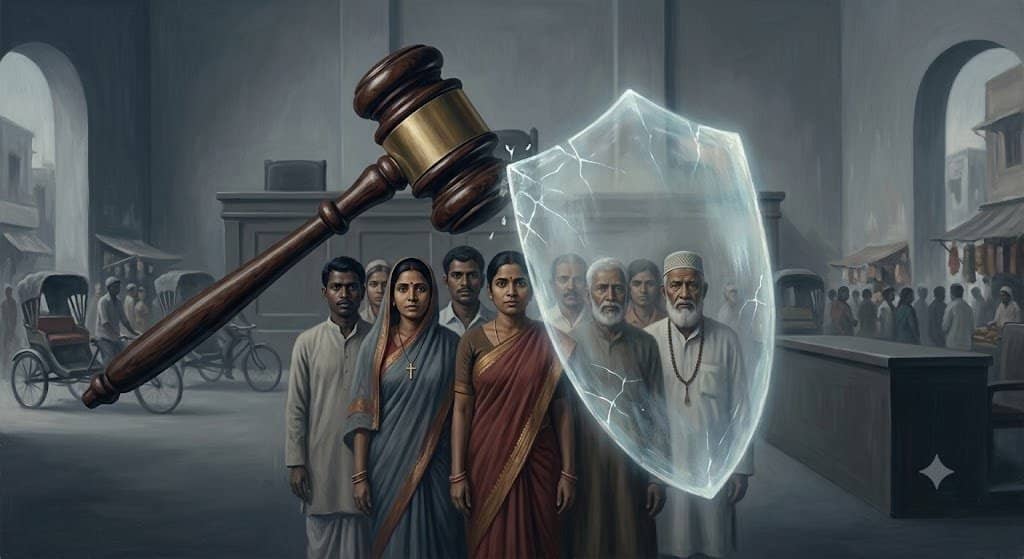
Dalits face exclusion in the judicial system, highlighting social injustices in India (Representative Image)
Key Takeaways
1 of 3
Automatically generated. Read full article for complete context.
The Indian constitutional scheme of reservationAffirmative Action PolicyIn India, a system of affirmative action providing quotas in education, employment, and legislative bodies for historically disadvantaged groups like Scheduled Castes, Scheduled Tribes, and Other Backward Classes. is predicated on the recognition of historical and structural disabilities associated with caste. However, a persistent legal tension exists regarding the eligibility of Scheduled Caste (SC) individuals who convert to religions other than Hinduism, Sikhism, or Buddhism. Recent judicial pronouncements, most notably the 2026 Supreme Court ruling, have reinforced the “mechanical bar” of Clause 3 of the Constitution (Scheduled Castes) Order, 1950Presidential Order Defining SCsA presidential order that specifies which castes, races, or tribes are to be considered Scheduled Castes in various states and union territories of India, and originally limited SC status to Hindus., asserting that conversion to Christianity or Islam results in the “immediate and complete loss” of SC status. This writer respectfully contends that this narrow, theological interpretation of social status is fundamentally flawed and merits urgent reconsideration.
The Fallacy of the “Theological Shield”
The core of the judiciary’s reasoning most recently articulated in cases involving the denial of SC status to converts, rests on the assumption that caste is an intrinsic feature of Hinduism, and therefore, conversion to a “caste-less” religion (like Christianity or Islam) inherently dissolves the social disability. This logic, however, suffers from a disconnect with the lived reality of Dalit converts.
Sociological studies and the persistent demand for the inclusion of “Dalit Christians” and “Dalit Muslims” demonstrate that the stigma of untouchability and the socio-economic barriers attached to one’s ancestral caste do not disappear upon baptism or conversion to Islam.
The judiciary, by relying on doctrinal tenets (such as quoting biblical verses or equating conversion to a “metamorphosis“), has substituted social reality with formal theological interpretations. In Soosai v. Union of India (1985), the Court itself acknowledged the need for socio-economic data to resolve the question of disability after conversion, a mandate that has been conspicuously absent in recent sweeping denials of such rights.
Existing judgements require reconsideration via understanding the fallacy of “Eclipse” vs. Extinguishment. The judiciary has often rejected the argument that caste remains in a state of “eclipse” upon conversion and can be resumed upon reconversion. This view fails to recognize that a community’s social identity is determined by historical, exclusionary practices rather than mere religious observance, and that this identity remains tied to the individual regardless of their current faith.
While the Constitution allows for the protection of historically oppressed groups, the current interpretation penalizes the exercise of Article 25Freedom of ReligionA fundamental right in the Indian Constitution guaranteeing all persons the freedom of conscience and the right to freely profess, practice, and propagate religion, subject to public order, morality, and health. (the right to profess, practice, and propagate religion). By creating a “religious test” for constitutional benefits, the state indirectly coerces individuals to remain within the Hindu fold to retain their socio-economic entitlements: a clear breach of the secular promise of the Constitution.
The pendency of the K.G. Balakrishnan CommissionInquiry into Dalit Converts’ StatusA commission constituted by the Indian government in 2022, headed by former Chief Justice of India K.G. Balakrishnan, to examine the issue of granting Scheduled Caste status to Dalits who have converted to Christianity or Islam., tasked with examining the feasibility of extending SC status to Dalit converts, suggests that the issue is far from settled. For the judiciary to issue definitive, restrictive rulings while such institutional inquiries are ongoing is to ignore the complex, ground-level data that defines caste-based discrimination in India.
Jurisprudential reform is needed if the purpose of reservation is to “undo the asymmetry” of caste, and the ground for reservation must be the disability itself, not the religious label.
As long as the caste network continues to determine access to employment, social dignity, and protection from violence, the state must delink the eligibility for affirmative action from the profession of a particular faith.
The judiciary must transition from a “religious identity” model of reservation to a “social reality” model.
Acknowledging that one can be both a practitioner of a different faith and a survivor of caste-based exclusion is not a “fraud on the Constitution“; it is a recognition of the incomplete nature of India’s social justice project. The blanket application of a rigid, archaic mechanism that protects the state from the burden of inclusion at the cost of the constitutional rights of the most vulnerable offends the guarantees of Article 25.
The recent 2026 Supreme Court ruling which maintains that individuals who convert to religions other than Hinduism, Sikhism, or Buddhism are ineligible for Scheduled Caste status and the associated reservation benefits is not a progressive ruling.
Jai Hind
Disclaimer:The views and opinions expressed in this article are those of the author(s) and do not necessarily reflect the official policy or position of The Rift.