Opening The Rift
therift
© 2026 The Rift. All Rights Reserved.
The Structural Mismatch: Labour Law and Tribal Rights in India’s Schedule V Areas
Constitutional shields meant for tribal protection are pointed in the wrong direction, leading to economic neo-bondage in India’s mineral-rich Schedule V areas.


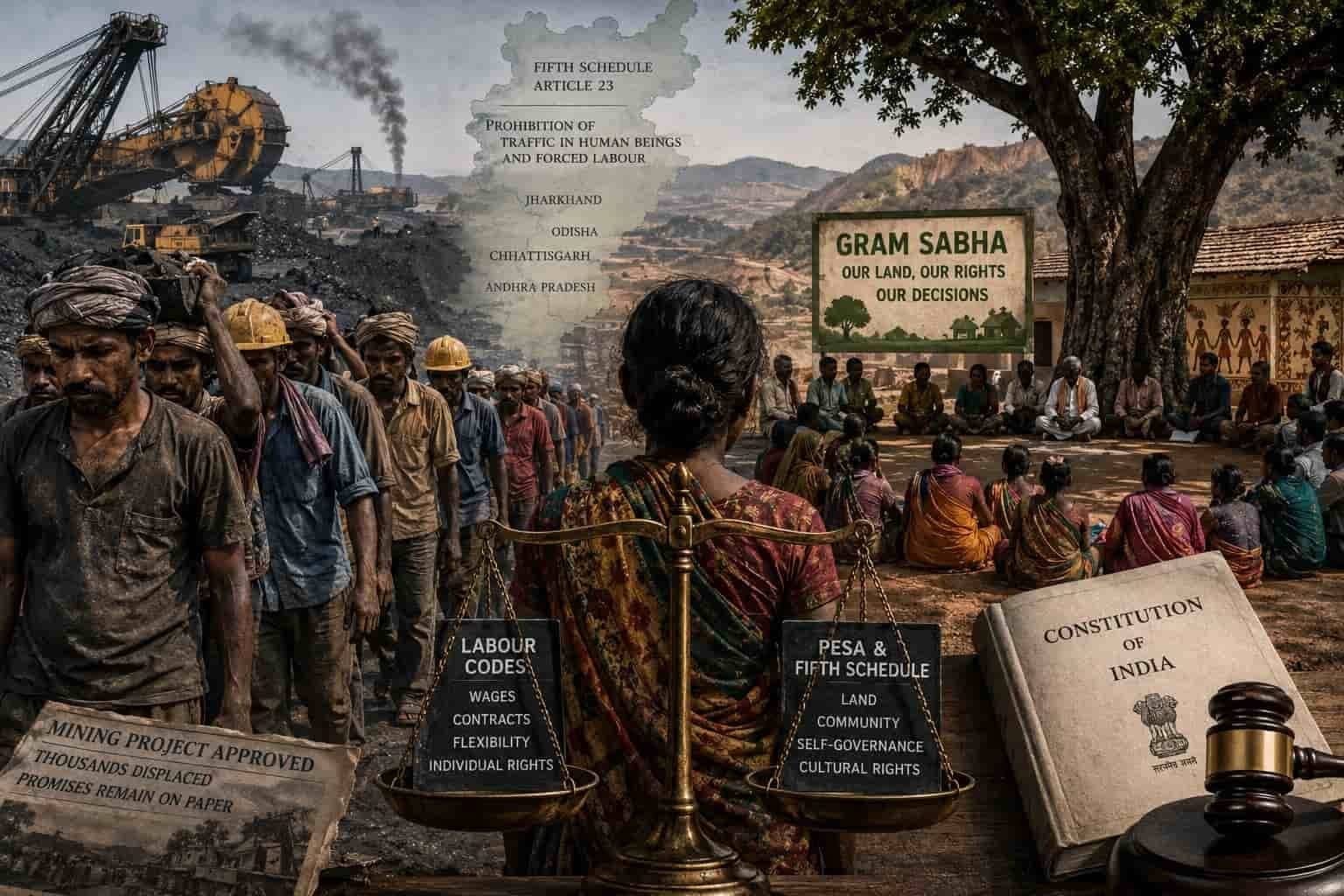
Tribal communities in India’s Schedule V areas struggle for rights (Representative Image)
Key Takeaways
1 of 3
Automatically generated. Read full article for complete context.
I. The Structural Mismatch
There is a fault line running through the constitutional topography of India’s tribal heartland, one that rarely surfaces in policy documents but quietly shapes the lives of millions. It is the fault line between two radically different legal grammars.
Tribal rights, as embedded in the Fifth Schedule and the Panchayats (Extension to Scheduled Areas) Act (“PESA”), speak the language of spatial protection: land, territory, community, and cultural continuity. Labour laws, by contrast, speak the language of functional protection: wages, hours, contracts, and individual entitlements within market transactions. When these two grammars are forced to operate in the same geography—the mineral-rich, displacement-scarred tribal belts of Jharkhand, Odisha, Chhattisgarh, and Andhra Pradesh—they do not simply co-exist. They collide.
The paradox is almost grotesque in its irony: Schedule V areas sit atop nearly 70% of India’s Coal Reserves, vast deposits of iron ore, bauxite, and manganese. They are the geological engine of India’s industrial economy. Yet the indigenous Adivasi population of these regions is, in overwhelming numbers, reduced to informal daily-wage labour, seasonal migrants, contract workers, and quarry hands on their own ancestral lands. The constitutional shields exist; they are just pointed in the wrong direction.
Mineral Wealth in Schedule V Areas
India’s Coal Reserves
70%
Located in Schedule V Areas
Major Deposits
Iron Ore, Bauxite, Manganese
Key to Industrial Economy
VISUALS BY THE RIFT
II. THE CONSTITUTIONAL PARADOX
A. Paragraph 5(1) of the Fifth Schedule: A Dormant Sword
The Governor of a Schedule V state holds extraordinary constitutional power under Paragraph 5(1): the authority to direct that any central or state law shall not apply to a Scheduled Area, or shall apply only with such modification as the Governor specifies. In theory, this is a sweeping instrument for tribal-sensitive governance.
In practice, it has been deployed almost exclusively to address land alienation and moneylending, the two most visible, ‘photogenic’ symptoms of tribal dispossession. The labour market, where the actual dispossession now happens, has been almost entirely ignored.
When the central government enacted four consolidated labour codes between 2019 and 2020, not a single Governor’s notification undertook a serious tribal impact assessment or sought to modify their application to Schedule V areas. The Industrial Relations Code, the Code on Wages, 2019, and The Code on Social Security, 2020, were all applied to tribal territories as if Jharkhand’s informal mining workforce operated under identical conditions to a formal factory in Pune. This is not an oversight; it is a structural choice, and its costs are borne entirely by tribal workers.
B. Article 23 and the Grammar of Neo-Bondage
Article 23 of the Indian Constitution prohibits “traffic in human beings and begar and other similar forms of forced labour”. Courts have interpreted “force,” but not broadly enough. The displacement-to-dispossession pipeline that characterizes tribal industrial zones produces what can only be called economic neo-bondage: self-sufficient farming communities are uprooted by mining projects, rendered landless, and then re-absorbed as informal contract labour by the very corporations that displaced them. The tribesperson who was a subsistence farmer with land rights became a wage labourer with no legal status, no collective bargaining power, and a debt-driven compulsion to accept whatever terms were offered. The chains are invisible, but the bondage is real.
Article 23’s prohibition was designed precisely for this, coerced labour arising not from physical constraint but from the elimination of all viable alternatives. The displacement-driven informal labour trap is, in its essence, a constitutional violation hiding in plain sight.
III. THE JURISPRUDENTIAL ARCHIETECTURE: Landmark Judgments
A. Samatha v. State of Andhra Pradesh (1997) : Trusteeship Cannot Be Partial
The Hon’ble Supreme Court’s Samatha’s judgment is rightly celebrated for striking down private mining leases in tribal areas and articulating the state’s role as a trustee for tribal welfare. But the jurisprudential implications extend further than land leases, and this extension has been entirely ignored.
If the state is a trustee for tribal communities, that trusteeship cannot be surgically limited to the moment of land transfer. It must follow the tribal person into the labour market. A state that refuses to grant mining lease on tribal land but then permits the mining corporation to hire displaced tribals as unregistered contract workers, without enforcing minium wages, without providing safety inspections, without ensuring social security, is betraying the trustee relationship at every subsequent step. Samatha created the doctrine; its architects simply failed to follow it downstream
B. Orissa Mining Corporation v. MoEF (2013): The Niyamgiri Paradox
In the Niyamgiri judgment, the Hon’ble Apex Court recognized that the Gram Sabha of the Dongria Kondh held ultimate sovereignty—more powerful than a multi-billion-dollar mining corporation, more powerful than the state government—over whether Vedanta’s bauxite project could proceed. of the Dongria Kondh held ultimate sovereignty, more powerful than a multi-billion-dollar mining corporation, more powerful than the state government, over whether Vedanta’s bauxite project could proceed. The community said no, and the project died.
This is, by any measure, a remarkable constitutional moment. Yet it illuminates a profound contradiction: the Gram Sabha can veto the project entirely, but once any project is approved, the same Gram Sabha has zero recognized authority over the labour conditions of the workers it generates. A village council that can kill a ₹50,000 crore investment cannot compel a subcontractor to pay minimum wages. This is not law being applied consistently; it is power being rationed selectively, and tribal communities consistently receive the ceremonial version.
C. People’s Union for Democratic Rights (PUDR) v. Union of India (1982): The Subsidy Hidden in Enforcement Failure
Justice Bhagwati’s foundational ruling in PUDR established that economic compulsion, the absence of any real alternative, is sufficient to constitute “force” under Article 23. The judgment held that construction workers receiving below-minimum wages were victims of forced labour within the constitutional meaning.
Apply this logic to remote mining belts today. Minimum wage enforcement in geographically isolated tribal regions is, by documented evidence, almost absent. Inspectors rarely visit; when they do, contractors have advance notice. The practical effect is that the State systematically subsidizes corporate labour costs through enforcement non-feasance. It is constitutional forced labour, not by explicit coercion, but by the deliberate abdication of the protective duty the State assumed when it enacted minimum wage legislation in the first place.
IV. INSTITUTIONAL FRICTION: PESA v. The Bureaucratic Inspectorate
The structural mismatch between tribal governance and formal labour administration is perhaps most visible at the institutional level. The consequences of this friction are an administrative vacuum. Labour Inspectors under the new labour codes are urban-trained, Hindi or English-medium bureaucrats assigned to territories where the relevant language may be Gondi, Mundari, or Kui. They operate out of district headquarters, often hundreds of kilometres from the worksites they nominally supervise. Contractors in remote mining clusters operate for years without a single compliance visit. The formal labour inspectorate is not merely understaffed; it is structurally alien to the terrain it is supposed to govern.
V. The Case for Institutional Convergence
The answer is not merely more inspectors; it is different inspectors, or more precisely, the democratization of the inspection function itself.
India’s constitutional architecture already contains the answer. The Gram Sabha, when genuinely empowered under PESA, is the only institution with local legitimacy, linguistic fluency, and lived knowledge to meaningfully oversee labour relations in tribal areas. What is needed is a formal bridge between PESA’s governance framework and the labour codes’ substantive protections.
Concretely, this means:
Proposed Solutions for Institutional Convergence
1. Labour Contract Registration
Mandate prior registration of contractors with the relevant Gram Sabha before engaging tribal workers, creating a traceable record.
2. Seasonal Migration Tracking
Designate Gram Sabhas as formal departure and registration points for seasonal migrant workers, feeding into the e-Shram database.
3. Primary Conciliation Authority
Empower Gram Sabhas to resolve wage disputes up to a defined threshold, reducing dependence on inaccessible district-level machinery.
VISUALS BY THE RIFT
- Labour Contract registration at the Gram Sabha level: No contractor should be permitted to engage tribal workers without prior registration with the relevant Gram Sabha, creating a traceable record.
- Seasonal migration tracking: Gram Sabhas should be designated as the formal departure and registration point for seasonal migrant workers from their jurisdiction, feeding into the e-Shram database..
- Primary conciliation authority: Gram Sabhas should be empowered to resolve wage disputes up to a defined threshold, reducing dependence on district-level machinery that tribals cannot practically access.
The gap between India’s constitutional intent and ground-level reality in Schedule V areas is not a gap in law; it is a gap in institutional imagination. The constitution gives tribal communities the shields. The task now is to ensure those shields face the right direction: not just against the developer at the gate, but against the wage thief already inside.
Disclaimer:The views and opinions expressed in this article are those of the author(s) and do not necessarily reflect the official policy or position of The Rift.