Opening The Rift
therift
© 2026 The Rift. All Rights Reserved.
Basti Suraksha Manch Demands Land Rights, Not Multi-Storey Apartments for Slum Dwellers; Opposes Forced Evictions and Sahajog Plus in Odisha
Slum residents do not need sympathy; they must be given their rights, not forced multi-storey housing, but protection of land rights.

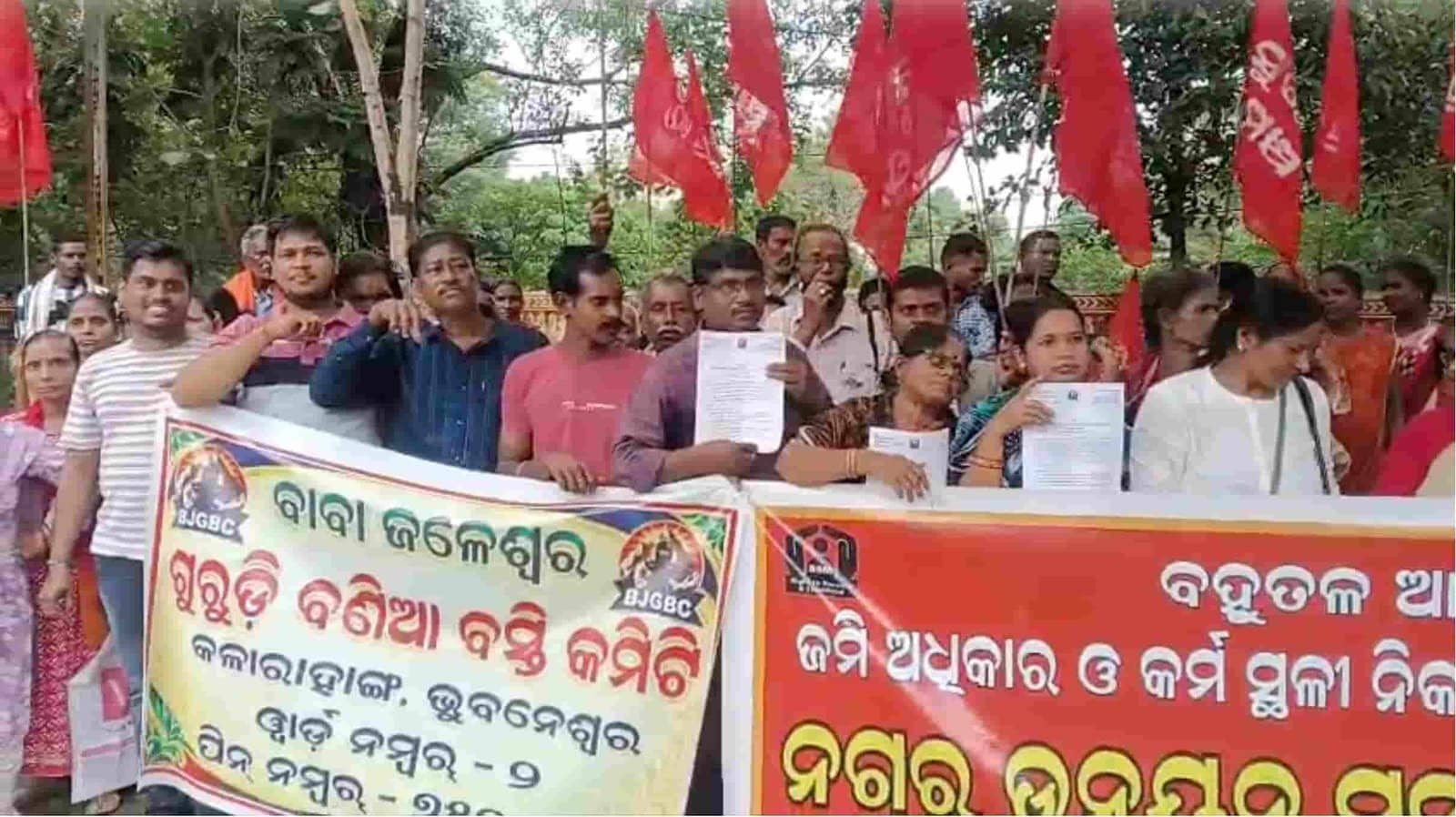
Basti Suraksha Manch activists raise their voices against forced evictions and demand land rights for slum dwellers in Odisha.
Key Takeaways
1 of 3
Automatically generated. Read full article for complete context.
Bhubaneswar, Odisha : Demanding the protection of slum dwellers’ land rights rather than compulsory multi-storey housing, an immediate halt to forced evictions, and guaranteed rehabilitation, Basti Suraksha Manch, Odisha, submitted a 15-point memorandum to Dr. Krushna Chandra Mahapatra, Minister for Housing and Urban Development, Government of Odisha, on October 30, 2026, at 10 AM.
A seven-member delegation led by the organisation’s President, Comrade Hena, and General Secretary, Comrade Pramila, met the Minister and submitted the memorandum, highlighting the growing concerns of slum residents over land rights, displacement and the implementation of government housing schemes.
In its memorandum, the organisation argued that slum settlements should not be viewed merely as unauthorised occupations of government land. Instead, they must be recognised as communities that have emerged from rapid urbanisation, unequal land distribution, the shortage of affordable housing and the migration of working-class people in search of livelihoods.
It pointed out that slum residents are an indispensable part of Bhubaneswar’s urban economy, working as construction labourers, domestic workers, sanitation workers, street vendors, small traders, transport workers and daily wage earners. Displacing them from the city would not merely destroy their homes but also disrupt their livelihoods, children’s education, access to healthcare and established social relationships.
According to the memorandum, nearly 40 per cent of Bhubaneswar’s population comprises slum dwellers, who reportedly occupy only around four per cent of the city’s land. The organisation also raised concerns over the non-implementation of the provision for reserving 10 per cent of land for socially and economically weaker sections under the Odisha Development Authorities Act, 1982.
Opposes Replacement of Statutory Rights with Sahajog Plus
A major issue raised by Basti Suraksha Manch was the protection of statutory land rights under the Odisha Land Rights to Slum Dwellers Act, 2017, and Chapter XXI of the Odisha Municipal Corporation (Amendment) Act, 2022.
The objective of these laws is to recognise slum dwellers as citizens of the city, entitled to legal rights and protection, rather than treating them merely as “unauthorised occupants”. It is the responsibility of the State Government to protect these legal rights and ensure their effective implementation.
The organisation maintained that these laws were the outcome of years of struggle by slum residents and provide a legal framework for recognising their land and property rights, along with provisions for slum redevelopment, rehabilitation and upgradation.
It strongly opposed the unilateral implementation of the Sahajog Plus scheme by the new BJP government as an alternative to these statutory rights.
The organisation argued that legally recognised land rights cannot be replaced or made subordinate to an administrative scheme or discretionary government policy. It demanded effective implementation of existing legislation in Municipal Councils, Notified Area Councils and Municipal Corporation areas.
It also clarified that its primary demand was protection of land rights rather than making multi-storey apartments a compulsory or universal alternative. Where relocation is unavoidable, residents must be provided with appropriate land or suitable housing, preferably close to their existing places of employment.
Narayani Basti and Daya West Canal Project Under Scrutiny
The memorandum specifically highlighted concerns over the proposed development of Pramod Udyan (Pramod Park) in the Bachelor Barrack area of Narayani Basti, Unit 8, Bhubaneswar.
The organisation demanded that the land rights of Dalit residents in the settlement must not be violated or disregarded in the name of park development.
It also expressed serious concern over the proposed Daya West Canal development and expansion project, which could potentially affect several slum settlements and hundreds of families.
Basti Suraksha Manch demanded a fresh, transparent survey of all potentially affected households, individual determination of their legal rights and publication of a comprehensive rehabilitation plan before any displacement takes place.
The organisation stressed that development projects must not come at the expense of the rights,homes and livelihoods of vulnerable communities, and must not proceed by first demolishing homes and considering rehabilitation afterwards. Proper rehabilitation and protection of residents’ rights must be ensured before any displacement takes place.
Its position is clear: survey the settlements first, determine the legal rights of residents, finalise rehabilitation arrangements and only then consider any displacement in accordance with the law.
Fifteen-Point Charter of Demands
The memorandum placed a comprehensive 15-point charter before the state government. The major demands include:
- Protection of statutory land rights: Effective implementation of the Odisha Land Rights to Slum Dwellers Act, 2017, and Chapter XXI of the Odisha Municipal Corporation Act, 2022.
- An end to forced evictions: No demolition or eviction without due legal procedures, prior notice, hearings and appropriate rehabilitation arrangements.
- Comprehensive slum surveys: Immediate surveys of all settlements that have not yet been covered, followed by individual determination of residents’ rights.
- Land rights and dignified rehabilitation: Priority to appropriate land rights under the existing law, with housing facilities wherever necessary, and adoption of the principle of housing near places of employment.
- Opposition to unilateral schemes: No government scheme, including Sahajog Plus, should replace or undermine the statutory land rights of slum residents.
- Protection of Narayani Basti residents: Safeguarding the land rights of Dalit families in the Bachelor Barrack area of Narayani Basti, Unit 8, against displacement for Pramod Udyan.
- Rights before Daya West Canal development: Transparent surveys, legal recognition of rights and guaranteed rehabilitation for all affected families.
- Basic civic amenities: Provision of drinking water, roads, drainage, electricity, sanitation, street lighting, healthcare and education in slum settlements.
- Consultation with slum organisations: Public consultations with organisations representing slum residents before introducing policies or projects affecting their lives.
- Reservation for weaker sections: Reservation of 10 per cent of land for socially and economically weaker families in areas being incorporated into urban limits, in accordance with the relevant provisions of the Odisha Development Authorities Act.
- Protection of previously granted land rights: No diversion of land already allotted or legally recognised in favour of slum residents for parks, roads or other public projects without ensuring due process and alternative arrangements.
- Livelihood protection: Assessment of the impact of rehabilitation on employment, markets, schools, hospitals and public transport.
- No eviction before completion of surveys: No eviction-related action until surveys and legal verification are completed.
- Time-bound slum development: A clear action plan for improving basic infrastructure and civic amenities in long-neglected settlements.
- Protection of transit housing beneficiaries: No unreasonable conditions should prevent people living in transit accommodation from becoming eligible for permanent housing.
The organisation further demanded a comprehensive survey of vulnerable settlements in newly urbanising areas outside Bhubaneswar Municipal Corporation limits, along with advance arrangements for rehabilitation and livelihood protection for families affected by urban expansion.
Demands Are Not Against Development, But Against Illegal Evictions and Forced Displacement
Emphasising its position on urban development, Basti Suraksha Manch stated that it was not opposed to infrastructure projects, roads, drainage systems, canal restoration, parks or urban beautification.
However, it strongly opposed making poor, Dalit and unorganised working-class families homeless through bulldozer-driven demolitions in the name of development.
The organisation argued that a city cannot be defined merely by wide roads, shopping malls, multi-storey buildings and flyovers. True urban development must ensure the overall well-being of all citizens, particularly the fulfilment of their basic needs of food, clothing and shelter.
It also cautioned against urban planning policies that push economically weaker communities to the outskirts as land values increase, stressing that inclusive urbanisation must recognise slum residents as equal citizens and participants in the city’s economic and social life.
Development is necessary, but it must take place without compromising people’s rights. The progress of a city should go hand in hand with the protection of its residents’ rights.
“Let there be development, but not at the cost of the housing rights of working people. Let there be parks, but not by disregarding the land rights of Dalits. Slum residents do not need sympathy; they must be given their rights,” the organisation stated.
Development Must Go Hand in Hand with People’s Rights: Advocate Biswapriya Kanungo
Speaking on the issue, noted human rights activist and advisor to Basti Suraksha Manch, Sri Biswapriya Kanungo, said that development versus rights is not the real issue; rather, the fundamental question is whether development will take place by recognising people’s rights or by dispossessing them.
He emphasised that urban development must be guided by constitutional values, social justice, equality and the right to live with dignity guaranteed under Article 21 of the Constitution of India. The State has a responsibility to ensure that development policies do not disproportionately burden communities that are already economically and socially vulnerable.
He further observed that the land on which slum communities have built their homes is not merely a real estate resource, but the foundation of their livelihoods, social existence and human dignity.
Seeks High-Level Meeting and Time-Bound Action Plan
Basti Suraksha Manch urged the Odisha Government to convene an immediate high-level meeting with representatives of slum residents and their organisations to discuss the 15 demands and announce a clear, time-bound and rights-based action plan.
The organisation reiterated that rehabilitation must protect not only housing but also livelihoods, education, healthcare, transportation and access to essential civic facilities.
It concluded that the objective of inclusive urbanisation should not be the removal of slum residents from cities but the recognition and protection of their legal rights as equal citizens.
The memorandum was submitted by Comrade Hena, President, and Comrade Pramila, General Secretary, on behalf of Basti Suraksha Manch, Odisha.
The organisation’s central message was unequivocal: “Not charity, No Sympathy but rights; not forced multi-storey housing, but protection of land rights and dignified rehabilitation.”
Disclaimer:The views and opinions expressed in this article are those of the author(s) and do not necessarily reflect the official policy or position of The Rift.