Opening The Rift
therift
© 2026 The Rift. All Rights Reserved.
Legal Struggle for Seed Rights of Farmers
The Supreme Court’s recent judgment comes as a disappointment, failing to protect farmers’ seed rights against corporate control, threatening India’s unique sui generis law.

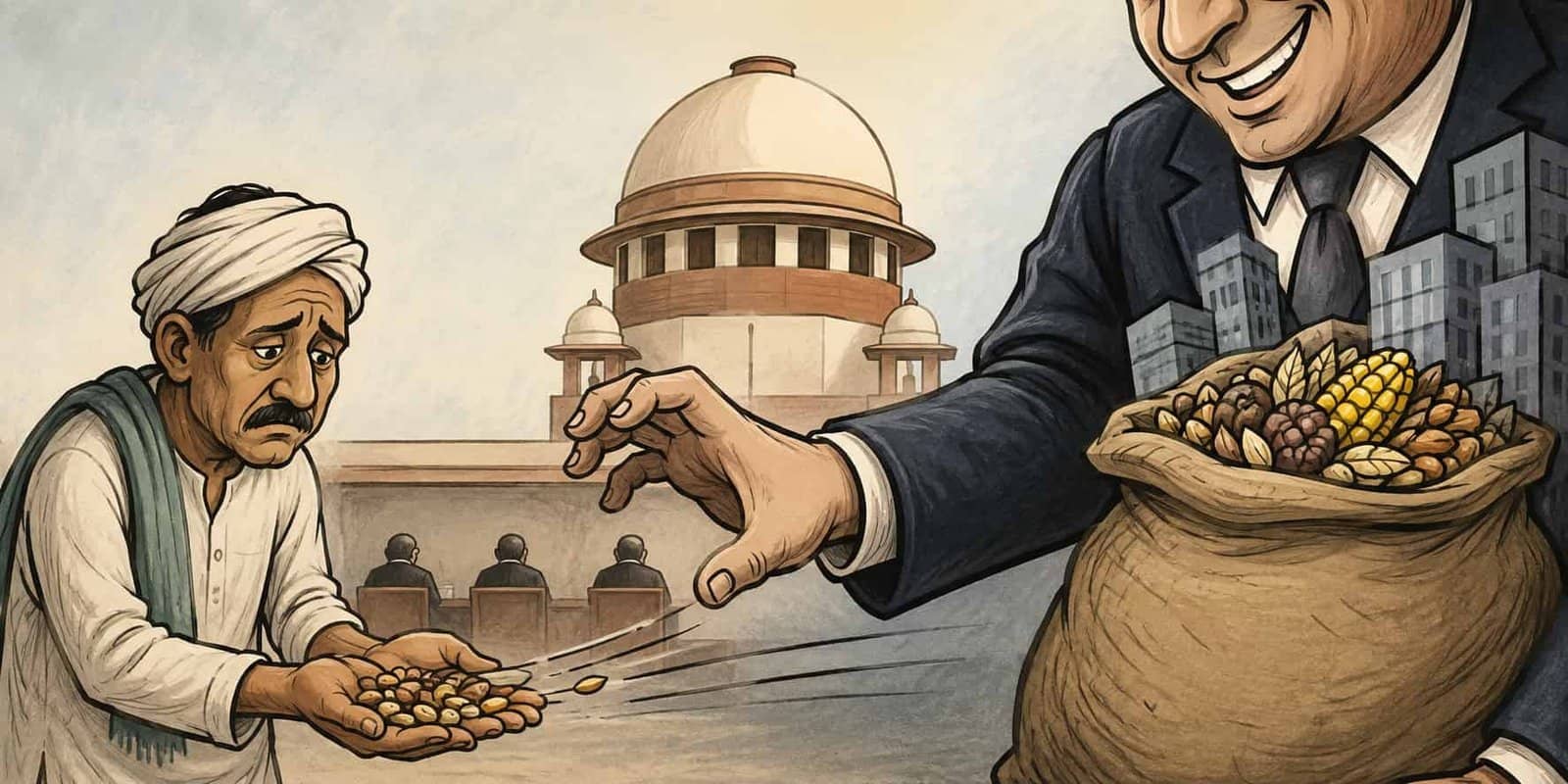
The Supreme Court’s recent judgment comes as a disappointment, failing to protect farmers’ seed rights against corporate
Key Takeaways
1 of 3
Automatically generated. Read full article for complete context.
One of the most important issues for farmers all over the world relate to the protection of their rights over seeds. Multinational companies have been misusing their enormous power in highly unethical ways to increase their grip over the world food and farming system, increasing problems for farmers and their livelihoods, for health and for environment. One of the most important ways of increasing their control over farming and food system is to increase their grip over seeds. Despite the fact that the diversity of seeds saved over the centuries is the contribution of many generations of farmers, every trick under the sun, including legal ones, has been tried in recent decades for powerful, resourceful companies to gain increasing control over seeds. It is in this context that the struggles of farmers as well as activists working with them to protect the seed rights of farmers should be seen.
Kavitha Kuruganti is one such famous activist in India who has been on the frontlines of such struggles for many years. One of her long legal battles has been against the PepsiCo company. The recent judgment by the Supreme Court of India in this case has come as a disappointment for farmers, particularly potato farmers, and activists working to protect their interests. Following this judgment Kavitha Kuruganti stated, ‘The judgment concludes that farmers being sued by IPR holders is not a matter of violation of public interest under Sec. 34(h), which was the main ground for the revocation application I filed.’ holders is not a matter of violation of public interest under Sec.34(h), which was the main ground for revocation application filed by me”, said Kavitha Kuruganti.

The SC Bench had in front of it the arguments presented by the petitioner to show the legislative intent of the Parliament of India in the creation of a unique sui generisOf Its Own KindA legal term meaning ‘of its own kind,’ used to describe a unique legal system or category that does not fit into existing classifications. India’s PPV&FR Act is considered a sui generis law. law called “Protection of Plant Varieties & Farmers’ Rights Act 2001”. The original Bill tabled in 1999 had sought to severely restrict farmers’ seed freedoms through Sections 31 and 34 of the Bill by curtailing their rights to only commercial produce and not seed, whereas the 2001 statute had a new Chapter included on Farmers’ Rights including a Sec.39(1)(iv) which gave over-arching rights to farmers over even sale of seed of protected varieties with a proviso that restricts the right to unbranded sales.
“The Bench sought clarity and took cognisance of the clear statutory provision on Farmers’ Rights under Sec.39(1)(iv) during the Hearing on August 5th 2026. Nonetheless, the learned judges did not accept that suing farmers using Sec. 28 as a ground (claiming exclusive right or IPR infringement), as Pepsico India Holdings (PIH) had done with potato farmers in Gujarat, is a matter of public interest that warrants the revocation of PIH’s certificate of registration under Sec.34(h)”, explained Kavitha Kuruganti.
“It is particularly disappointing that the Bench did not see through the modus operandi of a multinational corporation like Pepsi against smallholder farmers of India, where Pepsi behaved as though it held a patent right, as is the case in the USA where companies like Monsanto have sued and jailed many farmers. India’s unique sui generis law is a great contrast to, and very different from patent law. PPV&FR Act 2001Protection of Plant Varieties and Farmers’ Rights Act, 2001An Indian law enacted to provide for the establishment of an effective system for the protection of plant varieties, the rights of farmers and plant breeders, and to encourage the development of new varieties of plants. is not just an IPR law but a statute that provides for various farmers’ rights.
“The judgement is inexplicable because during the oral arguments on August 5th, 2023, the Bench pointedly asked the counsel of Pepsi why the company sued farmers and the response clearly explained that it was PIH’s bid to tackle competitors. PIH’s written submissions in the various proceedings so far also reflect this. This vexatious litigation against farmers, operating in a SLAPP mode, was not taken cognizance of by the Bench, despite being part of written submissions and oral arguments., was not taken cognisance of by the Bench despite it being part of written submissions and the oral arguments!”, added Kuruganti.
“It is good that during the Hearing on August 5th, 2023, we got Pepsi to state that it will allow farmers to enjoy their rights under Sec.39(1)(iv) to the fullest extent in front of the SC Bench. The judgment, unfortunately, does not make a note of this. We will keep an active watch, as we did in the past too, to protect our farmers’ rights over any seed variety”, asserted Kuruganti.
Background to this case:
Due to an intense public campaign mounted by Beej Adhikaar Manch in Gujarat and ASHA-Kisan Swaraj at the national level, PepsiCo was forced to withdraw all the cases unconditionally in May 2019. Taking cognizance of PIH’s abuse of its plant varietal registration, activist Kavitha Kuruganti filed a Revocation Application under Sec. 34 of the PPV&FR Act on multiple grounds, including Sec. 34(h) related to public interest violation. The Authority ruled in her favour in December 2021 and revoked the Certificate of Registration granted to Pepsico in 2016.
PIH went in appeal to the Delhi High Court where a Single Judge Bench (Justice Navin Chawla) once again granted in favor of Kavitha Kuruganti on two grounds and upheld the revocation done by the Authority. Pepsi appealed once again to a Division Bench in the Delhi High Court which in its judgement in January 2024 set aside the Single Judge’s order of July 2023. One of these judges was later caught in an unexplained cash-at-home row and subsequently resigned. Kavitha Kuruganti appealed in the Supreme Court in a Special Leave PetitionAppeal to Supreme Court of IndiaA special petition filed in the Supreme Court of India seeking special permission to appeal a judgment or order of any court or tribunal in the country, typically used when there is a substantial question of law or a grave injustice..
The recent judgment of the Supreme Court must be seen only as a temporary setback as the struggle for seed rights of farmers should never stop. Over the centuries, a vast diversity of seeds suitable for various needs and locations were saved by many generations of farmers, including women farmers, with wisdom, skills, commitment, creativity, and love. These were saved carefully for own use but also shared freely with other farmers or exchanged with them. Hence, a diversity of seeds, tailored to the needs of farmers, could be available to them without imposing any economic burden, year after year, thereby ensuring self-reliance in the most important requirement of farming.
In recent decades, however, there has been a big drift towards increasing corporate control over seeds, particularly with big multinational companies and their collaborators getting a huge share, assisted by patents over life forms that were unthinkable earlier. This control has been becoming a huge problem in the path of what the world really needs –a farming and food system based on small farmers producing safe food in ecologically protective and sustainable ways.
In such conditions, a very narrow framework of discussion based on patent system claims by big companies cannot lead us on the path of justice. As the history of the corporate control over seeds shows, all the way from the smaller companies to the domination of huge multinational companies with ambitions of world-level control, the main aim of these multinational companies, broadly speaking, is a longer-term, huge increase in profits, best achieved by increasing control over seeds, assisted by patents and technologies like genetic modification.
However this is not at all compatible with protecting the livelihoods of small farmers, or protecting environment and ensuring safe and healthy food. Instead, seed companies push towards increasing the burden of seed costs, as well as herbicides and other inputs often linked to the sales of their seeds. Thus, farming becomes more expensive and increasingly ecologically destructive, with more harmful chemical inputs being used and more monocultures being promoted instead of a decentralized, diversity-based approach. Where seed multinationals have been very active and strong, there have been reports of many-sided adverse impacts on farming communities.
In addition, there have also been several reports of seed multinational companies gaining access to the genetic diversity of the Global South in highly unfair ways. Thus the real issue is of changing a highly unfair system of control over seeds which is only a few decades old but has been threatening in serious ways the common heritage of humankind, the result of the work of hundreds of generations of farmers. Hence, we must move towards the truly needed task of creating a seed system based on the conservation of diversity on farmers’ farms and their ability to access the kinds of seeds they need through saving, sharing, or exchanging, instead of having to buy expensive seeds from the market—seeds often engineered to serve highly suspect motives of pushing polluting and costly chemical inputs. It is such a system, based on farm-based seed conservation, protecting diversity, sharing, and exchange, that we should strive for.
Disclaimer:The views and opinions expressed in this article are those of the author(s) and do not necessarily reflect the official policy or position of The Rift.