Opening The Rift
therift
© 2026 The Rift. All Rights Reserved.
An Open Goal: The Supreme Court’s Notice on Muslim Inheritance Law
The Supreme Court’s notice on Muslim inheritance law risks empowering an executive eager to dismantle personal laws, bypassing community consent.


The Supreme Court’s notice on Muslim inheritance law risks empowering an executive eager to dismantle personal laws, bypassing community consent.
Key Takeaways
1 of 3
Automatically generated. Read full article for complete context.
On 23 September 2026 a bench of Chief Justice Surya Kant, Justice Joymalya Bagchi and Justice V. Mohana issued notice, according to reports, on a public interest petition filed by someone. The petition apparently seeks a declaration that any rule of Muslim personal law giving unequal inheritance shares on the basis of sex is unconstitutional and unenforceable, and for directions securing equal succession rights for Muslim women, ancestral property included. Counsel for petitioner are stated to have argued that the differential shares violate Articles 14, 15 and 21, and that, after Shayara Bano, personal laws cannot be shielded from constitutional scrutiny when they produce manifest arbitrariness. Notice went to the Ministry of Law and Justice and, as every report records, the Ministry of Youth Affairs and Sports.
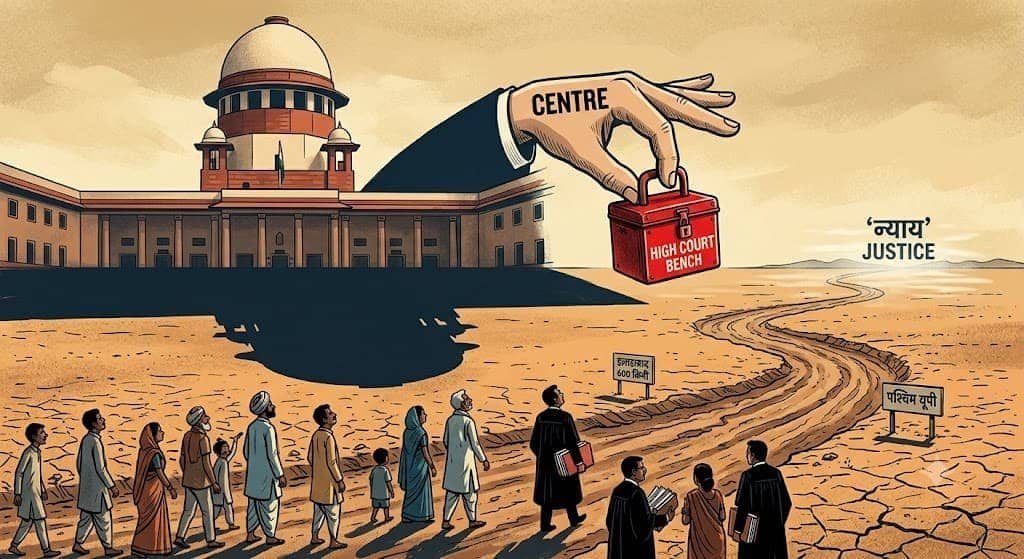
The Hon’ble Court could have dismissed the petition at the threshold. It had every doctrinal reason to, and it had said as much itself only months earlier. Instead it has invited a counter-affidavit from an executive that has made its disdain of Muslim personal law public, even its dismantling, a declared political programme. An issue of notice is formally neutral. In the present climate it is not neutral in effect : it passes the ball to a “side” that has been waiting at the goalmouth for a “pass” as it may be misinterpreted by it.
This submission makes three arguments.
- First, the order seems inconsistent with the Hon’ble Court’s own precedent and with the position this very bench took earlier in March and April 2026.
- Second, the petition’s premise, that a different share is a discriminatory share, is sound only if Islamic law is judged by the yardstick of another jurisprudential system.
- Third, the comparative record shows that mature constitutional democracies accommodate Muslim family law by consent and choice, not by judicial decree or executive fiat.
This is not the first time the Hon’ble Court has met the question. In Poulomi Pavini Shukla v. Union of India, W.P.(C) 510 of 2026, a challenge to Section 2 of the Muslim Personal Law (Shariat) Application Act, 1937 on the same ground of unequal inheritance, the Chief Justice said on 10 March 2026 : “In our over-anxiety for reforms, we may end up depriving them and they might end up getting less than what they are already getting. If the Shariat Act 1937 goes away, then what is the question? Will it not create an unnecessary void?” Justice Bagchi added : “It is best to defer it to legislative wisdom.” The matter was adjourned for the petitioner to say what would replace the law if it were struck down.
In April 2026 the Hon’ble Court issued notice in that case to the Ministry of Minority Affairs, while stating that the Hon’ble Court “can neither legislate nor create amendments”, that reform “should seem as a reformation from within the faith itself”, and that actual sufferers, not outside petitioners, should be before it.
Those were the right instincts. The September order appears to abandon them. Nothing in the reports suggests the new petitioner is, or represents, a Muslim woman who has been short-changed in an actual estate. Nothing suggests that any Muslim body, any woman heir or any scholar of Islamic law has been heard. And the bench that warned of a vacuum has now issued a second invitation to the one institution that has promised to fill that vacuum with a code of its own choosing.
The bench also said, in March, that “the answer is Uniform Civil Code.” With respect, that remark is where the difficulty begins. It risks being read by the executive as an endorsement. The Hon’ble Court should make clear that it is not.
(Justices Nariman and Lalit have held in Shayara Bano that the 1937 Act makes personal law open to review under Article 14. I respectfully disagree.)
The Hon’ble Court did not need new doctrine to decline this petition. It needed only to follow its own.
- State of Bombay v. Narasu Appa Mali, AIR 1952 Bom 84. Chief Justice Chagla and Justice Gajendragadkar held that uncodified personal law is not “law in force” under Article 13 and is therefore not open to challenge under Part III. The Supreme Court echoed this in Krishna Singh v. Mathura Ahir (1980) 2 SCC 186.
- Maharshi Avadhesh v. Union of India, 1994 Supp (1) SCC 713. A writ seeking a mandamus for a uniform code was dismissed in limine as a matter for the legislature.
- Ahmedabad Women Action Group v. Union of India (1997) 3 SCC 573. This is the closest precedent, and it is squarely against the order. The petitions there challenged, among other things, the unequal inheritance shares of Muslim women. The Hon’ble Court declined to entertain them, holding that these were questions of state policy with which the Hon’ble Court would not ordinarily concern itself, and that the remedy lay with the legislature.
- Pannalal Bansilal Pitti v. State of A.P. (1996) 2 SCC 498. The Hon’ble Court warned that a uniform law applicable to all communities in one go “may be counter-productive to the unity and integrity of the nation”, and that change must be gradual.
- Madhu Kishwar v. State of Bihar (1996) 5 SCC 125. Faced with tribal customary succession that excluded women altogether, the majority refused to strike it down because of the dislocation that would follow, and fashioned a narrower remedy instead. If a total exclusion of women did not warrant a declaration of invalidity, a system of defined shares for women hardly does.
- Reynold Rajamani v. Union of India (1982) 2 SCC 474. The Hon’ble Court cannot add to or rewrite personal law under the guise of interpretation; that is legislative work.
Shayara Bano v. Union of India (2017) 9 SCC 1 does not carry the petitioner as far as counsel reportedly suggested. The majority result rested on two different routes. Justices Nariman and Lalit held that the 1937 Act made talaq-e-biddat a “law in force” open to Article 14 review; Justice Kurian Joseph held that the practice was simply not part of the Qur’an and so could not claim protection. The Chief Justice and Justice Nazeer held that personal law enjoys Article 25 protection. No majority has held that the Qur’anic scheme of inheritance can be tested against Article 14 and struck down. And, as noted in this series earlier, Shayara Bano struck down a practice that the community’s own representative body conceded was sinful. It did not strike down a single rule of Islamic law. Inheritance under Surah al-Nisā’ (4 :7, 4 :11, 4 :12, 4 :176) is not an aberration from Islamic law. It is Islamic law, in its most textually explicit form.
Finally, a nine-judge bench is seized of the reference in Kantaru Rajeevaru v. Indian Young Lawyers Association (2020) 2 SCC 1, which asks how Articles 25 and 26 interact with the rest of Part III and what test governs religious practice. A three-judge bench issuing notice on a petition that presupposes the answer to those questions is putting the cart before the Constitution Bench.
Why notice to executive may not operate as a neutral act
A notice asks the respondent for its stand. The difficulty is that the respondent’s stand is already a matter of public record, and it is not the stand of a neutral custodian of a minority’s family law.
- The programme is declared. The Union’s governing party has placed a uniform civil code in successive manifestos. Uttarakhand’s Uniform Civil Code, in force since January 2025, has already replaced the Qur’anic shares with a single scheme for everyone. Assam’s Assembly has passed a bill criminalising polygamy. The earlier pieces in this series on legislative harassment and selective universalism documented how “uniformity” and “gender justice” have been deployed as vocabulary for measures whose burden falls on one community.
- Intent is proved by conduct. Orthodox evidence law, from Sections 8 and 14 of the Evidence Act to their successors in the Bharatiya Sakshya Adhiniyam, lets intent be inferred from what a person says and does. The governing party has campaigned for years for a uniform code that would displace Muslim personal law, and the Hon’ble Court is entitled to take that record into account in anticipating what a counter-affidavit from the Union is likely to say.
- Concession replaces adjudication. The danger, flagged in this series in the madrasa litigation, is that a far-reaching result is produced not by a judgment after full argument but by the Union “not opposing” the prayer. A petitioner asks, the Union agrees, and the only party with a real interest in resisting, the Muslim community, is not before the Hon’ble Court. The Hon’ble Court then hears a friendly suit.
- The pass is wanted. A legislature that wishes to enact a uniform code does not need Court’s permission. What it values is the Hon’ble Court’s cover: the ability to say that the Supreme Court found the existing law discriminatory and asked the government to act. Notice supplies the first half of that sentence. The March remark that “the answer is Uniform Civil Code” supplies the second.
- The respondents chosen tell their own story. Of all the ministries of the Union, the report says notice has gone to the Ministry of Youth Affairs and Sports. Whatever the explanation, a petition that touches the succession of some twenty crore citizens deserved more care in identifying which Ministry should answer it, and who should be heard on the other side. Are those Ministries, not Muslims who would be directly impacted, the stakeholders?
The 21st Law Commission, after a nationwide consultation, concluded in its 2018 consultation paper on family law reform that a uniform civil code was “neither necessary nor desirable at this stage”, and recommended that discrimination be addressed within each personal law.
That is the approach this petition bypasses, and the approach the present executive has abandoned. As the earlier piece in this series on hostage leadership argued, a government that draws its legitimacy from escalation cannot be expected to choose restraint once it is handed an occasion for confrontation.
One approach, two laws
Exactly a year before this order, on 25 September 2025, a bench of Justices B.V. Nagarathna and R. Mahadevan heard a challenge to Section 15 of the Hindu Succession Act, 1956. Under that provision, the property of a Hindu woman who dies intestate and childless passes to her husband’s heirs before her own parents; a Hindu man’s property never travels to his wife’s family in preference to his own. The bench said : “Do not demean the structure of the Hindu society that we already have,” and “We do not want our judgment to break something that has been there for thousands of years.” The parties were sent to mediation.
That restraint was right.
The same Court would not respond differently to comparable challenges to Hindu and Muslim succession law. The caution should apply to both. A structure “that has been there for thousands of years” deserves care; so does a structure that has governed the succession of Indian Muslims for fourteen centuries and that the Constitution consciously left in place.
The comparison also cuts on substance. Every major reform of Hindu inheritance came from the legislature, not the Hon’ble Court : the 1956 Act, the state amendments of Kerala (1975), Andhra Pradesh (1986), Tamil Nadu (1989), Karnataka and Maharashtra (1994), and the 2005 amendment that Vineeta Sharma v. Rakesh Sharma (2020) 9 SCC 1 later interpreted. Even Mary Roy v. State of Kerala (1986) 2 SCC 209, the landmark for Christian women, was decided on the ground that a pre-constitutional statute had been repealed, and not by striking down personal law under Article 14.
And the Hindu daughter’s equal share can be taken away by a single will : Section 30 of the 1956 Act allows complete testamentary disinheritance. A Muslim daughter’s share cannot. Islamic law caps bequests at one-third of the estate and bars a bequest to an heir without the other heirs’ consent. Formal equality on intestacy, with unlimited power to disinherit, is not self-evidently more protective of women than fixed shares that no father can will away.
Equality is not sameness
The petition assumes that a different share is a discriminatory share. Indian equality law has never accepted that assumption.
From Charanjit Lal Chowdhury v. Union of India (1950) and State of West Bengal v. Anwar Ali Sarkar (1952) to Budhan Choudhry v. State of Bihar (1955) and Ram Krishna Dalmia v. Justice S.R. Tendolkar (1958), the Hon’ble Court has held that Article 14 forbids class legislation, not reasonable classification. A classification is valid when it rests on an intelligible differentia that has a rational nexus with the object of the law. Equal protection means equal treatment of those who are similarly situated; it does not require identical treatment of those who are not.
The European Court of Human Rights put the same point from the other side in Thlimmenos v. Greece (Grand Chamber, 2000) : discrimination also occurs when a State, without objective justification, fails to treat differently persons whose situations are significantly different. A uniform share imposed on heirs who carry unequal legal burdens is not equality. It is a different inequality.
The petition’s reliance on manifest arbitrariness fares no better. Shayara Bano itself defined the doctrine as action taken “capriciously, irrationally and/or without adequate determining principle.” The Qur’anic scheme has a determining principle, stated in the text and developed over fourteen centuries of jurisprudence : the share follows the obligation. Jurists express it in the maxim al-ghunm bil-ghurm, gain goes with liability. One may prefer a different principle. That preference does not make the existing one arbitrary.
Nor does Article 15(1) settle the matter. It bars discrimination on grounds “only” of sex. The Islamic allocation is not made on sex alone; it is made on sex together with the legally enforceable financial role that Islamic law attaches to each heir. And Article 15(3) expressly permits special provision for women, which is what mahr, maintenance and the woman’s exemption from all household expense are.
The petition’s premise, in short, is sound only if Islamic law is judged through the lens of another jurisprudential system, one in which inheritance is detached from obligation. Judged on its own terms, as every legal system is entitled to be judged, the scheme treats persons differently because they are differently placed. That is not discrimination. It is classification.
Arithmetic and responsibility
Islamic inheritance is not a rule that women get half. It is a system of fixed shares, set out in Surah al-Nisā’ 4 :11, 4 :12 and 4 :176, in which the size of a share tracks the financial duties the heir carries. The 2 :1 ratio appears in some configurations, mainly between children and between full or consanguine siblings who take as residuaries. In others the woman takes the same as the man, more than the man, or inherits where the man takes nothing.
| Heirs of the deceased | Woman’s share | Man’s share | Outcome |
| Son and daughter (4 :11) | 1 part | 2 parts | Woman takes half |
| Mother and father, where there is a child (4 :11) | 1/6 | 1/6 | Equal |
| Uterine sister and uterine brother (4 :12) | 1/6 | 1/6 | Equal |
| Only daughter, and the deceased’s full brother | 1/2 | 1/2 (residue) | Equal |
| Deceased woman leaves husband, full sister and consanguine brother | Sister : 1/2 | Brother : nil | Woman inherits, man excluded |
| Widow or widower, with a child (4 :12) | 1/8 | 1/4 | Woman takes half |
One well-known study, Salah al-Din Sultan’s Mīrāth al-Mar’a wa Qaḍiyyat al-Musāwāh, reportedly counts only a handful of situations in which the woman takes half of what a man in the same degree takes, against a larger number in which she takes an equal share, more, or inherits alone.
Where the 2 :1 ratio does apply, it is the other face of a balance sheet the petition leaves out :
- Mahr. The husband must pay dower to the wife (4 :4). It is her property absolutely; the man pays it, the woman receives it.
- Maintenance. The husband must maintain the wife regardless of her own wealth (4 :34, 65 :6–7), and the father his children. The woman has no legal duty to spend a rupee of her inheritance, her earnings or her mahr on the household, or even on herself.
- Kin support. Sons must maintain needy parents, and, in the Hanafi school that most Indian Muslims follow, the duty to support needy relatives falls on those who would inherit from them, in proportion to their shares.
Indian law already recognises this correlation. Section 4 of the Muslim Women (Protection of Rights on Divorce) Act, 1986 makes the relatives who would inherit from a divorced woman liable to maintain her, in the proportions in which they would inherit. The Constitution Bench upheld the Act in Danial Latifi v. Union of India (2001) 7 SCC 740. The legislature and this Court have thus accepted that, in Muslim law, inheritance and liability travel together.
Take an estate of ₹30 lakh left to a son and a daughter. The son takes ₹20 lakh and with it the duty to pay mahr, to maintain a wife and children, and to support his parents if they are in need. The daughter takes ₹10 lakh that no one can touch, receives mahr of her own, and is maintained by her husband. Measured by what each is left to keep, the daughter is not the one short-changed.
Two further points expose the petition’s framing.
First, it seeks equal rights in “ancestral property.” Muslim law has no coparcenary and no ancestral property; no heir takes any right by birth, and succession opens only on death. The prayer framed in Mitakshara vocabulary shows exactly which system’s lens is being applied.
Second, where the balance sheet fails in practice, because maintenance is not paid or mahr is nominal, the answer is to enforce the obligations, not to abolish the shares that presuppose them. A reform that equalises shares while leaving the Muslim husband’s and son’s obligations untouched would load men with duties and strip them of the means; one that also dissolved those obligations would leave Muslim women worse off than they are now. That is precisely the vacuum the Chief Justice warned of in March.
Testimony : duty, not a right
The inheritance argument is usually travelling with a second one : that Islam values a woman’s evidence at half a man’s. The charge misreads both the verse and the concept.
The verse is 2 :282, and its subject is the documentation of a deferred commercial debt. It asks for two men, or a man and two women, “so that if one of them errs, the other can remind her.” The second woman is there to remind, not to supply the missing half of a credibility score. The same verse says : “Let not the witnesses refuse when they are called,” and the next forbids concealing testimony (2 :283).
That is the key. In Islamic law, bearing witness (shahāda) is not a privilege to be claimed; it is an obligation that can be summoned, and a burden that can expose the witness to hardship. False testimony carries serious penalties. In the commercial setting of seventh-century Arabia, where women were rarely party to such transactions, the verse spreads that burden across two women so that neither bears it alone and the lapse of one does not defeat the transaction. It lightens a duty. It does not diminish a person.
The classical tradition read it that way. Ibn Taymiyya and Ibn al-Qayyim, in al-Ṭuruq al-Ḥukmiyya, distinguished between documenting a transaction and giving evidence before a judge, and held that the judge may rely on whatever establishes the truth, including a single credible woman. In matters within women’s knowledge, such as birth, the jurists accepted the testimony of women alone. In li’ān (24 :6–9), the wife’s five oaths stand equal to the husband’s and defeat his accusation. And the transmission of the Prophet’s own sayings, the foundation of the entire legal system, accepts a woman’s report exactly as it accepts a man’s; a large part of that corpus rests on the word of bibi A’isha alone.
In any case, the point has no bearing on this petition. Evidence in every Indian court is governed by the Bharatiya Sakshya Adhiniyam, 2023, as it was by the Evidence Act of 1872, which apply alike to all. No Indian court weighs a Muslim woman’s testimony at half. Raising 2 :282 in a debate about succession serves rhetoric, not law.
A petition that isolates one ratio from one verse gives a distorted picture of the law it attacks. Read as a whole, Islamic family law gave women legal standing that other systems reached only much later.
- Consent and contract. Nikah is a civil contract, not a sacrament. It is void without the woman’s consent, and she may write conditions into it, including a delegated right of divorce (talaq-e-tafwid, also written as talaq-e-tafweez) .
- Separate legal personality. A Muslim woman keeps her own name and her own property on marriage. Her husband acquires no rights over her estate. English law did not fully abandon coverture until the Married Women’s Property Acts of 1870 and 1882.
- A right to exit. Islamic law recognised the wife’s right to end a marriage by khul’. The Dissolution of Muslim Marriages Act, 1939 gave Muslim women statutory grounds for judicial divorce sixteen years before the Hindu Marriage Act, 1955 gave Hindu women a nationwide right to divorce. In 2021 the Kerala High Court affirmed that a Muslim wife may invoke khul’ without the husband’s consent. A division bench of the Telangana High Court reached the same conclusion.
- Mahr and maintenance. Dower is the wife’s own; maintenance is the husband’s duty whatever her wealth. The Constitution Bench in Danial Latifi read the 1986 Act to require a reasonable and fair provision for the divorced wife’s future, not merely maintenance for the iddat period.
- Remarriage. Widows and divorcees have always been free to remarry. No reform movement was ever needed to secure it.
- Inheritance from the seventh century. Verse 4 :7 gave women “a share of what the parents and close relatives leave, be it little or much : an obligatory share” at a time when, in much of the world, women were themselves treated as part of the estate.
None of this means Muslim women never suffer injustice. They do, as women in every community do. But the injustice lies overwhelmingly in the non-enforcement of rights the law already gives : unpaid mahr, withheld maintenance, daughters pressured to relinquish their shares. The remedy for a right not enforced is enforcement. It is not to replace the right with one borrowed from a different system, under the supervision of an executive whose record on Muslim women’s rights has been selective.
What other democracies and courts are stated to have done
The petition presents equalisation by judicial decree as the only modern course. The comparative record says otherwise. Plural democracies with Muslim minorities, and courts that have faced the question, have overwhelmingly chosen accommodation, consent and individual choice.
- Kenya. Article 24(4) of the 2010 Constitution qualifies the equality provisions “to the extent strictly necessary for the application of Islamic law before the Kadhis’ (Qazi’s) courts, to persons who profess the Muslim religion, in matters relating to personal status, marriage, divorce and inheritance.” A modern, rights-heavy constitution wrote Islamic inheritance into its text rather than out of it.
- Singapore. Under the Administration of Muslim Law Act, 1966, Muslim estates are distributed by the Islamic rules of succession, with a Syariah (Shariah) Court for family matters. Singapore entered reservations to Articles 2 and 16 of CEDAW specifically to protect Muslim personal law.
- The Philippines. The Code of Muslim Personal Laws (Presidential Decree 1083 of 1977) applies Islamic succession to Muslim Filipinos through dedicated Shari’a courts.
- South Africa. Section 15(3) of the Constitution authorises legislation recognising systems of personal and family law. The Constitutional Court has repeatedly extended protection to Muslim spouses within their own law, not displaced it : Daniels v. Campbell (2004), Hassam v. Jacobs (2009) and Women’s Legal Centre Trust v. President of the Republic of South Africa (2022). Where it did strike down a succession rule, in Bhe v. Magistrate, Khayelitsha (2004), the rule was customary male primogeniture, which excluded women entirely, and the challenge was brought by the women it excluded. Neither feature is present here.
- Greece. In Molla Sali v. Greece (Grand Chamber, 2018), the European Court of Human Rights found a violation where Greece forced Islamic succession on a Muslim testator’s estate against his own choice. The lesson was not that Islamic law is discriminatory; it was that the choice belongs to the individual Muslim, not the State. Greece responded by making recourse to Islamic law optional (Law 4511/2018), not by abolishing it. India already provides such an exit : a Muslim who marries under the Special Marriage Act, 1954 is governed by the Indian Succession Act. That is choice. What the petition seeks is compulsion.
- India’s own treaty commitments. When India ratified CEDAW in 1993, it declared that it would apply Articles 5(a) and 16(1) “in conformity with its policy of non-interference in the personal affairs of any Community without its initiative and consent.” That declaration stands. A court-driven or executive-driven rewrite of Muslim inheritance, without the community’s initiative or consent, is the very thing India told the world it would not do. Article 27 of the ICCPR, to which India acceded in 1979, protects the right of religious minorities to profess and practise their own religion in community with other members of their group, and the UN Human Rights Committee’s General Comment 23 reads it as requiring positive measures to protect minority identity.
The cautionary model sits on the other side. China’s 2021 Civil Code unified family and inheritance law across the country and has operated in Xinjiang as an instrument of erasure, not equality. Uniformity pursued as a marker of loyalty is not reform. The question for India is which of these models its institutions are moving towards.
What the Hon’ble Court can do now
The notice has issued, but the ball is not yet in the net. The Hon’ble Court still controls how this matter proceeds, and it may decide take the following steps.
- Hold the matter for the nine-judge bench. The questions in the Kantaru Rajeevaru reference go to the root of this petition. The Hon’ble Court may hold that no three-judge bench should decide, or invite the executive to pre-empt, what a Constitution Bench of nine is yet to answer.
- Insist on the real parties. The Hon’ble Court may decide that Muslim women heirs, community bodies, scholars of fiqh, the National Commission for Minorities and the Ministry of Minority Affairs belong in this case. The Ministry of Youth Affairs and Sports does not. A declaration affecting the succession of an entire community cannot be sought behind its back.
- Apply its own April test. The bench said reform should come from within the faith and that actual sufferers should be before it. The Hon’ble Court may require the petitioner to implead affected groups and stakeholders.
- Refuse adjudication by concession. The Hon’ble Court may make clear that the Union’s counter-affidavit, whatever it says, cannot dispose of the constitutional question, and may not end the matter by directing the Union to “consider a representation,” as that route turns a writ petition into a mandate for executive policy with no court ever having decided the law.
- Ask what fills the vacuum. In March His Lordship the Chief Justice asked what would replace the 1937 Act. That question has not been answered. Until it is, the Hon’ble Court may decide not to take any step that invites the executive to answer it unilaterally.
- If the concern is Muslim women, enforce their existing rights. Unpaid mahr, maintenance withheld, and daughters coerced into relinquishing their shares are real and justiciable. The Hon’ble Court may decide to issue directions on those : that would help Muslim women now, without dismantling the law that gives them their rights.
The judiciary’s standing as the nation’s conscience-keeper rests on independence from every kind of pressure; constitutional correctness must be renewed with every judgment.
A constitutional court earns its authority by being the one institution that does not defer to either majority or minority. When the executive’s position is a matter of public record and the petition’s premise rests on another system’s yardstick, the better counter-majoritarian course was perhaps to decline. That would have denied an interested striker, waiting for just such a pass, the chance to score an unjustified goal.
The Muslims need not worry. The Hon’ble Court, having issued notice, may well now prefer that the answer comes from the Hon’ble Courtroom, after hearing those whose law it is, and not from a body that may have been waiting for the question.
Jai Hind
Disclaimer:The views and opinions expressed in this article are those of the author(s) and do not necessarily reflect the official policy or position of The Rift.