Opening The Rift
therift
© 2026 The Rift. All Rights Reserved.
Toni Morrison: The Voice That Gave the Marginalised a Universal Voice
Through her pen, she proved that when the stories of marginalized communities are told with the right strength and honesty, they cease to belong only to that community and become part of the shared heritage of all humankind.

Key Takeaways
1 of 3
Automatically generated. Read full article for complete context.
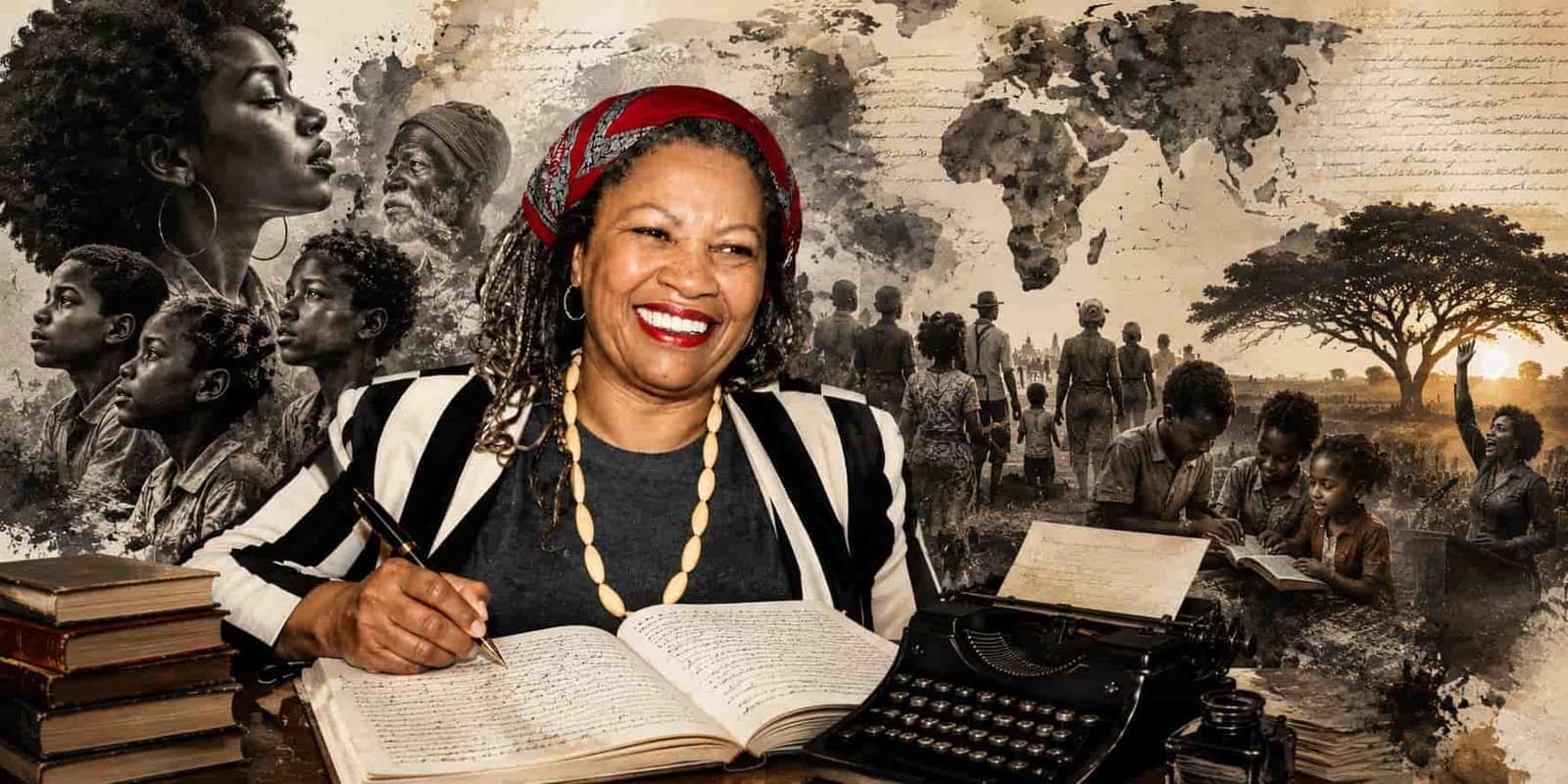
Very few writers in the history of American literature have shaped not just the world of literature but the very direction of a society’s thinking through their pen. Toni Morrison is one of those rare names. Throughout her life, she gave voice through her writing to the injustice, oppression, and marginalisation faced by the Black community. She is regarded as one of the most respected names in American English literature. Over the course of her long literary career, she wrote eleven novels along with children’s literature, plays, and numerous essays, mastering nearly every form literature has to offer. Her writing was never confined merely to storytelling; it became a living document reflecting the pain, resistance, and struggle for existence of an entire community.
Toni Morrison was born on 18 February 1931 in the small town of Lorain, Ohio, in the United States. Her original name was Chloe Ardelia Wofford. She was the second of four siblings. Although Lorain was a relatively mixed town, the shadow of racial discrimination loomed over every Black family in those times. As a young girl, Chloe witnessed with her own eyes the mob violence and discrimination inflicted upon Black people. Her own family, too, bore the brunt of this inhuman treatment; her father had faced similar violence himself. An incident that occurred when Toni was barely two years old remained etched in her memory for the rest of her life — because the rent could not be paid on time, the landlord set fire to the very house they lived in, while the family was still inside. Yet the family that survived this horrifying ordeal did not give up. On the contrary, reading, storytelling, and music always held a place of honour in their household. The elders in the family would tell the children folk tales, fantastical stories, and mysterious experiences drawn from African-American tradition. It was this very environment that later lent Toni’s writing its distinctive mystical and poetic radiance.
Toni developed an extraordinary love for reading during her school years itself. She later pursued her undergraduate education in the humanities at Howard University in Washington, D.C. It was during this period that she acquired the nickname “Toni,” which would go on to become her permanent literary identity. After Howard University, she completed her postgraduate studies at Cornell University. Once her education was complete, she stepped into the field of teaching, working as a professor at Texas Southern University and later once again at Howard University. Around this time, she married Harold Morrison, with whom she had two children. However, the marriage did not last long, and the couple eventually separated.
After her marriage, Toni began working as an editor at the renowned publishing house Random House. This work was, for her, far more than a means of livelihood it became a veritable university that deepened her understanding of the literary world. As an editor, she brought the works of many Black writers into the light of publication. It was also during this very period, while she was still at the university, that she began her own writing career. Building on a short story, she wrote a novel titled “The Bluest Eye.” Notably, by the time her first novel was published, she was already thirty-nine years old. Rather than working as a full-time writer throughout her life, she combined editorial work with writing a fact worth particular note.
“The Bluest Eye” did not attract much attention when it was first published, but a few years later, the City University of New York included it in the curriculum of its Black Studies department. This brought the novel considerable popularity and a marked increase in sales. Following this success, Toni never looked back. Within a few years, her second novel, “Sula,” was published. It received a nomination for the National Book Award and was widely praised by critics. Her third novel, “Song of Solomon,” which followed soon after, established Toni’s own distinct place in the world of American literature. This novel was honoured with the National Book Critics Circle Award and brought her wide-ranging national recognition.
In the years that followed, she wrote “Tar Baby,” a novel that examines the complex entanglements of race and class. Around this time, she also served as a writer-in-residence at the State University of New York. In 1989, she accepted a professorship at Princeton University, where she continued to teach for many years thereafter.
Toni Morrison’s most widely discussed and celebrated novel is “Beloved.” Set in the period following the American Civil War, the story centres on a woman who escapes slavery and flees from Kentucky to seek refuge in the free state of Ohio. Based on a true incident, the novel portrays with tremendous power both the brutal reality of slavery and the desperate anguish of motherhood. Published in 1987, the novel was honoured in 1988 with the Pulitzer Prize and the American Book Award. It remained at the top of The New York Times bestseller list for a full twenty-five weeks. Later, in a 2006 survey conducted by The New York Times, “Beloved” was chosen as the finest American novel of the preceding twenty-five years, a recognition that underscores the immense literary significance of this work. A film was later made based on the novel “Beloved,” in which Oprah Winfrey played the lead role. The film continued to draw audiences in American cinemas for years. Toni subsequently also wrote the librettoLibrettoThe text of an opera or other long vocal work. for the opera “Margaret Garner,” based on the real life of the woman who inspired the novel’s protagonist, revealing yet another dimension of her creative range.
In 1992, Toni’s novel “Jazz” was published, woven around violence and intense love set in the Harlem neighbourhood of New York during the 1920s. That same year also saw the publication of her critical work “Playing in the Dark.” Together, these two works bore witness to both the creative and intellectual dimensions of her work. Barely a year after this success, in 1993, Toni Morrison was honoured with the Nobel Prize, literature’s highest accolade. She became the first African-American woman to receive this award. The Nobel Committee described her novels as works characterised by visionary power and poetic depth, which bring to life an essential aspect of American reality. In her Nobel lecture, Toni offered a deeply moving reflection on the power of language. Narrating the allegoryAllegoryA story, poem, or picture that can be interpreted to reveal a hidden meaning, typically a moral or political one. of a blind old Black woman, she posed the question of whether their lives had no context at all — no story, poem, or history to carry them forward and give them strength. This question was not confined merely to that allegorical tale; it represented the broader search of the entire Black community for its cultural existence.
Even after the Nobel Prize, the stream of honours accorded to Toni did not cease. In 2000, she was awarded the National Humanities Medal. In 2012, then-U.S. President Barack Obama honoured Toni Morrison with the Presidential Medal of Freedom, the nation’s highest civilian honour, in recognition of her contribution to literature and her powerful portrayal, through her writing, of the voice of the oppressed and labouring classes. In 2015, the National Book Critics Circle honoured her with a lifetime achievement award, and to this day, the organisation continues to present the “Morrison Award” in her memory.
The core of Toni Morrison’s writing revolved consistently around the world of experience of the Black community, and particularly of Black women. Speaking of her literary role, she would say with great pride that her entire body of work was centred on the oppressed, labouring, and suffering Black people. She deliberately refused the established convention of treating the white reader as the central audience of literature. Her decision to place non-white characters not merely in the background but at the very centre of her narratives is regarded as a revolutionary step in American literature. Critics hold that Toni, who had studied the writing style of William Faulkner, elevated the American experience to almost mythic heights through her extraordinary imagery and deeply moving language.
Even while working as an editor at Random House, she brought to light the works of numerous Black thinkers and writers this too is regarded as an important example of her social commitment. She held the firm conviction that writing was not merely a tool of individual expression but a medium for awakening and preserving the collective memory of an entire community.
Even after receiving the Nobel Prize, Toni Morrison’s pen never rested. In 1997, “Paradise” was published, a novel that reflects on the complex social relationships within an imagined Black settlement. “Love” was published in 2003, and “A Mercy” in 2008. “A Mercy” explores the intricate social fabric of colonial America in the period before slavery came into existence. In her 2012 novel “Home,” she told the story of a Black soldier returning from the Korean War. Through all these novels, she offered a profound exploration of the Black experience across different periods of American history. Her contribution to the field of literary criticism, too, is regarded as invaluable.
Over the course of her long and rich literary career, Toni Morrison left her mark on the world of American literature for more than six decades. She passed away on 5 August 2019 in a hospital in New York following a brief illness, at the age of eighty-eight. In the statement issued by her family after her death, she was described as a writer who cherished the written word with her whole being. News of her passing came as a great shock to literature lovers across the world, for with her passing, a bold and fearless voice of the Black people had fallen silent.
The life and writing of Toni Morrison are not confined merely to the story of personal success. Her journey from a childhood scarred by fire to the highest literary honour the world has to offer stands as a living embodiment of the human spirit rising through struggle. Through her pen, she proved that when the stories of marginalised communities are told with the right strength and honesty, they cease to belong only to that community and become part of the shared heritage of all humankind. To this day, her novels are studied in universities across the world, and new generations of writers continue to draw inspiration from her style. To this great writer, we offer our humble tribute.
Disclaimer:The views and opinions expressed in this article are those of the author(s) and do not necessarily reflect the official policy or position of The Rift.
*Toni MorrisonAfrican American HistoryAmerican LiteratureBlack AuthorsCivil RightsinfocusNobel Prize