Opening The Rift
therift
© 2026 The Rift. All Rights Reserved.
Islamic Law : Archaic and Obsolete, or Modern and Progressive? Diya’, the ‘Aqila and the Return of the Victim: A Comparative Study
The classical scheme addressed three problems that modern systems confronted much later: victim exclusion, uninsured accidents, and human life valuation.


Key Takeaways
1 of 3
Automatically generated. Read full article for complete context.
We read a lot about Shariah, or Islamic Law : how it is obsolete, outdated, archaic, barbarian… Is it, really? Let us examine it in some depth.
Islamic criminal law is usually judged by its fixed punishments. Tested on the aspects of the charge of archaism on narrower and more measurable ground, the law of homicide compensation, referencing three classical institutions, namely diya’ (compensation for death or injury), the ‘aqila (the solidarity group liable for accidental harm) and the heirs’ election between retaliation, settlement and pardon in intentional killing, reading each against the case law of the Supreme Court of India and the High Courts, against the codified law of Pakistan, the United Arab Emirates, Saudi Arabia and Iran, and against the law of England and Wales, the United States, New Zealand and Canada, we actually realise that the classical scheme addressed three problems that modern systems confronted much later : the exclusion of the victim from the criminal process, the uninsured accident, and the valuation of human life by earning capacity. It also reveals that where the classical scheme fell short, particularly in the ostensibly unequal valuation of women and non-Muslims and in the risk that private settlement becomes impunity for the powerful, we see that the institutions are neither obsolete nor self-sufficient. They are functional solutions whose value depends on public-law safeguards, and they offer specific lessons for Indian victim compensation law.
[The misleading popular translation “blood money” is itself loaded. The Qur’anic term diya’ denotes a compensation payment to the family of the deceased: Qur’an 4:92. For a modern treatment of the doctrine see Mohammad Hashim Kamali, Crime and Punishment in Islamic Law: A Fresh Interpretation (OUP 2019).]
When a human life is cut short, the loss is more than an abstract moral event. The deceased can no longer support dependants, work, serve others or add to the common welfare. When a legal system allows money to be paid for that loss, it invites an obvious objection: that it places a price on what cannot be priced. Critics of Islamic law often cite diya’, commonly translated as “blood money”, as evidence that the system belongs to a tribal past.
This is not a general article on Islamic criminal law, whose fixed punishments raise other distinct questions. It confines itself to the law of homicide compensation, where the classical rules can be compared, institution by institution, with modern statutes and judgments. Three institutions are examined: diya’; the ‘aqila, the group that bore liability for accidental killing; and the right of the heirs, in a case of intentional killing, to choose between retaliation (qisas), settlement (sulh) and pardon (‘afw).
The comparison has a particular interest for us Indian lawyers. Until the Indian Penal Code came into force in 1862, the law of homicide administered in the Bengal Presidency was, in form, the Hanafi law of the Hedaya, translated into English by Charles Hamilton in 1791 on the orders of the Governor-General in Council. One of the first things the colonial administration changed was the heirs’ power to remit the sentence of death. The present Indian rule that murder cannot be compounded is therefore partly the product of a deliberate colonial choice, and not simply a neutral mark of modernity.
The article proceeds to set out the classical architecture, examine accidental killing and the ‘aqila against modern insurance and no-fault schemes, examines intentional killing and the victim’s place in the criminal process, compares diya’ with wrongful death damages, checks how Pakistan, the UAE, Saudi Arabia and Iran have codified diya’, and proceeds to state the strongest objections ending with conclusions, including proposals for Indian law.
A. The Classical Textual foundations
The Qur’anic foundation is found in three passages. Verse 2:178 prescribes legal retribution for those murdered and then provides: “But whoever overlooks from his brother anything, then there should be a suitable follow-up and payment to him with good conduct. This is an alleviation from your Lord and a mercy.” The following verse gives the rationale for retaliation: “And there is for you in legal retribution [saving of] life, O you [people] of understanding.” Verse 4:92 deals with accidental killing and requires “a compensation payment presented to his family, unless they give [up their right as] charity.”
Two features of these texts shape everything that follows. Retaliation is stated as a right of the victim’s family, and forgiveness is presented as a mercy and an alleviation. The measure of diya’ was fixed by the Prophetic tradition at one hundred camels for a life. The same body of reports records the conversion of that measure into gold and silver for town-dwellers, which is the origin of the modern practice of expressing diya’ as a monetary sum.
B. The classification of homicide
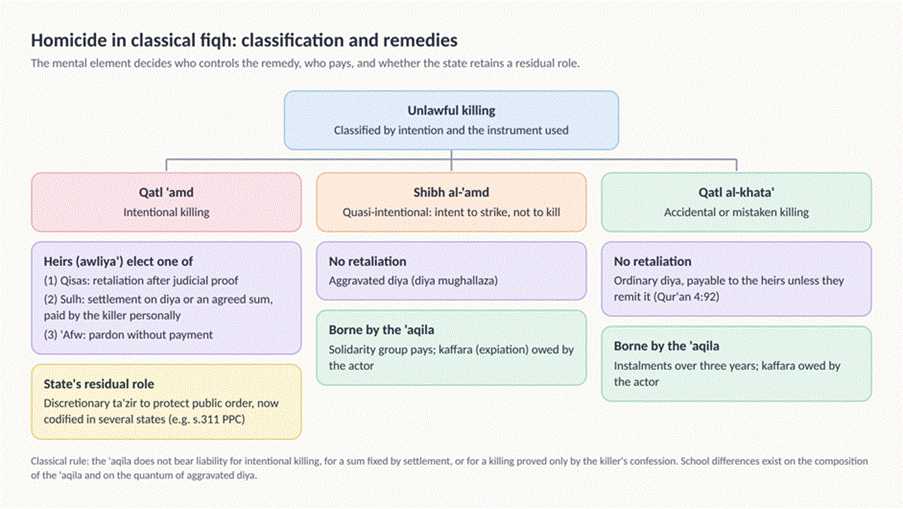
Classical jurists classified unlawful killing by the actor’s mental state and, as evidence of it, the instrument used. The majority recognised three categories: intentional killing (qatl ‘amd), quasi-intentional killing (shibh al-‘amd), in which the actor intended to strike but not to kill, and accidental or mistaken killing (qatl al-khata’). Retaliation was available only for intentional killing. For the other two categories the remedy was diya’, in an aggravated form for quasi-intentional killing, together with an act of expiation (kaffara) owed by the actor to God. The chart below sets out the scheme.
C. Two kinds of right
Classical jurisprudence distinguished between the claims of God (haqq Allah), which correspond broadly to the public interest, and the claims of persons (haqq al-adami). Homicide and wounding were placed predominantly in the second category. The heirs, not the ruler, were the claimants; they could insist on retaliation, accept compensation or forgive. The ruler nevertheless kept a discretionary power to punish (ta’zir) in order to protect public order, a power whose scope varied between schools and periods. The distinction matters because it answers, in advance, the most common objection to the scheme: that it privatises murder. The classical law privatised the remedy, but it did not wholly surrender the public interest.
D. The ‘aqila
In accidental and quasi-intentional killing, diya’ was payable not by the actor alone but by his ‘aqila. In the older doctrine this was the agnatic kin, which Peters describes as the actor’s “solidarity group”, usually his agnatic male relatives. The Hanafi school identified the ‘aqila with the ahl al-diwan, the men enrolled on the army register and paid from it, where such a register existed. Hanafi jurists attributed this rule to the second caliph, ‘Umar ibn al-Khattab. Recent scholarship argues that deducting blood money from stipends began under the Umayyads, and that the Hanafis, the only school to adopt it, legitimised the practice by attributing it to ‘Umar. Either way, the institution changed from a kinship obligation into an administrative pool.
Payment was spread over time. Malik records that blood money was divided into instalments over three or four years, and states that three was his preference. Classical doctrine also excluded certain liabilities from the ‘aqila: it did not bear liability for intentional killing, for a sum agreed in settlement, or for a killing proved only by the actor’s own confession. Each exclusion guards against a specific risk: that the group would subsidise deliberate violence, or pay for a collusive settlement or confession to which it was not a party.
Accidental Killing: Spreading the Loss
A. The case against punishing the careless actor
In an accidental death, the loss of the deceased’s future cannot be undone. Imprisoning the actor adds a second loss. It removes a second earner and may leave a second family in hardship, without deterring anyone who did not intend harm in the first place. The classical scheme did not punish the careless actor. It imposed a significant money liability, which gives the community a reason to take care, and directed the money to the family of the deceased, whose need is immediate.
Modern Indian law takes a different path. Causing death by a rash or negligent act is an offence punishable with imprisonment of up to five years and fine, and compensation is pursued in a separate civil or quasi-civil forum. Yet the most important Indian compensation scheme for accidental death has moved in the classical direction. Since 1 April 2022, section 164 of the Motor Vehicles Act 1988 has required the owner or insurer to pay a fixed sum of five lakh rupees on death and two and a half lakh rupees on grievous hurt, and the claimant “shall not be required to plead or establish” any wrongful act, neglect or default. Victims of hit-and-run accidents receive a fixed sum from the Motor Vehicle Accident Fund. The Supreme Court described the earlier structured-formula remedy under section 163A as “a social security scheme. It is a code by itself”. A fixed sum, payable without proof of fault, from a pool rather than from the actor’s own pocket, is in substance the classical accidental diya’ paid by the ‘aqila.
B. From kinship to contract to social insurance
The ‘aqila and modern third-party liability insurance respond to the same risk: a single careless act that causes death creates a liability large enough to ruin the actor while leaving the bereaved family unpaid. Guido Calabresi called the response “loss spreading”: the cost of an accident is least harmful when it is spread thinly across many people and over time. The ‘aqila spread the loss across a group and over three years. England made third-party motor insurance compulsory by the Road Traffic Act 1930, and India made the same choice in the Motor Vehicles Act.
India applied the same logic to industrial hazards. After the oleum gas leak in Delhi, the Supreme Court held that an enterprise engaged in a hazardous activity is “strictly and absolutely liable”, without the exceptions available under Rylands v Fletcher, and that compensation “must be co-related to the magnitude and capacity of the enterprise because such compensation must have a deterrent effect”. Parliament followed with the Public Liability Insurance Act 1991, which requires compulsory insurance before any hazardous substance is handled, grants relief without proof of fault, and creates an Environment Relief Fund. The two Indian responses point in different directions. MC Mehta ties compensation to the defendant’s wealth for deterrent effect; the 1991 Act, like diya’, fixes a uniform sum for immediate relief.
New Zealand went furthest. The Woodhouse Report of 1967 recommended a scheme resting on five principles, the first of which was “community responsibility”, and the Accident Compensation Act 1972 abolished the action for damages for personal injury from 1 April 1974 in favour of a publicly funded no-fault scheme. The present Act provides that “No person may bring proceedings independently of this Act … for damages arising directly or indirectly out of” personal injury covered by it. If the ‘aqila has a modern descendant, it is this scheme rather than commercial insurance. Both treat accidental harm as a cost of living together, to be borne by the community rather than by the unlucky individual. The chart below compares the three models.
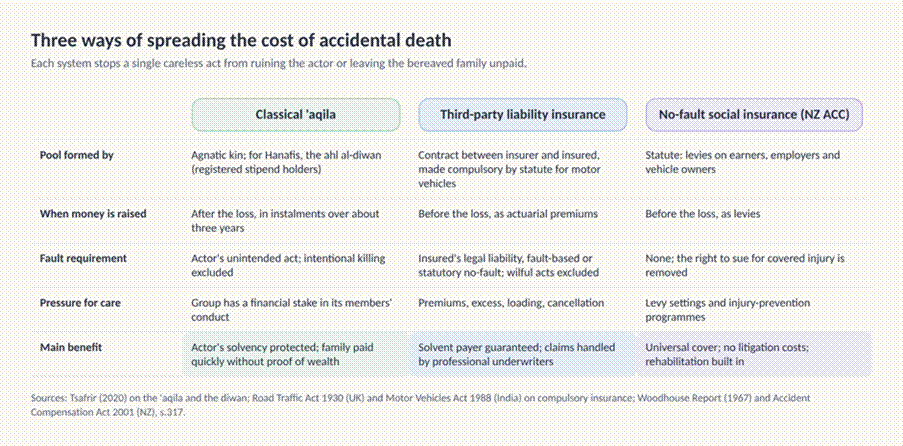
The link between the ‘aqila and Islamic cooperative insurance (takaful) is not only a modern scholarly observation. The International Islamic Fiqh Academy approved cooperative insurance in 1985, and in 2005 it defined the ‘aqila as the relatives or “the group committed to mutual support and solidarity among its members”, recognising that where kinship groups no longer exist, takaful insurance, professional associations and institutional funds may serve as the ‘aqila. A note of caution is needed. To say that the ‘aqila “anticipated” insurance is a claim about function, not about intention. The jurists who developed the doctrine did not conceive of actuarial risk pooling, and Tsafrir’s history shows that the administrative ‘aqila was a political adaptation as much as a doctrinal one.
Intentional Killing: Retribution, Settlement and Pardon
A. The classical election
In intentional killing the classical law makes retaliation the default sanction, justified in the Qur’an by its deterrent effect: “in legal retribution [there is saving of] life”. But the choice belongs to the heirs. They may insist on retaliation after judicial proof, accept compensation by settlement, or forgive. Compensation in intentional killing is paid by the killer personally, never by the ‘aqila. It is not a right of the killer, who cannot insist on paying instead of facing retaliation. It is a concession that only the heirs can make.
The rationale can be stated in terms a modern lawyer would recognise. Executing the killer vindicates the value of the lost life, but it does nothing for the widow and children left without support. By allowing the heirs to choose compensation or pardon, the law lets the people most affected decide which outcome best serves their own recovery and security. Money does not purport to equal the life lost. It limits the compounding of harm and preserves as much welfare as possible in a situation that is already damaged.
B. The modern monopoly and its critics
The common law developed on the opposite premise. Blackstone defined crimes as “a breach and violation of the public rights and duties, due to the whole community, considered as a community, in its social aggregate capacity”, in contrast to private wrongs, which he called “civil injuries”. On that view the victim is, in the criminal court, a witness. In 1977 Nils Christie argued that modern criminal justice had taken conflicts away from the parties directly involved and made them the property of lawyers and the state. Howard Zehr’s work on restorative justice gave the critique a programme: crime is to be understood first as harm to people and relationships, and justice as the repair of that harm.
International law followed. The United Nations Declaration of Basic Principles of Justice for Victims of Crime and Abuse of Power of 1985 provides that offenders “should, where appropriate, make fair restitution to victims, their families or dependants”, and that the state should provide compensation “when compensation is not fully available from the offender or other sources”, including to the families of persons who have died. The Economic and Social Council adopted Basic Principles on the use of restorative justice programmes in criminal matters in 2002, and the European Union’s Victims’ Rights Directive provides for safeguards in restorative justice services and for a decision on compensation from the offender in the course of criminal proceedings.
National courts moved in the same direction. The Supreme Court of the United States held in 1987 that victim impact statements were inadmissible in capital sentencing, and reversed itself four years later: “The Eighth Amendment erects no per se bar prohibiting a capital sentencing jury from considering ‘victim impact’ evidence”. Congress later enacted a Crime Victims’ Rights Act, including a right to “full and timely restitution”. In England and Wales the Victims’ Code gives victims the right to make a Victim Personal Statement, the Victims and Prisoners Act 2024 places the Code on a statutory footing, and criminal courts may order an offender to pay compensation, including for funeral expenses or bereavement where the offence caused death. In Canada, the Supreme Court read the sentencing principle in section 718.2(e) of the Criminal Code as remedial and linked it to restorative approaches to sentencing. None of these systems gives the family control over the outcome. They give it a voice.
C. India: voice without control
The Indian story begins with the colonial encounter described in Part I. According to the Law Commission of India, Cornwallis’s Regulation of 3 December 1790, followed by Bengal Regulation IX of 1793, made the weapon used irrelevant to proving intention and took away the discretion of the victim’s next of kin to remit the sentence of death. The practice of commuting blood money into imprisonment followed in 1797. The victim’s family was thus removed from the decision long before the Penal Code.
The modern law keeps that position for murder. Murder is not among the compoundable offences, and the Supreme Court has held that the High Court’s inherent power to quash proceedings on a settlement does not extend to serious offences: “In respect of serious offences like murder, rape, dacoity, etc; or other offences of mental depravity … the settlement between offender and victim can have no legal sanction at all.” Offences of attempted murder are treated as generally heinous, though the court may look at the nature of the injury and the weapon.
Within that frame, however, the Supreme Court has built a substantial body of victim-centred law. As early as 1988 it described compensation to the victim as “a measure of responding appropriately to crime as well of reconciling the victim with the offender. It is, to some extent, a constructive approach to crimes.” The language of reconciliation is the language of sulh. In 2013 the Court held that section 357 of the Code “confers a power coupled with a duty” on courts to consider compensation in every criminal case, and that there is “a mandatory duty on the Court to apply its mind to the question in every criminal case”. It later directed interim compensation from the moment of cognizance, and awarded ten lakh rupees under the state victim compensation scheme for two deaths. That scheme itself was introduced by section 357A in 2009 and is now section 396 of the Bharatiya Nagarik Suraksha Sanhita.
The Court has also given victims procedural standing. It held that a victim may appeal against an acquittal without seeking leave, observing that “The rights of victims, and indeed victimology, is an evolving jurisprudence and it is more than appropriate to move forward in a positive direction”. It has warned that “One cannot afford to treat the victim as an alien or a total stranger to the criminal trial”. Most significantly, it held in 2022 that a victim “has a legally vested right to be heard at every step post the occurrence of an offence”, with “unbridled participatory rights from the stage of investigation till the culmination of the proceedings in an appeal or revision”.
The High Courts have tested how far this can go. A Full Bench of the Delhi High Court in Karan v State (NCT of Delhi) required convicted persons to file affidavits of their income and assets and directed the Delhi State Legal Services Authority to prepare a Victim Impact Report to guide the award of compensation. In 2025 a Bench of five judges held that those guidelines were no longer operative, because the computation of compensation is the trial court’s own duty and cannot be delegated, and because compelling an accused person to disclose assets infringes constitutional and statutory rights. The Kerala High Court, by contrast, has read the victim compensation scheme liberally, holding that “A beneficial legislation/scheme cannot distinguish between victims of crimes”.
The resulting position can be summarised simply. Indian law gives the victim’s family compensation and a voice, but no control over the outcome. The chart below places India and the other systems on a spectrum from state monopoly to family control.
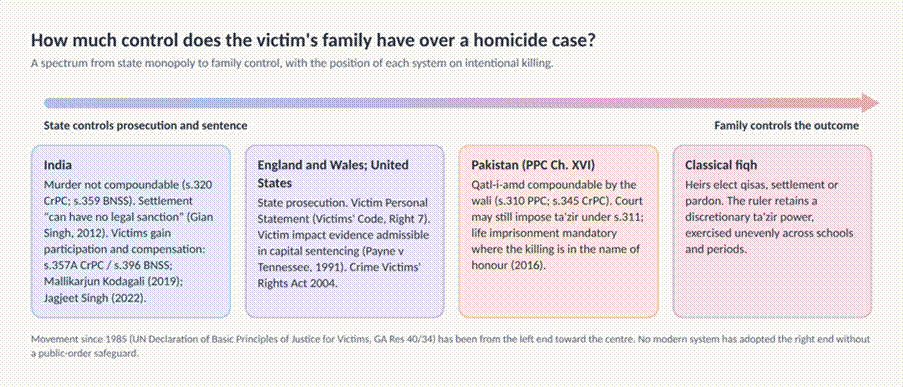
The comparison exposes a real difference of principle. The modern trend, in India and elsewhere, is to restore the victim’s voice while keeping control with the state. The classical scheme gives the family control, subject to the ruler’s residual power. Which is preferable depends on how far one trusts the family’s choice to be free, a question Part VII takes up.
Diya’ and Wrongful Death Damages
Diya’ and wrongful death damages both answer the loss of a life with money, but they rest on different premises. Modern tort law is an individualised compensatory regime kept separate from the criminal process. Classical diya’ combines restitution, communal liability and a penal function. Table 1 sets out the main differences.
Table 1. Diya’ and wrongful death damages compared
| Feature | Diya’ (classical fiqh) | Wrongful death damages (tort) |
| Nature | Mixed: private restitution with a penal and deterrent function | Civil: redress for a private wrong, separate from criminal punishment |
| Measure | Fixed sum (100 camels, now a statutory figure) | Individual: income, age, multiplier and dependency (Sarla Verma; Pranay Sethi) |
| Who pays | In accidental killing, the ‘aqila; in intentional killing, the killer | The wrongdoer, usually through an insurer or employer |
| Effect on criminal case | In intentional killing, acceptance replaces retaliation | None: civil and criminal proceedings run independently |
| Who receives | Heirs, by shares of inheritance (fara’id) | Dependants and legal representatives, by loss of dependency and conventional heads |
A. A standard sum or individual loss
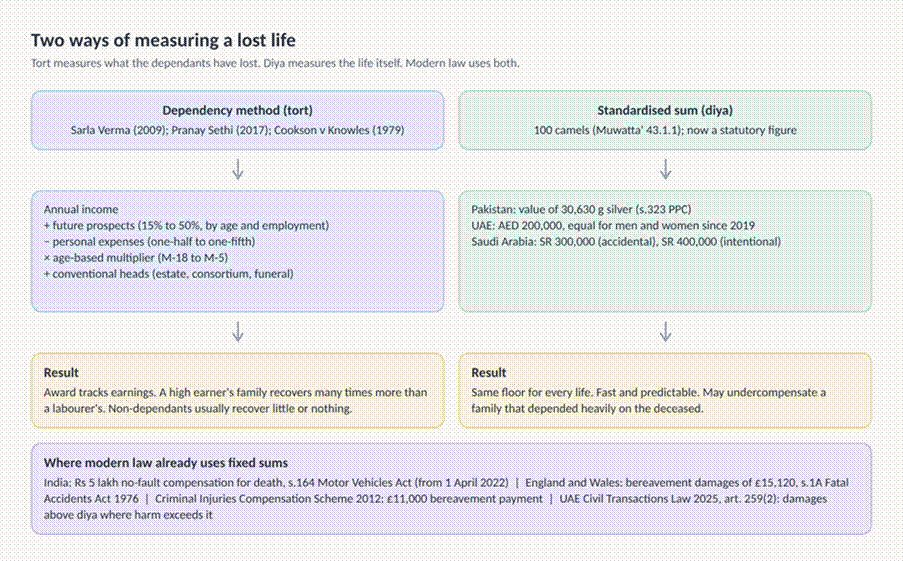
Indian courts assess death claims by the multiplier method. Sarla Verma v Delhi Transport Corporation fixed the deductions for the deceased’s personal expenses and an age-based table of multipliers running from 18 to 5. A Constitution Bench in National Insurance Co Ltd v Pranay Sethi added percentages for future prospects according to age and employment, and fixed the conventional heads: “Reasonable figures on conventional heads, namely, loss of estate, loss of consortium and funeral expenses should be Rs 15,000, Rs 40,000 and Rs 15,000 respectively. The aforesaid amounts should be enhanced at the rate of 10% in every three years.” English law uses the same method.
The method is rational, but its consequence is plain. The family of a high earner recovers many times what the family of a labourer recovers for the same death. The award reflects and reproduces the inequalities of the labour market. The September 11th Victim Compensation Fund in the United States calculated awards largely on economic loss, with a presumed non-economic award of 250,000 dollars for each deceased victim and 100,000 dollars for the spouse and each dependant. Its Special Master, Kenneth Feinberg, later concluded that families would have been treated more fairly if all had received the same amount, and was reported as saying: “A better approach might be to provide the same amount for all eligible claimants.” That is, in substance, the principle of diya’.
Modern law already uses fixed sums where it wishes to recognise the loss of life itself rather than the loss of income. In England and Wales, bereavement damages under the Fatal Accidents Act are a single statutory sum: “the sum to be awarded as damages under this section shall be £15,120”. After the Court of Appeal declared the exclusion of cohabitants incompatible with the European Convention, the class of claimants was widened, but the sum remained fixed. The Criminal Injuries Compensation Scheme pays a tariff award of £11,000 to a single qualifying relative of a person killed by crime. In India, the conventional heads fixed in Pranay Sethi and the five lakh rupee award under section 164 of the Motor Vehicles Act are standard sums of the same kind. The chart below sets the two methods side by side.
B. Who pays
The ‘aqila and its modern counterparts were examined in Part III. The difference that remains is one of principle. In tort, liability stays legally anchored to the individual wrongdoer, with the insurer standing behind him by contract. In the classical law of accidental killing, liability rests on the group from the outset.
C. Relation to the criminal process
In modern systems the criminal court tries the offender to protect the public, and the family must pursue compensation separately or seek an order ancillary to the sentence. Indian courts have supplemented private remedies with public law compensation where the state itself is at fault, “a remedy available in public law, based on strict liability for contravention of fundamental rights to which the principle of sovereign immunity does not apply”. Payment has no formal bearing on prosecution or sentence. In the classical law of intentional killing, by contrast, payment by settlement disposes of the claim to retaliation, and changes the course of the criminal case.
D. Inheritance or dependency
Wrongful death statutes direct compensation to those who have lost support. An adult sibling who did not depend on the deceased usually recovers nothing. Diya’ passes to the heirs according to the Qur’anic shares, whether or not a particular heir depended on the deceased. Here too the two systems are converging. The Supreme Court of India has recognised spousal, parental and filial consortium, and in Magma General Insurance Co Ltd v Nanu Ram awarded consortium to the father and the sister of an unmarried young man: “The greatest agony for a parent is to lose their child during their lifetime.” A three-judge bench later held that loss of love and affection is comprehended in consortium and is not a separate head. Consortium compensates relationship, not income, and so moves Indian law some way toward the classical premise that the loss of a family member is itself compensable.
Codification in other modern States
The codification of diya’ in states with a modern criminal justice system shows the friction that arises when a private-right scheme enters a system built on state prosecution. It also shows how that friction has been managed.
A. Pakistan
In Federation of Pakistan v Gul Hassan Khan the Shariat Appellate Bench of the Supreme Court held the provisions of the Pakistan Penal Code on homicide and hurt to be repugnant to the injunctions of Islam. The government responded with the Criminal Law (Second Amendment) Ordinance of 1990, popularly known as the Qisas and Diya’t Ordinance, which was re-promulgated many times until Parliament enacted it as Act II of 1997.
The resulting Chapter XVI of the Penal Code fixes diya’t at the value of not less than 30,630 grams of silver, notified by the Federal Government each financial year. The heirs (wali) may waive the right of retaliation or compound it on receipt of badal-i-sulh. The state’s residual role is preserved by section 311, which in its present form provides that where all the heirs do not waive or compound, “or if the principle of fasad-fil-arz is attracted, the court may … punish an offender against whom the right of qisas has been waived or compounded with death or imprisonment for life or imprisonment of either description for a term of which may extend to fourteen years as ta’zir: Provided that if the offence has been committed in the name or on the pretext of honour, the punishment shall be imprisonment for life.”
The courts have used this residual power. In one reported case the Supreme Court accepted a compromise but imposed fourteen years’ rigorous imprisonment under section 311, having regard to the principle of fasad-fil-arz. It has held that a so-called honour killing is murder and that nobody may “take law in his own hands to take the life of anybody in the name of ‘Ghairat'”. It has also held that section 311 applies only to murders liable to qisas, so that where qisas is not proved the offender may be punished as ta’zir under section 302(b) whatever the heirs’ wishes. Whether an accepted compromise erases the conviction or only the sentence has divided the Court.
Two cases show why these safeguards matter. In 2011 an American contractor, Raymond Davis, who had shot two men in Lahore, was released after their heirs accepted diya’t reported at 2.34 million US dollars. In the case of the social media personality Qandeel Baloch, killed by her brother in July 2016, the trial court convicted him and sentenced him to life imprisonment in 2019. The Lahore High Court acquitted him in February 2022, relying on defects in his confession, the absence of other evidence that the killing was for honour, the parents’ pardon and hostile witnesses; the 2016 amendment, enacted after the killing, was held not to apply. Where the killer and the heirs belong to the same family, the heirs’ election is not a free choice by the injured party, and the premise of the classical scheme fails.
Commentators have also noted that the Pakistani codification adopted diya’t without the ‘aqila, so that the whole burden falls on the offender, payable in instalments within three years. The codification kept the price and discarded the pool, which was the part of the classical design that made the price bearable.
B. United Arab Emirates
The UAE fixed diya’ for accidental death at AED 150,000 in 1991 and raised it to AED 200,000 in 2003. In 2019 a Federal Decree-Law fixed the sum at AED 200,000 for the deceased, male or female, ending the practice of some courts awarding half for women. The present penal code is Federal Decree-Law No 31 of 2021 on the Crimes and Penalties Law, in force from 2 January 2022.
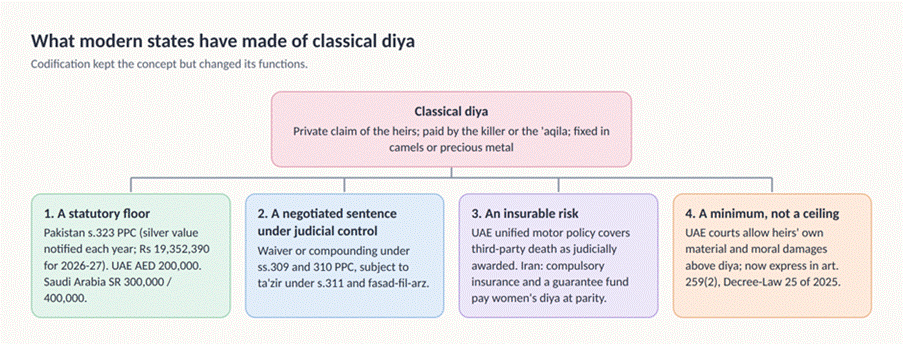
The relationship between diya’ and civil damages has been the subject of litigation. Article 299 of the Civil Transactions Law of 1985 provided that where diya’ or arsh is payable, it “shall not be payable in addition to such compensation unless the parties agree to the contrary”. The cassation courts read that bar as applying only to compensation owed to the deceased for his own harm, and allowed the heirs to claim their own material and moral damages in addition to diya’. The new Civil Transactions Law, in force from 1 June 2026, makes the point express: “the court may, upon the request of the injured party, award compensation if the death or injury results in material and moral harm not covered by the blood money (Diya’h) or Arsh.” Third-party liability for death in motor accidents is covered by the unified motor insurance policy at “the value judicially awarded without any limit”. In practice, therefore, diya’ has become a statutory floor, insured through compulsory motor cover, on which proven additional loss may be built.
C. Saudi Arabia and Iran
Saudi Arabia raised diya’ in 2011, on the recommendation of its Supreme Court, to SR 300,000 for accidental death and SR 400,000 for intentional killing, from figures that had been unchanged for twenty-nine years. In Iran the Head of the Judiciary fixes the amount each year under the Islamic Penal Code of 2013. Following a ruling of the Supreme Court in 2019, the Physical Damages Compensation Fund pays the difference so that a woman’s family receives diya’ equal to a man’s, and the Compulsory Insurance Law of 2016 already required equal payment in traffic cases “without regard to gender or religion”. Iran thus reached equality not by reinterpreting the classical measure but by filling the gap from a public fund: the ‘aqila principle used to correct the inequality of the classical rule.
D. Synthesis
Across these jurisdictions, diya’ has been converted into four modern instruments: a statutory minimum payment; a negotiated disposal of the criminal case under judicial control; an insurable risk carried by compulsory cover; and a floor rather than a ceiling on compensation. The chart below summarises the development. No state that has codified diya’ has left the matter entirely to the heirs. Each has found it necessary to keep, or to strengthen, a public-order power.
The Case Against, and a Reply
A scholarly defence of the classical scheme must meet the strongest objections, not the weakest.
Unequal lives. The claim that classical diya’ treated every life equally is true only within a status class. Maliki doctrine gave a woman’s family the same sum as a man’s for injuries up to one third of the full diya’, and half beyond that. The diya’ of Jews and Christians was fixed by the Umayyad caliph ‘Umar ibn ‘Abd al-‘Aziz at half that of a Muslim, and the schools differed widely, the Hanafis holding it equal. The equality argument made above is therefore an argument for a reinterpreted diya’, of the kind the UAE and Iran have adopted, not for the classical tariff unchanged. (Note I say reinterpreted, not reformed.)
Justice for sale. Where the offender is rich and the heirs are poor, or where the offender and the heirs are the same family, the right to settle can become a right to buy impunity. The Davis and Baloch cases show that this is not a theoretical concern. The reply is not that the risk is imaginary, but that the classical scheme itself contained the answer in the ruler’s residual power, and that modern codifications which have strengthened that power, as Pakistan did in 2016, have reduced the risk. The Indian position in Gian Singh reflects the same concern from the other side.
Adequacy. A fixed sum may be too low for a family that depended entirely on the deceased. The modern answer, visible in the UAE’s 2025 law and in the Indian choice between the no-fault award and a full claim for compensation, is to treat the fixed sum as a floor and to permit proven loss above it.
Anachronism. It is tempting to say that seventh-century jurists “anticipated” restorative justice or social insurance. The claim should be made with care. The classical institutions solved practical problems in their own setting, and their resemblance to modern solutions lies in function, not in intention. That is still a significant finding. It shows that the problems modern law treats as recent were identified and addressed long ago, and that the classical solutions deserve study rather than dismissal.
Conclusion
The question in the title admits of no single answer, but the evidence examined here supports a clear conclusion. On the law of homicide compensation, the classical scheme is not obsolete. Its three central institutions each respond to a problem that modern systems recognised much later. The heirs’ election gave the victim’s family a place in the process that the common law denied it until the victims’ rights movement of the late twentieth century. The ‘aqila spread the cost of accidental death across a community, a principle that modern law rediscovered in compulsory insurance and, most completely, in New Zealand’s accident compensation scheme. The fixed diya’ treated the loss of life as compensable in itself, independently of earnings, a principle that modern law now uses in bereavement damages, criminal injuries tariffs and India’s no-fault motor award.
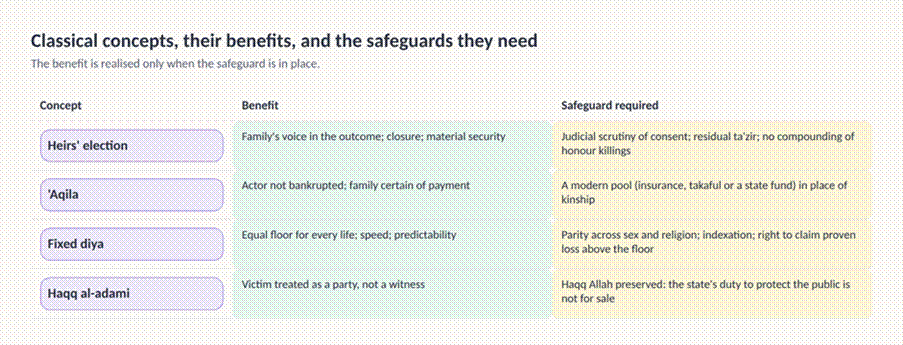
The scheme is not self-sufficient. Its classical form valued some lives less than others, and its private-settlement mechanism can be exploited where the heirs are not free. Its value is realised in full only with public-law safeguards woven into the scheme : parity across sex and religion, indexation, judicial scrutiny of settlements, a real residual power to punish, and a modern pool in place of the kin group. A chart below summarises the relationship between each concept, its benefit and the safeguard it requires.
Three lessons follow for Indian law, none of which requires murder to be made compoundable.
First, the victim compensation schemes under section 396 of the Bharatiya Nagarik Suraksha Sanhita could provide a statutory minimum payment to the family of every homicide victim, indexed in the manner of the conventional heads in Pranay Sethi, and payable without waiting for conviction.
Second, the participatory rights recognised in Jagjeet Singh and Mallikarjun Kodagali could be given structured form at the sentencing stage in murder cases, with the care that the five-judge bench in Saif Ali showed to be necessary.
Third, the no-fault pooling now found in the Motor Vehicle Accident Fund could be extended to other forms of accidental death where the wrongdoer is unknown or cannot pay.
Each proposal draws on an institution the classical jurists developed. None depends on accepting their theology. Each depends only on taking seriously the problem they were trying to solve.
Indian politicians and jurists would do well to sit down for some serious study, instead of mechanically repeating canards.
Jai Hind
Disclaimer:The views and opinions expressed in this article are those of the author(s) and do not necessarily reflect the official policy or position of The Rift.
*Islamic LawAfwAqilaComparative LawDiyaHomicide CompensationIndian LawIranMotor Vehicles ActPakistanQisasSaudi ArabiaSulhUAEVictim Rights