Opening The Rift
therift
© 2026 The Rift. All Rights Reserved.
Aged Parents vs Rogue Children: Property Protection via Private Trust
The real question is whether elderly parents should surrender ownership of their life’s earnings during their lifetime. In many cases, the answer is no. Instead, a Carefully Structured Private Trust May Be the Safest Legal Solution.

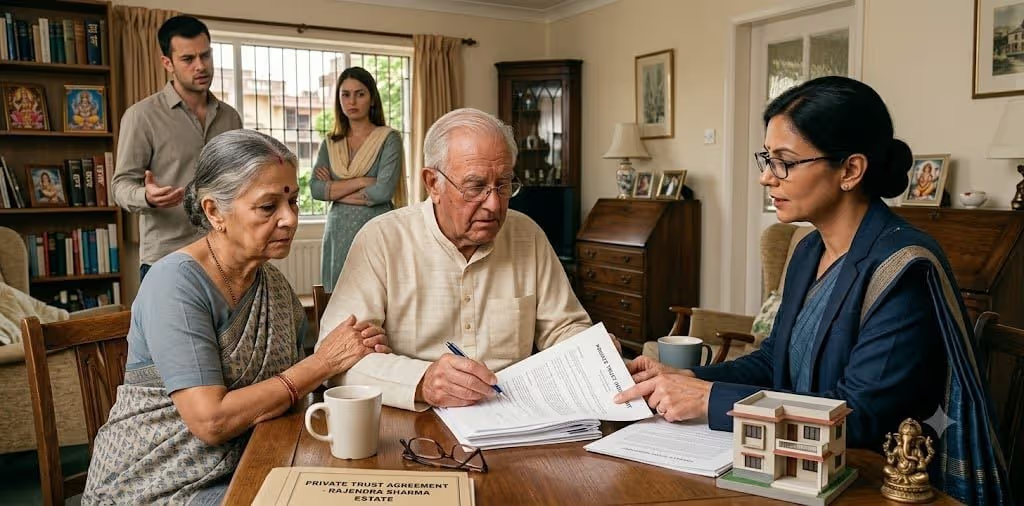
Aged parents seeking legal recourse to safeguard their assets from untrustworthy offspring (Representative Image)
Key Takeaways
1 of 3
Automatically generated. Read full article for complete context.
Every few months, newspapers and social media carry disturbing accounts of elderly parents being dispossessed from the very homes they spent decades building. A widely circulated video recently narrated the story of an elderly father who, out of affection and trust, executed a Gift DeedLegal TransferA legal document transferring ownership of property without monetary consideration, typically out of love and affection. in favour of his only son. Shortly thereafter, he allegedly found himself without control over his own home and was compelled to seek relief under the Maintenance and Welfare of Parents and Senior Citizens Act, 2007. Ultimately, the competent Tribunal and the High Court intervened to protect his rights.
The case illustrates an important truth. The law can sometimes restore rights after they have been lost. Far better, however, is to structure one’s affairs so that those rights are never lost in the first place.
Most children care for their parents with love, respect and gratitude. This article is not written because children are untrustworthy. It is written because circumstances change. Financial pressures arise. Marriages alter family dynamics. Businesses fail. Relationships deteriorate. Human nature is unpredictable. Sound legal planning is intended to protect families from uncertainty, not from one another.
The question, therefore, is not whether parents should trust their children. The real question is whether elderly parents should surrender ownership of their life’s earnings during their lifetime. In many cases, the answer is no.
The Problem with Gift Deeds
Parents frequently execute Gift Deeds because they fear disputes after their death or because they are emotionally persuaded that an immediate transfer is the best course. Unfortunately, a Gift Deed ordinarily transfers ownership immediately. Once ownership passes, control also passes.
Although Section 23 of the Maintenance and Welfare of Parents and Senior Citizens Act, 2007 empowers the competent Tribunal, in appropriate circumstances, to declare certain transfers void where children fail to provide the promised care and basic amenities, litigation is never an ideal retirement plan. The object of estate planning should be to avoid litigation; not merely to succeed in it.
A Will Is Better Than a Gift Deed : But It Is Not Always the Complete Answer
A Will has one important advantage. Ownership remains with the TestatorWill CreatorA person who makes a will, specifying how their property should be distributed after their death. throughout his or her lifetime. The beneficiaries obtain rights only after the testator’s death. However, a Will is not free from legal difficulties.
Contrary to popular belief, a Will need not be registered and need not be executed on stamp paper. Nevertheless, registration is often advisable because it may reduce disputes regarding execution, though registration alone never guarantees validity.
The greater difficulty is that a person may execute several Wills during his lifetime. Ordinarily, the last valid Will prevails.
The question frequently litigated is: Which document is truly the last valid Will?
This problem becomes particularly acute where elderly persons have weak, abbreviated or shaky signatures capable of being imitated or disputed.
A Will must also satisfy statutory formalities. Ordinarily, it must be AttestedWitnessed & CertifiedTo bear witness to a document’s signing, certifying its authenticity by signing as a witness. by two witnesses. Each witness must either see the testator sign the Will or receive from the testator a personal acknowledgment of that signature. Each witness must thereafter sign the Will in the presence of the testator. These are not mere technicalities. They are statutory safeguards intended to prevent fraud, forgery and undue influence. Failure to comply with these legal requirements can defeat an otherwise genuine testamentary intention.
An Important Position Under Muslim Law
For Muslims, a Will is subject to additional limitations under Muslim Personal Law. Ordinarily, a Muslim cannot make a valid bequest in favour of a legal heir unless the other legal heirs consent. Similarly, a Muslim cannot ordinarily dispose of more than one-third of the net estate by Will without the consent of the legal heirs. There is also an important distinction between Sunni and Shia law. Under Sunni law, where the consent of the heirs is necessary, such consent ordinarily becomes effective only after the death of the testator, since no heir possesses a vested interest during the lifetime of the testator.
Under Shia law, consent may also be given during the lifetime of the testator, subject to the applicable principles governing Shia succession. These limitations demonstrate that, particularly for many Muslim families, reliance solely upon a Will may not always accomplish the estate-planning objectives intended by the owner.
The Better Alternative: A Carefully Structured Private Trust
For many families, particularly those wishing to retain complete control over their assets during their lifetime while ensuring orderly succession thereafter, a private trust provides a more comprehensive legal solution. Unlike a Gift Deed, the trust does not require parents to surrender the beneficial enjoyment of their property.
Unlike a Will, the trust operates immediately and provides a framework for management during the lifetime of the settlors. The ideal structure in many cases is straightforward. The husband and wife settle their properties into a private trust. They appoint themselves, together with one or more persons whom they completely trust, as trustees. They remain the principal beneficiaries during their lifetime. Only after both of them cease to be beneficiaries by reason of death do the children, grandchildren, relatives, charitable institutions or any other persons chosen by them become entitled according to the terms of the Trust DeedTrust DocumentA legal document that formally establishes a trust, outlining its terms, conditions, and the roles of the settlor, trustees, and beneficiaries.. Thus, the parents continue to live in their home, receive the income from the property and enjoy every benefit exactly as before. The trust protects them without requiring them to surrender their independence.
A Trust Is More Than a Succession Document
Many people mistakenly think that a trust merely distributes property after death. That is incorrect. A trust is primarily a mechanism for protecting and managing property during life. Its greatest value often emerges when the SettlorTrust CreatorA person who creates a trust by transferring property to a trustee for the benefit of beneficiaries. becomes elderly, infirm or incapable of managing his affairs. Suppose an elderly couple requires expensive medical treatment. Suppose one spouse develops dementia. Suppose immediate funds are required. If the Trust Deed authorises it, the trustees may mortgage trust property, obtain loans, sell assets, reinvest proceeds or otherwise deal with the property strictly in accordance with the Trust Deed for the benefit of the beneficiaries. The property continues working for the elderly persons when they are no longer physically capable of managing it themselves.
Trustees Are Not Owners
One of the greatest legal safeguards provided by the Indian Trusts Act is the FiduciaryTrust-Based RelationshipInvolving trust, especially with regard to the relationship between a trustee and a beneficiary, where one party acts in the best interest of another. character of the office of TrusteeAsset AdministratorA person or entity legally appointed to hold and administer property or assets for the benefit of a third party (the beneficiary).. A trustee does not become the owner of the property for his own benefit. He becomes its legal custodian. Once trustees accept office, they cannot administer the trust according to personal preferences. They must administer it according to the Trust Deed and the Indian Trusts Act. They cannot divert trust property for personal benefit. They cannot disregard restrictions imposed by the Trust Deed. They cannot exercise powers which the Trust Deed does not confer. Conversely, where the Trust Deed requires trustees to perform certain duties, they cannot simply decline to act because those duties have become inconvenient. A trustee committing breach of trust may become personally liable.
Beneficiaries Enjoy Legal Protection
The beneficiaries of a trust are not dependent merely upon the goodwill of the trustees. The law protects their interests. Beneficiaries can enforce proper administration of the trust. Trustees are accountable. They must preserve trust property. They must maintain accounts. They must act honestly, prudently and solely for the benefit of the trust in accordance with its objects. The Trust Deed therefore creates enforceable legal rights rather than mere moral obligations.
The Trust Deed Must Anticipate the Future
The quality of a trust depends upon the quality of its drafting. A properly drafted Trust Deed should anticipate foreseeable contingencies extending over many years. Among other matters, it may provide for:
- illness or prolonged hospitalisation;
- physical or mental incapacity;
- dementia;
- appointment and removal of trustees;
- succession to trusteeship;
- borrowing against trust property;
- sale of trust assets where necessary
- investment of trust funds;
- payment of medical expenses;
- maintenance of beneficiaries;
- education of grandchildren;
- charitable gifts;
- disputes among trustees;
- death or insolvency of beneficiaries;
- divorce or remarriage affecting family arrangements.
The Trust Deed should be drafted not merely for today’s circumstances but for events that may occur twenty or thirty years later.
This includes the possibility that one or both settlors may require medical treatment, may go into a coma, fall and become disabled, etc., and then the trustees can step in to protect their interests, have them treated and so on, accessing their property and/or assets for the purpose which they would not be able to, and which the successor beneficiaries would not be able to since the first level beneficiaries are still alive, and beneficial interest is to pass to the next level, the children, only after the demise of the parents.
Proper Administration Is Essential
Executing the Trust Deed is only the beginning. A trust is a continuing legal institution and must be properly administered throughout its existence. Depending upon the nature of the trust property and the applicable law, further legal and administrative steps may become necessary. These may include transferring or vesting the trust property in accordance with law and, wherever applicable, making appropriate applications for MutationRecord ChangeThe process of changing the title ownership of property in local revenue or municipal records from one person to another. or corresponding changes in municipal or revenue records before the competent authorities, including authorities such as the Greater Hyderabad Municipal Corporation (GHMC), municipal bodies, the District Collector or other revenue authorities, as the nature and location of the property may require.
Proper administration also requires that the trust maintain its own bank account, separate from the personal accounts of the trustees. Trust money should never be mixed with personal funds. Trustees should maintain proper books of account, preserve vouchers and receipts, maintain an inventory of trust assets and record important decisions by passing resolutions and maintaining minutes of meetings. Such records demonstrate transparency, facilitate accountability and substantially reduce the scope for future disputes.
Wherever applicable, statutory filings, taxation requirements and other legal compliances should also be attended to in a timely manner. Good administration is as important as good drafting.
The Court Can Guide Trustees
The Indian Trusts Act contains an important but underutilised safeguard. Section 34 permits a trustee to approach the Principal Civil Court of Original Jurisdiction for its opinion, advice or direction regarding the management or administration of the trust property. This provision is of considerable practical importance. Trustees are not expected to guess the correct legal course when difficult questions arise. Instead, they may seek judicial guidance before taking important decisions. For Hyderabad, the Principal Civil Court of Original Jurisdiction is ordinarily the Court of the Chief Judge, City Civil Court, Hyderabad, subject to the applicable law governing jurisdiction. This statutory mechanism protects both trustees and beneficiaries and promotes responsible administration of trust property.
Conclusion
Parents devote their entire lives to building homes, businesses and savings; not merely as financial assets, but as the foundation of family security and dignity. Those assets should not become the means by which they lose their independence. The law certainly provides remedies after disputes arise. The Maintenance and Welfare of Parents and Senior Citizens Act, 2007 has provided meaningful relief to many senior citizens who were neglected after transferring their property. Yet no litigation, however successful, can fully compensate for the emotional trauma of being compelled to fight one’s own children in court. The wiser course is prevention. While a Gift Deed may prematurely divest parents of ownership, and while a Will remains subject to technical requirements and, for Muslims, important limitations under personal law, a carefully conceived private trust provides a far more comprehensive legal framework.
It enables parents to retain complete beneficial enjoyment of their property throughout their lifetime. It protects them during illness, incapacity and advancing age. It imposes enforceable fiduciary duties upon trustees. It creates legally protected rights in beneficiaries. It permits orderly administration over many years. It provides statutory access to the Court for guidance whenever genuine doubts arise. Above all, it preserves the independence and dignity of elderly persons while ensuring that their life’s work ultimately reaches the persons or causes they genuinely wish to benefit.
Creating a trust is not an expression of distrust towards one’s children. It is an exercise in prudence. Just as prudent people insure their homes without expecting a fire, prudent parents should structure their estates without expecting family discord. The true purpose of estate planning is not merely to preserve wealth. It is to preserve dignity, financial security and peace of mind throughout one’s lifetime while ensuring that one’s property is administered responsibly, lawfully and in accordance with one’s considered wishes.
For many families, a carefully drafted and professionally administered private trust is the most effective legal instrument for achieving that objective.
Estate Planning Instruments: A Comparison
| Feature | Gift Deed | Will | Private Trust |
|---|---|---|---|
| Ownership Transfer | Immediate | After Testator’s Death | Immediate (to Trustees), Beneficial Enjoyment Retained |
| Control Over Assets | Lost Immediately | Retained During Lifetime | Retained (as Beneficiary/Co-Trustee) |
| Litigation Risk | High (post-transfer disputes) | Moderate (validity, multiple wills, attestation) | Low (structured, judicial guidance available) |
| Management During Lifetime | None (owner dispossessed) | By Testator (until death) | By Trustees (for Settlor’s benefit) |
| Flexibility & Contingencies | Low | Limited (only post-death distribution) | High (illness, incapacity, specific conditions) |
| Legal Safeguards | Section 23 MWPSC Act (remedial) | Statutory formalities, personal law limits | Fiduciary duties, beneficiary rights, court guidance |
VISUALS BY THE RIFT
Footnotes
- The Indian Trusts Act, 1882, s. 3 defines a “trust” as an obligation annexed to the ownership of property arising out of a confidence reposed in and accepted by the owner or declared and accepted by him for the benefit of another or of another and the owner.
- Indian Trusts Act, 1882, Chapters II and III (ss. 11–30) enumerate the duties, liabilities, rights and disabilities of trustees, including the duty to execute the trust, protect trust property, maintain accounts, exercise reasonable care and avoid conflicts of interest.
- Indian Trusts Act, 1882, s. 34 empowers a trustee, without instituting a regular suit, to apply by petition to the Principal Civil Court of Original Jurisdiction for its opinion, advice or direction regarding questions respecting the management or administration of the trust property. A trustee acting upon such opinion, advice or direction is deemed, so far as regards his own responsibility, to have discharged his duty in the subject-matter of the application.
- In Hyderabad, the Principal Civil Court of Original Jurisdiction is ordinarily the Court of the Chief Judge, City Civil Court, Hyderabad, subject to the provisions governing territorial and pecuniary jurisdiction.
- The Maintenance and Welfare of Parents and Senior Citizens Act, 2007, s. 23 empowers the competent Tribunal, in appropriate circumstances, to declare void a transfer of property made by a senior citizen where such transfer was subject to the condition that the transferee would provide basic amenities and physical needs to the transferor and the transferee has failed to do so.
- See Mulla, Principles of Mohammedan Law (22nd ed., LexisNexis), Chapters XXIII and XXIV (Wills), discussing testamentary disposition, limitations on bequests and the law governing heirs.
- Under classical Sunni Mohammedan Law, a bequest in favour of an heir is ordinarily invalid unless the other heirs consent after the death of the testator. Mulla, Principles of Mohammedan Law, paras. 118–119.
- Under Mohammedan Law, a Muslim cannot ordinarily dispose of more than one-third of the net estate by Will, after payment of funeral expenses and debts, without the consent of the heirs. Mulla, Principles of Mohammedan Law, paras. 117–118.
- Under Sunni law, the consent of the heirs, where required, ordinarily becomes effective only after the death of the testator because no heir has a vested interest during the lifetime of the testator. Under Shia law, consent may also be given during the lifetime of the testator. See Mulla, Principles of Mohammedan Law, paras. 119–120; Tyabji’s Muslim Law (4th ed.), Chapter on Testamentary Succession.
- The Indian Succession Act, 1925, ss. 63 and 68 of the Indian Evidence Act, 1872 (now s. 67 of the Bharatiya Sakshya Adhiniyam, 2023 where applicable), prescribe the manner of execution and proof of Wills governed by that Act. Although registration of a Will is not compulsory, proper execution and attestation are essential.
- Registration of a Will is optional under the Registration Act, 1908. See Registration Act, 1908, ss. 17 and 18. Registration does not by itself validate an otherwise invalid Will, nor does non-registration invalidate a properly executed Will.
- The Supreme Court has consistently held that where suspicious circumstances surround the execution of a Will, the propounder bears the burden of dispelling such suspicion before Probate or reliance can be granted. H. Venkatachala Iyengar v. B.N. Thimmajamma, AIR 1959 SC 443; Jaswant Kaur v. Amrit Kaur, (1977) 1 SCC 369; S.R. Srinivasa v. S. Padmavathamma, (2010) 5 SCC 274.
- The fiduciary nature of trusteeship is a fundamental principle of the law of trusts. Trustees hold property not for their own benefit but for the purposes declared by the trust and must administer the trust strictly according to its terms and the Indian Trusts Act, 1882. See M.P. Jain, The Indian Trusts Act; B.K. Mukherjea, Tagore Law Lectures on Hindu Law of Religious and Charitable Trusts (for general fiduciary principles).
- Good governance of private trusts ordinarily requires maintenance of separate books of account, preservation of financial records, operation of a dedicated trust bank account and maintenance of trustee resolutions and minutes. Although the Indian Trusts Act does not prescribe a universal accounting format for every private trust, these are recognised principles of sound fiduciary administration and substantially reduce future disputes.
- Depending upon the nature of the trust property and the applicable municipal, revenue and local laws, consequential applications for mutation or corresponding changes in revenue or municipal records may be necessary before the competent authorities. Such requirements vary according to the State, the nature of the property and the governing statutory framework.
- Every Trust Deed should be drafted keeping in view not only the Indian Trusts Act, 1882, but also the applicable personal law, taxation statutes, the Registration Act, 1908, the Stamp Act applicable to the State concerned, municipal laws, succession law and other legislation governing the particular property settled upon the trust.
Final remark: before you implement any of this, go discuss it with your lawyer.
Disclaimer
This article is intended for legal awareness and public education only. It is not a substitute for legal advice. Estate planning depends upon numerous variables, including the nature of the property, title documents, personal law, family structure, taxation, stamp duty, municipal and revenue regulations and the objectives of the owner. Every case is different. Before executing a Gift Deed, Settlement Deed, Will, Trust Deed, Power of Attorney or any other document affecting valuable property rights, consult a qualified advocate after placing before him or her all the relevant facts and documents. There is no “one-size-fits-all” solution in property law.
Jai Hind
Disclaimer:The views and opinions expressed in this article are those of the author(s) and do not necessarily reflect the official policy or position of The Rift.