Opening The Rift
therift
© 2026 The Rift. All Rights Reserved.
The Wider Reality Missing in Most Discourse on Wars
A critical look at the normalization of violence, the lucrative business of conflict, and the urgent need for a sincere global peace movement.

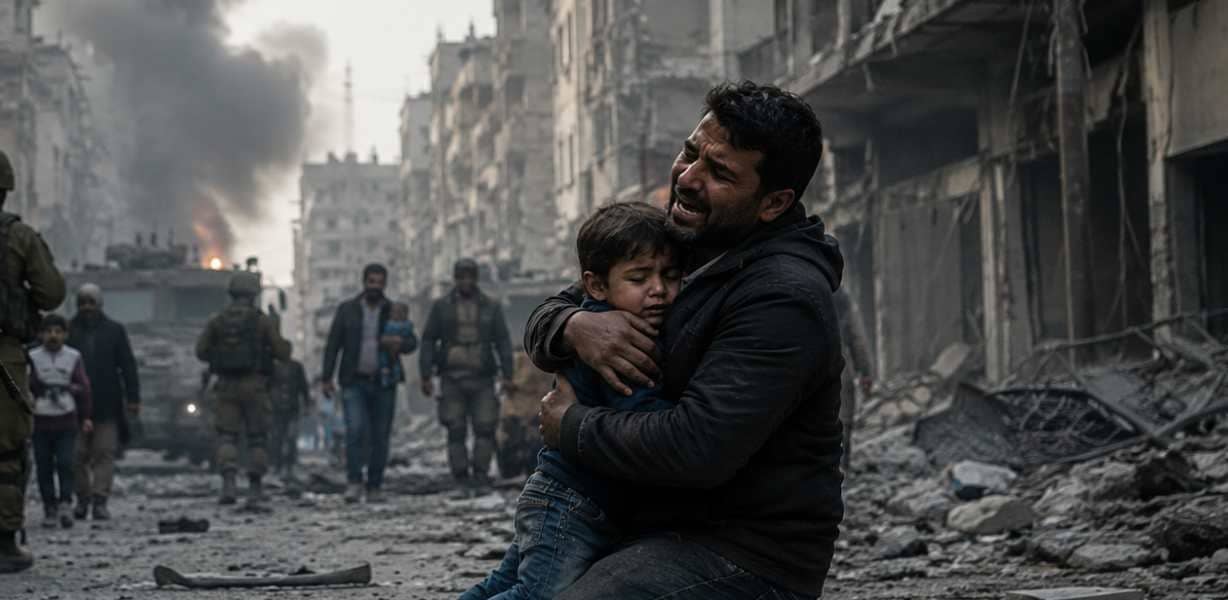
Representative Image
Key Takeaways
1 of 3
Automatically generated. Read full article for complete context.
Increasing concern has been expressed in recent times regarding the several dangerous ongoing wars and civil wars and the possibilities of their escalation and expansion. While any discourse motivated by peace objectives is most welcome, we argue here that a lot of recent discussion may be missing out on a wider and very important reality that has two important aspects. Firstly, human society may be becoming more of a violent society with intolerably high levels of physical and emotional violence, which in turn helps in the emergence of the kind of leadership which follows a more aggressive and violent agenda. Secondly, very powerful and resourceful lobbies have emerged that want some wars or the other to continue for their narrow and selfish reasons and are willing to spend vast amounts of money on media and think tanks to push for wars. A combination of these two factors creates conditions in which wars become more likely and are likely to continue for longer periods. Hence regardless of the more specific conditions of this war or that war, a broader reality is that overall conditions are more favorable for increasing wars and violence.
The number of people who are victims of violence is in the hundreds of millions in any given year. As ‘WHO Violence InfoWHO Violence InfoA comprehensive database maintained by the World Health Organization that collates global, regional, and national data on interpersonal violence.—A global knowledge platform for preventing violence’ tells us, “Globally some 475,000 people are victims of homicide every year. Hundreds of millions more men, women and children suffer non-fatal forms of interpersonal violence, including child maltreatment, youth violence, intimate partner violenceIntimate Partner ViolenceBehavior by an intimate partner or ex-partner that causes physical, sexual, or psychological harm., sexual violence and abuse of older people, with many suffering multiple forms (of violence)…Violence blights the lives of individuals for decades. Beyond death, physical injury and disability, violence can lead to stress that impairs the development of the nervous system and the immune system.”
475,000 — The number of people globally who are victims of homicide every year, according to WHO Violence Info.
If we add robbery-related assaults then the number of victims of violence increases further. Also we must remember that in each act of violence not only the direct victim of violence but also several near and dear ones of the victim are acutely distressed ( for example the parents of a victim or children of a victim).
Further it is important to add that physical acts of violence may be outnumbered significantly by the daily emotional violence which may involve no physical injury at all but nevertheless harms its victims greatly on a short-term as well as long-term basis. Emotional violence is more likely to be a long and continuing process. This is closely related to all social relationships based on dominance.
Each act of violence involves not just the victim but also the perpetrator. It is important to realize that while acts and attitudes of violence clearly harm the victims, these also harm the perpetrators as in the course of committing the violence the perpetrator is reduced, hollowed and loses the human sensitivity that is so essential for good and meaningful relationships.
It has also been seen that acts of violence tend to be repeated in terms of leading to more victims and perpetrators in future.
Acts of violence also involve injustice and generally the perpetrator of violence is also involved in inflicting injustice. To gain legitimacy or wider acceptance for this, the perpetrator resorts to falsehoods. As the perpetrator is stronger, he has more power to spread falsehood. Hence in the course of millions of such acts of violence, injustice and use of falsehoods to justify violence and injustice are being normalized. In a society experiencing all this it becomes much easier for war-mongering to succeed and for powerful persons to somehow ‘justify’ blatantly unjust wars by spending enough to spread falsehoods.
Contracts worth hundreds of billions of dollars are given every year to a handful of the biggest arms suppliers and military contractorsMilitary ContractorsPrivate companies that provide weapons, equipment, logistics, or armed security services to government defense departments.. Profit margins are so high that a very substantial share of this is available for corruption and propagating widely an aggressive agenda of war and accumulation of the most destructive weapons. Some leaders are tempted in such situations to build up their power base on an agenda of creating false scares and justifying endless warfare.
On the basis of this understanding, it is clear that a strong worldwide peace movement is needed in which on the one hand peace and non-violence are strengthened in daily life and on the other hand those promoting continuing wars while resisting peace efforts are exposed and resisted.
This is the wider reality in the context of which the phenomenon of increasing and more prolonged wars should be understood. According to the latest available (2025) Global Peace Index (GPI)Global Peace IndexAn annual report produced by the Institute for Economics and Peace that measures the relative peacefulness of nations and regions., prepared by the Institute for Economics and Peace, the number of internationalized, interstate conflictsInternationalized Interstate ConflictA conflict between two or more national governments where at least one side receives direct military support from other nations. increased 175% since 2010. 78 countries were involved in a war beyond borders in 2023. The briefing for this report stated bluntly that the prospect of a conflict has never been higher.
175% Increase — The rise in the number of internationalized, interstate conflicts since 2010, according to the 2025 Global Peace Index.
Another highly disturbing trend that this report highlights is that while the number of conflicts is higher than at any period since World War 2, yet global investment in conflict prevention has reduced significantly from already low levels. Expenditure on peace-keeping and peace buildingPeace-keeping & Peace-buildingInterventions, often deployed by the UN, that include both military and civilian efforts to prevent conflict and assist in post-conflict recovery. at 47 billion dollars was only 0.5% of the military spending in PPP termsPurchasing Power Parity (PPP)An economic metric used to compare the absolute purchasing power of different countries’ currencies by adjusting for differing price levels. in 2024. This represents a reduction in real termsReal TermsAn economic value that has been adjusted for inflation, reflecting its actual purchasing power rather than its nominal face value. of 26% from $ 64 billion in 2008. This is extremely unfortunate and reflects one of the biggest distortions of the spending priorities of a world which appears to be at a complete loss of understanding its own real needs.
Global Peace-keeping & Peace-building Expenditure
A comparison showing a 26% reduction in real terms between 2008 and 2024.
2008 Expenditure
$64 Billion
2024 Expenditure
$47 Billion
Context: The 2024 peacekeeping budget represents only 0.5% of global military spending in PPP terms.
Since 2008, relationships with neighboring countries have worsened for 59 countries while improving for only 19. This indicates that the possibilities of future conflicts are also increasing.
The latest available GPI report also tells us that the successful resolution of conflicts is lower than at any other point in the last 50 years. Comparing the 1970s with the 2010s, this report tells us that conflicts that ended with peace agreements fell from the already low of 23% to an alarming low of 4% during this period.
Conflicts Ended with Peace Agreements
A stark look at the historical decline in successful conflict resolutions over the decades.
1970s
23%
2010s
4%
These highly disturbing, disrupting and distressing trends should be checked, and this is only possible on the basis of a sincere and honest agenda of peace based on truth. On the one hand at the level of grassroots in all villages and cities, in communities and in schools and colleges, there should be continuing efforts to create a strong base for peace and non-violence. On the other hand at world level the forces which promote never ending wars and more and more destructive weapons should be exposed and checked. By reducing violence in daily life the distress of people will be greatly reduced and released from this burden and oppression, more and more people will also be encouraged to demand a future without wars and a future of peace for themselves and the next generations. Without such actions of a strong and thoughtful world peace movement, it will be difficult to stop wars.
Disclaimer:The views and opinions expressed in this article are those of the author(s) and do not necessarily reflect the official policy or position of The Rift.