Opening The Rift
therift
© 2026 The Rift. All Rights Reserved.
When the Paperwork Is a Machine: Inside the UK’s First AI-Assisted Court Trial Win
How Garfield AI helped a freelancer recover £7,000 at Wandsworth County Court and what it does, and doesn’t, tell us about the future of courtroom advocacy

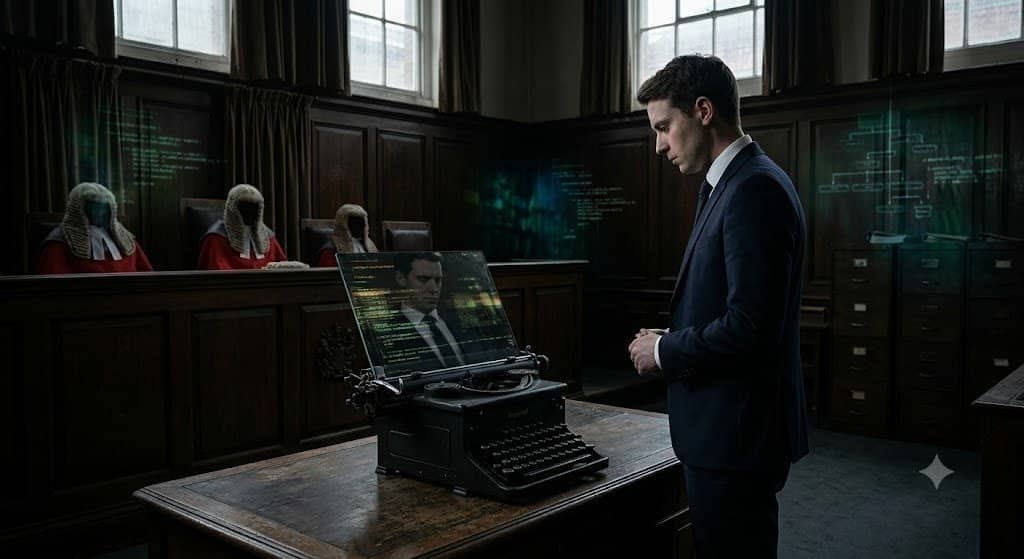
The UK’s first AI-assisted court trial win sets a precedent for the use of artificial intelligence in the legal system (Representative Image)
Key Takeaways
1 of 3
Automatically generated. Read full article for complete context.
On 14 May 2026, a freelance HR consultant walked out of Wandsworth County Court £7,000 richer, after a three-hour trial in which the other side had fielded both a solicitor and a barrister. On paper, it was an unremarkable small-claims debt recovery dispute. What made it notable is that the claimant, Camal Taquidir, had built her case with the help of Garfield AI a regulator-approved artificial intelligence legal platform that its founders describe as the world’s first pure AI law firm. It is, by several accounts, the first trial an AI-assisted litigant has won against represented human opposition in England and Wales though the actual courtroom advocacy, notably, was still done entirely by a human being.
The Dispute:
Taquidir had provided HR-related consultancy services to a hospitality business and was left chasing unpaid fees. Rather than instructing a conventional solicitor’s firm, she turned to Garfield AI, which she used first to generate pre-action correspondenceFormal Demand LettersOfficial letters sent to an opposing party before legal proceedings are initiated, typically demanding payment or action to resolve a dispute. the formal demand letters that typically precede litigation and subsequently to prepare and issue court proceedings when the debtor failed to pay up. The defendant did not simply contest the claim; it brought a counterclaim of its own—a tactic Taquidir later said felt designed to intimidate her into dropping the case. That counterclaim, too, was resisted through the Garfield AI platform.
As the matter approached trial, Garfield instructed a junior barrister, Dominic Li, to appear for the client. This detail matters, because it draws a firm and probably deliberate line around what the AI platform actually did and did not do.
What the AI Did, and What It Didn’t:
Garfield AI’s own account of the case is candid about the division of labour. The company describes its role as handling “the structured, document-heavy steps” of the small-claims process witness statements, the trial bundleCourt Document CompilationA collection of all documents, evidence, and legal arguments prepared by parties for submission to the court before a trial, used by the judge and advocates., correspondence, and the procedural mechanics of issuing and progressing a claim while leaving oral advocacy entirely to qualified human lawyers.
AI vs. Human: Division of Labor & Cost
| Aspect | AI-Assisted Claimant (Garfield AI) | Traditional Defendant |
|---|---|---|
| Role in Case Prep | Handles structured, document-heavy steps (witness statements, trial bundle, correspondence, procedural mechanics). | Solicitor-led drafting and preparation. |
| Courtroom Advocacy | Entirely by human barrister (Dominic Li). | By human solicitor and barrister. |
| Outcome | Won claim, counterclaim dismissed. | Lost claim, counterclaim dismissed. |
| Approx. Fees Paid | £400 (Garfield AI fees) | Significantly higher (engaged both solicitor & barrister). |
Visuals by The Rift
That distinction was borne out at trial. Legal Cheek’s report on the case is unambiguous that the cross-examination of witnesses, the skeleton argumentSummary of Legal ArgumentsA concise written summary of the main legal points and arguments that a barrister intends to make orally in court, often submitted in advance to the judge., and the “on-your-feet” advocacy in front of the judge were conducted by Li, a barrister from what the outlet describes as a top set with a distinction in the Bachelor of Civil Law. The AI platform did not appear as an advocate before the court at any point. Following the three-hour hearing, which involved multiple witnesses and cross-examination on both sides the court found for Taquidir and dismissed the counterclaim against her.
There is a reasonable case, made pointedly by some commentators on the Legal Cheek report, that the “AI wins court case” framing somewhat overstates the machine’s contribution: a small County Court claim was, in the end, won because a highly credentialled human barrister argued it well. Whether Garfield absorbed the cost of instructing counsel of that calibre for a modest claim, and how that squares with the platform’s ordinary fee structure, is not fully explained in the available reporting. Readers should treat claims about the economics of the model with some caution until Garfield discloses more detail.
The Money:
The commercial contrast is nonetheless striking. Taquidir reportedly paid in the region of £400 in Garfield AI fees to recover the £7,000 she was owed a fraction of what conventional solicitor-led litigation over a comparable sum would typically cost. The losing side, by contrast, had engaged both a solicitor and a barrister. Garfield’s co-founders have framed this asymmetry as the core of their pitch: access to justice for claims too small to interest traditional law firms but too large, and too stressful, for a layperson to pursue alone. Daniel Long, the firm’s co-founder and chief technology officer, has said the platform’s purpose is to give individuals and businesses “the tools to enforce their rights when the traditional route would be too slow, too costly, or too complex,” rather than to displace lawyers outright.
Garfield AI’s Track Record:
Garfield AI received authorisation from the Solicitors Regulation Authority (SRASolicitors Regulation AuthorityThe regulatory body for solicitors and law firms in England and Wales, responsible for setting and enforcing professional standards and authorizing legal service providers.) in May of the preceding year a step the SRA’s chief executive, Paul Philip, described at the time as a landmark moment for legal services in England and Wales. Since then, the firm says it has processed more than 600 claims and recovered or resolved roughly £500,000 for users, with individual claim values ranging from about £30 to £10,000. This Wandsworth judgment builds on what the company bills as a string of earlier “firsts,” including being the first AI law firm to issue court proceedings on a client’s behalf and the first to collect on court judgments obtained this way, along with an earlier £7,000 debt recovery for a UK transport consultancy.
Garfield AI: Key Metrics (Since May 2023 SRA Authorization)
600+
Claims Processed
£500k
Recovered/Resolved
£30–£10k
Claim Value Range
Visuals by The Rift
The firm’s leadership has also said its model has drawn interest from parts of the judiciary including, per its own press materials, Lord Justice Birss and that it has presented its work to Parliament’s Justice Select Committee. These claims come from Garfield’s own communications and have not been independently verified for this piece; they are reported here as the company’s characterisation of its reception, not as confirmed fact.
Reading the Case Correctly:
It would be a mistake to read this judgment as a court endorsing an “AI lawyer” in the sense of a machine arguing a case. It did not. What the Wandsworth trial actually demonstrates is a hybrid model already familiar to litigators in many jurisdictions, India included: a division between the document-intensive, procedural spadework of civil litigation drafting, bundling, correspondence, evidence organisation and the advocacy that remains, for now, an irreducibly human function requiring judgment, real-time argument, and the ability to respond to a judge’s questions or an opponent’s cross-examination on the spot.
For practitioners in India’s district courts, where the volume of pre-trial drafting plaints, written statements, affidavits, bundles often consumes disproportionate time relative to the substantive legal issues at stake, the Garfield AI case is a useful illustration of where AI assistance is plausibly mature enough to deploy today, and where it is not. It also underscores a point the Supreme Court’s own AI Committee has grappled with in its recent consultations on AI regulation for courts: that the line between permissible AI-assisted drafting and impermissible AI “practice of law” is not always self-evident, and jurisdictions that get ahead of it as the SRA arguably has, through its regulatory approval of Garfield may offer useful templates, and useful cautionary lessons, for regulators elsewhere.
Whether this becomes a template that spreads beyond small-claims debt recovery, or remains a niche solution for a narrow category of low-value, document-heavy disputes, is not yet clear from the available record. What is clear is that the case that made headlines as “AI wins in court” was, at the moment that mattered most when a judge was actually weighing the evidence argued by a human being.
Disclaimer:The views and opinions expressed in this article are those of the author(s) and do not necessarily reflect the official policy or position of The Rift.