Opening The Rift
therift
© 2026 The Rift. All Rights Reserved.
The UCC and Islamic Law and The Supreme Court of India
Uniform civil codes reveal their true character not in their stated aims but in how they treat religious minorities in practice.

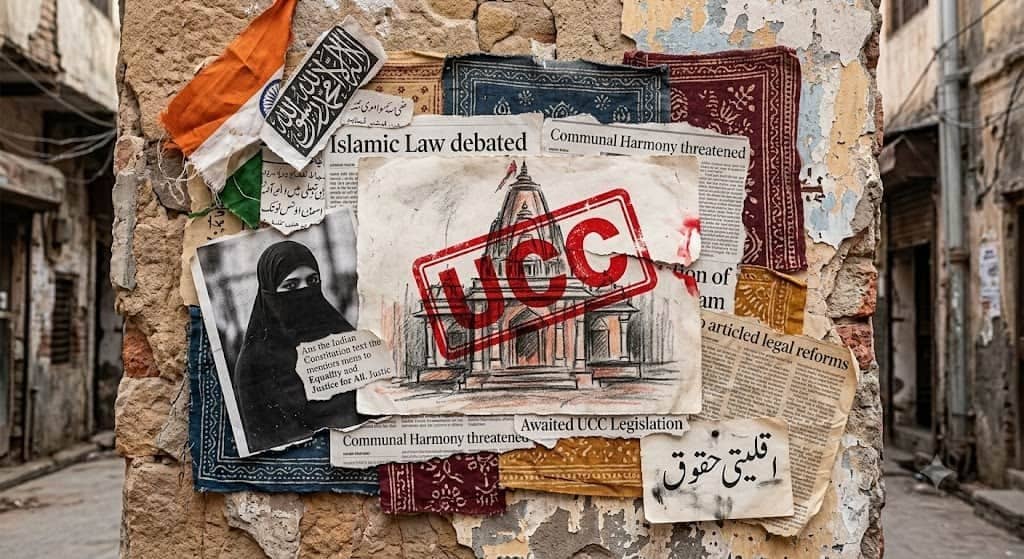
(Representative Image)
Key Takeaways
1 of 3
Automatically generated. Read full article for complete context.
Uniform civil codes reveal their true character not in their stated aims but in how they treat religious minorities in practice, and a comparison between China’s coercive model and India’s constitutional model shows why India’s own Supreme Court has consistently rejected coercive uniformity in favor of a rights-respecting, evidence-based approach, one that nikah halalaNikah HalalaAn Islamic practice where a woman, after an irrevocable divorce, must marry another man, consummate the marriage, and then divorce him, before she can remarry her first husband. The article discusses its ‘sham’ version., properly understood, actually fits well.
China’s 2021 Civil Code formally unified marriage, family, and inheritance law across the country, but its application to Muslim minorities, particularly Uighurs and Hui communities, has functioned as an instrument of cultural erasure rather than neutral legal reform. Authorities have banned the nikah vow itself from wedding ceremonies in Xinjiang, with officials openly stating that omitting Islamic religious elements from marriage, funeral, and naming ceremonies is treated as a marker of loyalty to the Party-state, while performing them can lead to detention on charges of “religious extremism”.
This is uniformity pursued not to protect individual rights within a marriage but to dissolve religious identity into a secular, Chinese national identity, reinforced by a broader 2026 “Ethnic Unity and Progress Law” that further narrows space for distinct religious and cultural practice. Even where the state permits a legally registered civil marriage, the substance of the couple’s own religious commitment is criminalized, which is why scholars describe China’s approach as coercive assimilation rather than legal reform.
This is the cautionary model: a uniform code that uses “modernization” as a pretext to target the religious content of a minority’s family life, rather than the specific harms individuals within that community may suffer. It is instructive precisely because it shows what a UCC becomes when the state substitutes ideological conformity for genuine, evidence-based protection of individual rights.
UCC Approaches: China vs. India
China’s Coercive Model
- ✘ Aim: Cultural erasure, dissolve religious identity into secular national identity.
- ✘ Implementation: Formal unification of laws (2021 Civil Code), bans on religious elements in ceremonies.
- ✘ Motivation: Ideological conformity, marker of loyalty to Party-state.
- ✘ Outcome: Criminalization of religious commitment, coercive assimilation.
India’s Constitutional Model
- ✔ Aim: Rights-respecting, evidence-based approach, protect individual rights.
- ✔ Implementation: UCC in non-justiciable Directive Principles, Supreme Court avoids unilateral imposition.
- ✔ Motivation: Consensus-building, constitutional scrutiny, genuine protection from harm.
- ✔ Outcome: Targeted reform (e.g., triple talaq), respect for distinct jurisprudential schemes.
VISUALS BY THE RIFT
Constitutional restraint outperforms coercion, and India’s constitutional framework has deliberately avoided the Chinese path. Article 44Article 44 of the Indian ConstitutionA Directive Principle of State Policy that states, ‘The State shall endeavor to secure for the citizens a Uniform Civil Code throughout the territory of India.’ places the UCC in the non-justiciable Directive PrinciplesDirective Principles of State Policy (DPSP)Guidelines or principles enshrined in Part IV of the Indian Constitution, intended to be kept in mind by the state when framing laws and policies, though not directly enforceable by courts., and the Supreme Court, across decades, from the Kesavananda Bharati observations in 1973 through Shah Bano (1985), Sarla Mudgal (1995), and Jose Paulo Coutinho (2019), has repeatedly called a UCC desirable while refusing to compel or impose it unilaterally, recognizing that a one-stroke implementation “may perhaps be counter-productive to the unity and integrity of the nation,” as the Court cautioned in Pannalal Bansilal. This is the opposite of China’s approach: the Indian Court’s institutional instinct has been that reform must be earned through consensus and constitutional scrutiny, not imposed as a marker of political loyalty. In bulldozing their way to force the uniformity India’s legislators are suggesting that it “may perhaps be counter-productive to the unity and integrity of the nation” is not something that is of much concern to them.
Where the Court has intervened in Muslim personal law, it has done so narrowly and on evidentiary grounds, not by decreeing wholesale uniformity. In Shayara Bano v. Union of India (2017), the five-judge bench struck down instantaneous triple talaq (talaq-e-biddatTalaq-e-Biddat (Instantaneous Triple Talaq)The practice of a Muslim man divorcing his wife by uttering the word ‘talaq’ three times in one sitting, which was declared unconstitutional by the Indian Supreme Court.) by a 3:2 majority, holding it “manifestly arbitrary” and unconstitutional, notably not because the Court decided Muslims must be brought into a uniform code, but because even the All India Muslim Personal Law Board conceded that ShariatShariat (Islamic Law)The moral code and religious law of Islam, derived from the Quran and the Sunnah (teachings and practices of Prophet Muhammad). itself “strongly condemns” the practice. In other words, the Court did not strike down any provision of Islamic Law; it struck down an aberration, a practice that was actually no part of Islam as it actually was.
Justice Nariman’s opinion emphasized that a practice sinful under the very religious text that supposedly sanctions it cannot claim protection as an essential religious practice under Article 25. Parliament then criminalized the practice through the Muslim Women (Protection of Rights on Marriage) Act, 2019. Crucially, Shayara Bano’s original 2016 petition challenged three practices together, talaq-e-biddat, polygamy (actually, polygynyPolygynyA form of polygamy in which a man has more than one wife at the same time.), and nikah-halala, but the Court’s bench confined its ruling to the one practice where the internal religious inconsistency was clearest and conceded by the community’s own representative body. Polygyny and nikah-halala were possibly left for more informed consideration at some later instance.
Indian Approach and Nikah Halala
Note what is stated above : triple talaq was declared void not because the Court decided Muslims must be brought into a uniform code, but because even the “AI Muslim PLB” conceded that Shariat itself “strongly condemns” the practice. In other words the Court did not strike down any provision of Islamic Law : it struck down as an aberration a practice that was actually no part of Islam as it actually was.
This is precisely the model that should govern how the state treats nikah halala as practiced today: not a Chinese-style ban on a named “Islamic practice,” but a Shayara Bano-style recognition that the practice, as commonly carried out, has no genuine Quranic sanction and can be addressed through existing law without legislating against Islam itself.
Surah Al-Baqarah 2:230 permits remarriage to a former husband only after a woman has entered a genuine, unplanned subsequent marriage that ends naturally through divorce or death. The version reported across India, a pre-arranged, temporary marriage entered into solely to enable reunion with the first husband, inverts this entirely, and authentic hadith recorded in Sunan Abi Dawud report the Prophet ﷺ cursing both the muhallilMuhallilIn the context of nikah halala, the second husband who marries a divorced woman with the intention of divorcing her so she can remarry her first husband. and the muhallal lahuMuhallal LahuIn the context of nikah halala, the first husband who wishes to remarry his divorced wife after she has married and divorced a second man. for exactly this arrangement. When the Supreme Court agreed in 2018 to examine nikah-halala alongside polygamy (polygyny, actually), Deobandi clerics themselves publicly stated that “nikah halala as is being interpreted by the governments and media is not recognized even in Islam”.
The doctrinally consistent path, following Shayara Bano rather than the Chinese model, is to treat the sham version of halala as a fraud on consent, prosecutable through existing provisions on cheating, criminal conspiracy, and exploitation of a dependent party, maybe even human trafficking laws, rather than through a new statute naming and banning “the Islamic practice of halala.” This achieves the protective goal without either the Chinese error of coercive religious erasure or the drafting error of criminalizing a practice the faith’s own primary sources never sanctioned in that form.
Note that the Supreme Court has long held that persons who are differently placed need not be treated identically, and that Article 14Article 14 of the Indian ConstitutionGuarantees equality before the law and equal protection of the laws within the territory of India, prohibiting discrimination. permits reasonable classification when the distinction has an intelligible differentiaIntelligible DifferentiaA legal term referring to a clear and rational basis for distinguishing between persons or things for the purpose of classification in law, permissible under Article 14. with a rational nexusRational NexusA legal term requiring that the basis of classification (intelligible differentia) must have a reasonable and logical connection to the object sought to be achieved by the law. to the object sought to be achieved. In Budhan Choudhry v. State of Bihar and Ram Krishna Dalmia v. Justice S.R. Tendolkar, the Court laid down the classic test that equality does not forbid all differentiation, only arbitrary differentiation; later decisions such as State of West Bengal v. Anwar Ali Sarkar and E.P. Royappa v. State of Tamil Nadu reaffirm that discrimination arises from hostile or irrational treatment, not from constitutionally justified classification. On that footing, a law that treats persons differently because their factual or legal positions are not the same does not offend equality merely because it does not apply one uniform rule to everyone.
The Supreme Court has also repeatedly recognized that reasonable classification is constitutionally permissible when it is grounded in real differences and bears a rational nexus to the law’s object. The differential rules in Islamic shariah relating to inheritance and testimony are not discrimination, but a structured allocation of rights and duties within a distinct jurisprudential scheme. The common assertion that a woman receives only “half” an inheritance is an oversimplification, since in many cases she receives a full defined share while the larger share to a male heir is accompanied by corresponding financial obligations toward dependents and family maintenance. Likewise, the idea that a woman’s testimony is inherently worth half of a man’s is often misunderstood; in the relevant jurisprudential context, testimony is treated as a duty shared so that two women collectively bear one testimonial burden, reducing the risk that a lapse in memory by one witness unfairly invalidates the evidentiary account, rather than casting any inference of falsehood on women as a class.
Speaking out against Islamic practices to cater to constituencies, while disregarding facts, is itself aberrant. It beats reason that there can be an attempt to ensure social peace by such distractions, despite damage to the nation’s secular fabric and despite legislative actions sowing apprehension in the minds of the Muslim community that would invite charges under 153A IPC 1860 or 196 BNS 2023 if the acts involved lay citizenry. or 196 BNS 2023Section 196 of the Bharatiya Nyaya Sanhita, 2023The corresponding section in India’s new criminal code, replacing IPC 153A, which addresses similar offenses related to promoting enmity between groups. if the acts involved lay citizenry.
When the legislating minds stop seeing Islam and Islamic practices as “the others” or “aliens” or “outsiders” they will start thinking free from prejudices and hostility, and then India shall see legislation conforming strictly to Constitutional norms where none feels discriminated against for his or her religious orientation. Till then, the Muslims wait, and trust that the judiciary will see what the politicians don’t…or maybe actually do but pretend that they don’t.
They trust that the judiciary will see through false equivalences, and will also see corrective action through.
Jai Hind
Disclaimer:The views and opinions expressed in this article are those of the author(s) and do not necessarily reflect the official policy or position of The Rift.