Opening The Rift
therift
© 2026 The Rift. All Rights Reserved.
The Ruins of the Rules: How Washington and Tel Aviv Demolished the International Order
Operation Epic Fury was not just an attack on Iran. It was an assault on the legal architecture that has restrained great-power violence since 1945—and the United Nations said so out loud.

Key Takeaways
1 of 3
Automatically generated. Read full article for complete context.
One hundred and sixty-five school girls and staff died in Minab reportedly by the Illegal American and Israeli attack on Iran. They were not enriching uranium. They were not assembling ballistic missiles. They were, by every available account, children—students at their desks in the southern Iranian city when ordnance struck the building on the morning of February 28, 2026. The Iranian Red Crescent would eventually count 555 dead across 131 counties in the first seventy-two hours of what the Pentagon branded Operation Epic Fury and what Israel called Operation Roaring Lion. The names were chosen for swagger. The dead in Minab did not get to choose anything.
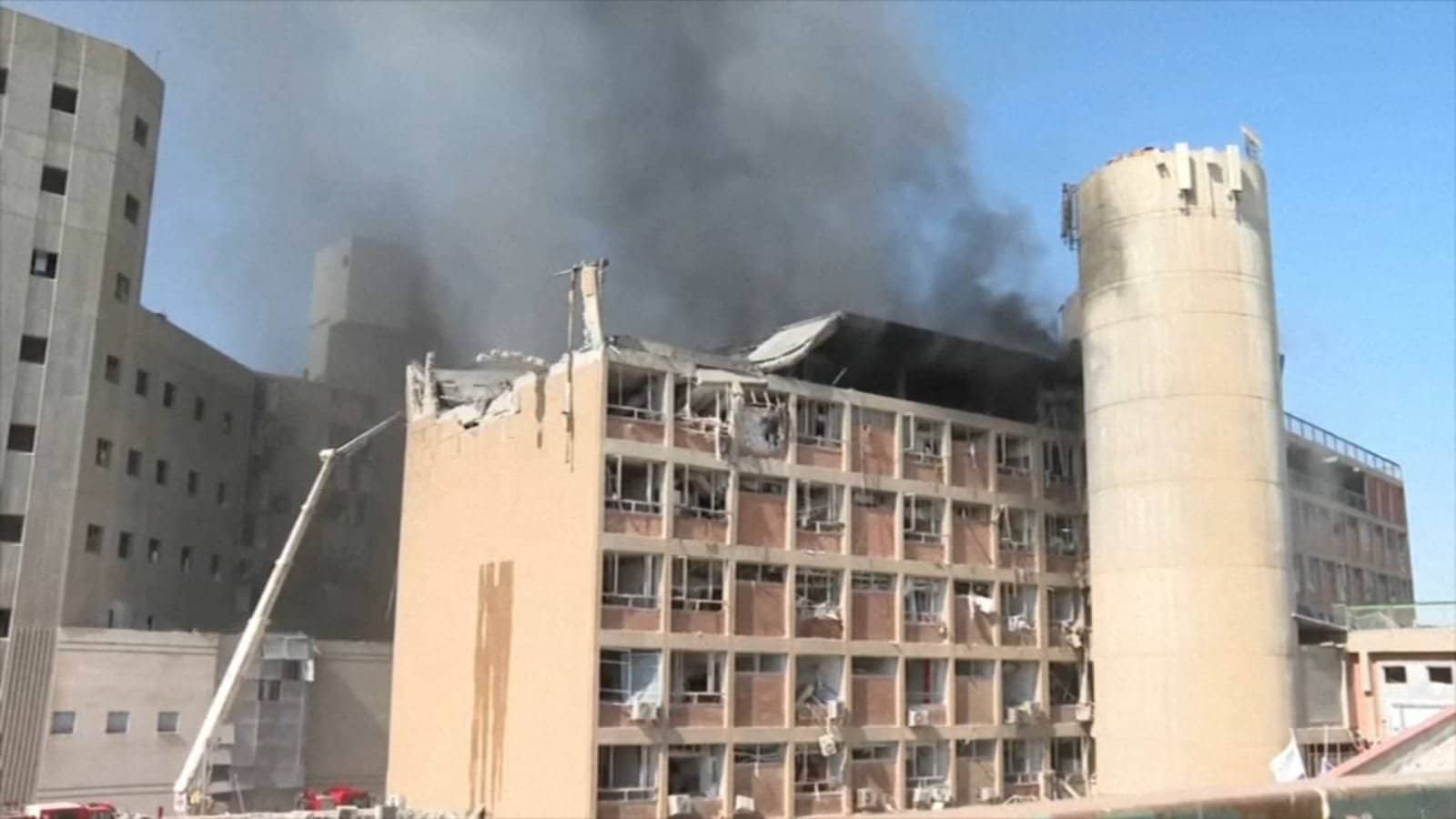
That single incident verified by Al Jazeera’s live tracker, reported by CNN, and cited in the UN Secretary-General’s emergency briefing, captures the central moral and legal obscenity of the joint U.S.-Israeli military campaign against Iran. This was not a surgical strike. It was a coordinated air assault spanning 24 of Iran’s 31 provinces, involving over 1,200 Israeli munitions and an undisclosed number of American cruise missiles and stealth bombers. Its declared objectives ranged from dismantling Iran’s nuclear infrastructure to decapitating its leadership, an objective fulfilled when Supreme Leader Ali Khamenei was confirmed dead on March 1, killed in what NBC News described as a targeted strike on his compound.
The road to February 28 did not begin in February. In June 2025, Israel and the United States had already struck Iranian nuclear sites—Fordow, Natanz, Isfahan—in a twelve-day war that ended with a ceasefire on June 24. That campaign, as the Jewish Telegraphic Agency documented in its timeline, was itself the culmination of two years of escalating proxy conflict following Hamas’s October 7, 2023 attack. A brittle peace followed. Iran agreed to resume nuclear talks with the E3 (Britain, France, and Germany) in August 2025, only for the Europeans to trigger the snapback mechanism reinstating UN sanctions weeks later. By December, massive anti-government protests had erupted across over a hundred Iranian cities, driven by economic collapse, the cratering rial, and a population exhausted by decades of theocratic mismanagement.
Then came the IAEA’s discovery, reported on February 27, 2026: Iran had concealed highly enriched uranium in an underground facility untouched by the June strikes. Washington and Tel Aviv seized on the revelation as casus belli. Within twenty-four hours, the bombs were falling.
But a casus belli is not, by itself, a legal justification for war. And it is here, on the terrain of international law that the U.S.-Israeli operation inflicts its deepest and most lasting damage.
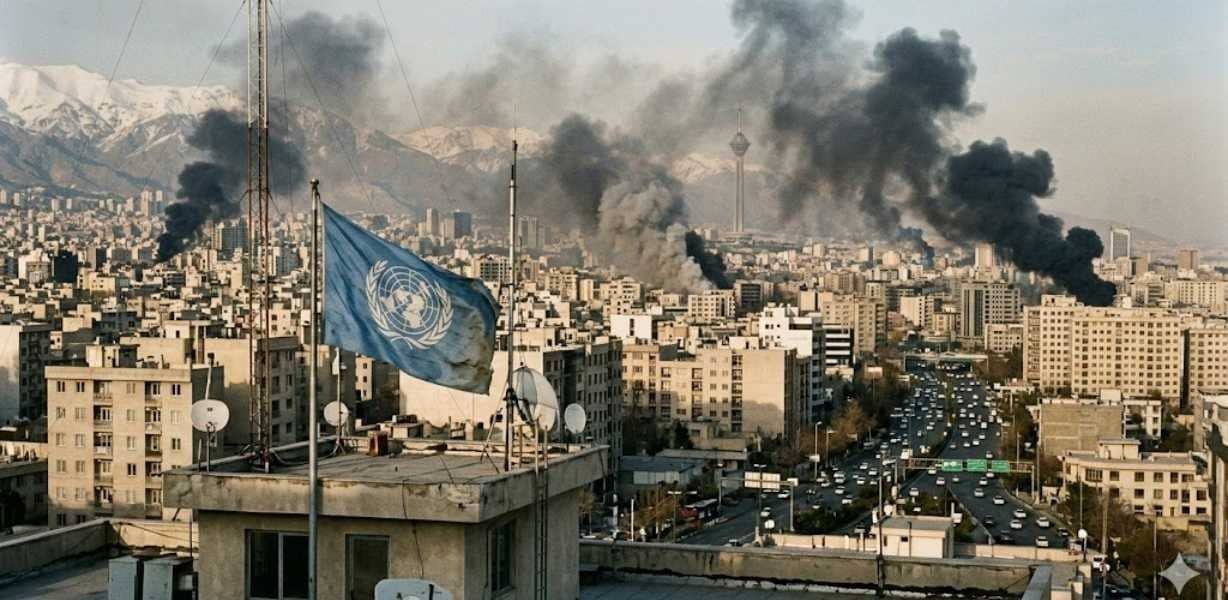
At the emergency session of the UN Security Council on February 28, Secretary-General António Guterres did something UN chiefs rarely do: he spoke without diplomatic cushioning. The strikes, he said, violated international law, including Article 2 of the UN Charter, which requires all member states to “refrain in their international relations from the threat or use of force against the territorial integrity or political independence of any State.” He noted that the assault came while indirect U.S.-Iran talks, mediated by Oman, were still underway meaning Washington and Tel Aviv had, in his words, “squandered an opportunity for diplomacy.”
The legal analysis from independent scholars has been, if anything, more damning. Marko Milanovic, professor of public international law at the University of Reading, told The Conversation that the strikes are “clearly illegal, in that they are a breach of the UN Charter.” The article’s headline left no room for euphemism: “Neither preemptive nor legal, US-Israeli strikes on Iran have blown up international law.” Many has reached the same conclusion: preventive war has no legal basis under the Charter, and the narrow doctrine of pre-emptive self-defence—rooted in the 1837 Caroline test—requires a threat that is “instant, overwhelming, and leaving no choice of means.” A concealed uranium stockpile, however alarming, does not meet that threshold.
The United States invoked Article 51, the self-defence provision, at the Security Council. Israel echoed the claim. But Article 51 is triggered by an “armed attack,” and no Iranian armed attack on U.S. or Israeli territory preceded the February 28 strikes. As reported, the operation lacked both UN Security Council authorization and congressional approval under the War Powers Resolution, making it illegal under both international and American domestic law.
Sovereignty is an abstraction until someone violates it. On February 28, the abstraction acquired a body count. The killing of Khamenei, a sitting head of state, however repugnant his regime, crossed a line that international law draws for reasons of systemic stability, not sentiment. The New York Convention on the Prevention and Punishment of Crimes against Internationally Protected Persons exists precisely to prevent the assassination of foreign leaders from becoming a tool of statecraft. The United States, which once issued Executive Order 12333 banning assassinations, has now participated in the targeted killing of a sovereign nation’s supreme leader during a military operation conducted without a declaration of war. The Indian National Congress, in a statement that stood out for its directness, “unequivocally condemn[ed] the targeted assassination” of Khamenei, noting it was carried out “without a formal declaration of war.”
The sovereignty violations rippled outward. Iran’s retaliation, missiles launched at Israel, at U.S. bases, and at Gulf states hosting American forces struck Bahrain, Kuwait, Qatar, the UAE, Jordan, and Saudi Arabia. Al Jazeera reported explosions shaking Dubai, Doha, and Manama. Bahrain intercepted 70 missiles and 59 drones; Qatar downed two Iranian aircraft and intercepted seven ballistic missiles; the UAE stopped nine ballistic missiles, six cruise missiles, and 148 drones. Guterres condemned Iran’s retaliatory strikes as violations of the sovereignty and territorial integrity of seven countries—a condemnation Iran earned. But Iran’s lawlessness does not retroactively legalize the operation that provoked it. Two wrongs do not make a right, and in international law, the aggressor state cannot claim the victim’s retaliation as post-hoc justification.
The deeper wound is institutional. The UN Security Council, the body designed to authorize or prevent exactly this kind of military action, was paralyzed before the first missile launched. The United States holds a permanent veto. No resolution condemning the strikes will pass. Russia’s Ambassador Vassily Nebenzia called the operation “yet another unprovoked act of armed aggression against a sovereign and independent Member State.” China’s Ambassador Fu Cong described it as “brazen.” Both demanded an immediate cessation of hostilities. Neither has the power to compel one.
The result is a Security Council that functions as a spectator to the very wars it was constituted to prevent, a condition that vindicates every critique the Global South has leveled at the post-1945 order for decades. When the world’s most powerful military alliance can wage war in defiance of the Charter and then veto any institutional response, the rules-based order is not merely under strain. It is performing a pantomime of itself. DAWN, the Washington-based rights organization, has called for an emergency General Assembly session under the Uniting for Peace procedure to declare the assault a war of aggression, a mechanism last invoked during the Korean War and the Suez Crisis, occasions that say something about the gravity of the present moment.
Defenders of the strikes argue, as the Times of Israel reported from the Security Council session, that Iran’s clandestine nuclear enrichment and its decades of proxy warfare across the Middle East made military action inevitable. They are not wrong that Iran’s regime posed a genuine threat. They are wrong that the response was unlawful, disproportionate, and illegal. Over 2,000 strikes across a sovereign nation in seventy-two hours, the assassination of a head of state, the destruction of civilian infrastructure including a school full of children. This is not counterproliferation. It is the prosecution of a war of choice dressed in the language of self-defense.
And it sets a precedent that will not stay contained to the Middle East. If the United States and Israel can launch a campaign of this scale without Security Council authorization, without an armed attack triggering Article 51, and without meaningful institutional consequence, then the Charter’s prohibition on the use of force is no longer a binding norm. It is a suggestion, one that applies to the weak but not the strong. Russia cited similar logic when it invaded Ukraine. The difference is that Moscow was sanctioned and isolated for it. Washington and Tel Aviv will not be.
That asymmetry is the real casualty of Operation Epic Fury, more durable than any missile crater, more consequential than any regime change. The international order’s legitimacy rested on the premise that its rules applied universally. February 28, 2026 did not shatter that premise. It confirmed what much of the world already suspected: that the order’s architects never intended the rules to apply to themselves. This is the ruins of the rules.