Opening The Rift
therift
© 2026 The Rift. All Rights Reserved.
The Gaza-West Bank Erasure Under the Shadow of War on Iran
With Gaza’s death toll now verified to have exceeded 75,000, the erasure of the West Bank continues in the shadow of a regional war that serves as both a screen and a justification.

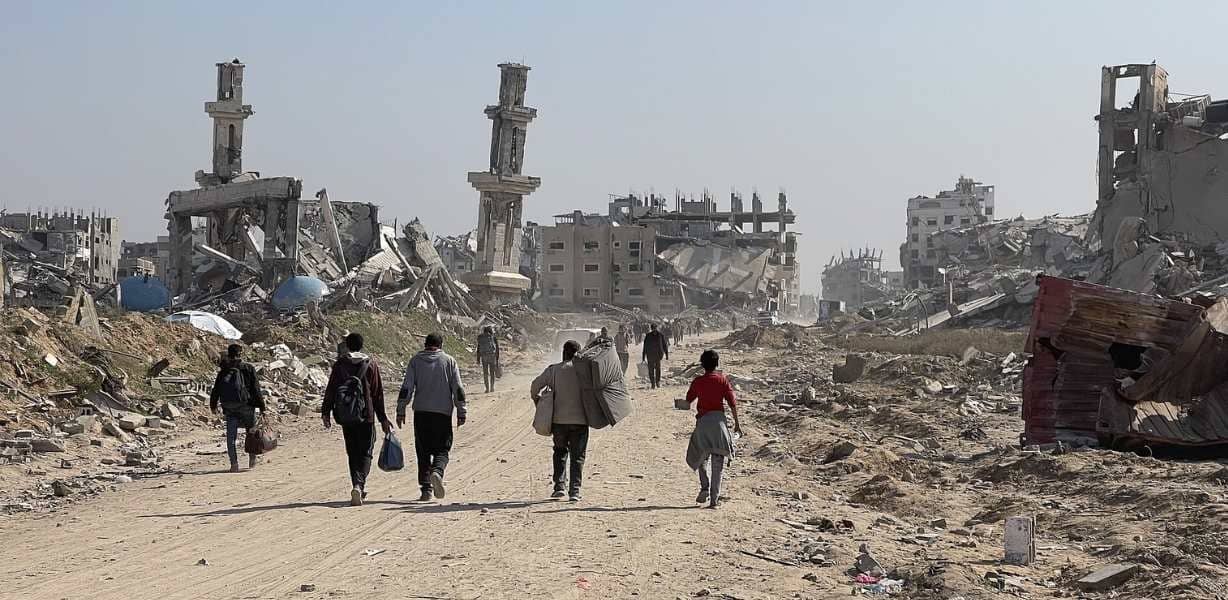
Displacement of Gaza Strip Residents During the Gaza-Israel War 23-25- Via Wikimedia Commons
Key Takeaways
1 of 3
Automatically generated. Read full article for complete context.
On February 18, 2026, a study published in The Lancet Global Health confirmed what humanitarian workers had long feared: the true death toll in the Gaza Strip is significantly higher than official administrative records. The Gaza Mortality Survey (GMS), led by Michael Spagat of the Royal Holloway University of London, identified a staggering volume of loss.
Verified Violent Deaths (May 2026)
75,200
+16,300 Indirect Deaths from Siege & Famine
This is not just a statistical anomaly, it is a demographic hollow. The survey confirms that women and children comprise 56.2% of these fatalities. Beyond the immediate violence, the destruction of Gaza’s healthcare infrastructure has led to a surge in preventable mortality. These are the silent deaths that international monitoring bodies warn are now accelerating as the region enters its third year of unprecedented siege. The institutional verification of these figures vetted by peer-reviewed journals shifts the conversation from allegation to scientific consensus. Gaza is no longer just a conflict zone, it is a site of verified mass mortality.
While the world watches the life support ceasefire between Iran and Israel, a second front of erasure is being finalized in the West Bank. The Iranian crisis provides the perfect political cover. While global diplomats focus on the Strait of Hormuz and uranium enrichment levels, the Israeli state has accelerated the declaration of State Land in the West Bank.
1,090
Fatalities Since Oct 7
2,500+
Displaced (Early 2026)
This displacement is driven by a surge in settler violence that reached a historic peak in March 2026, the second-highest monthly total for settler-related fatalities since records began in 2005. At least one in five of those killed in the West Bank since October 2023 have been children. The shadow of Iran acts as a screen, territorial expansion happens most aggressively when global eyes are elsewhere. This is a strategic distraction where a regional war is used to justify a local annexation that renders a future Palestinian state physically impossible.
The collapse of Palestinian life is matched by the collapse of the institutions designed to protect it. In the Palestinian context, this collapse and silence is global. The erasure is being codified through new military tribunals and the transfer of authority from military to civil administration in Area C, the final legal step toward permanent Israeli sovereignty.
Strategic autonomy was never just a slogan. It was the most valuable asset of a rules-based order. The regional war on Iran has not only shifted the maps of the Middle East but has provided the noise necessary to complete a territorial project decades in the making. The question now is not whether a two-state solution exists, but whether the international community will continue to treat the erasure of the West Bank as a peripheral issue while a regional conflagration burns.