Opening The Rift
therift
© 2026 The Rift. All Rights Reserved.
WHY GOA MUST QUESTION ITS RELATIONSHIP WITH ISRAEL
Goa must ask whether its relationships with Israel meet ethical standards, serve its interests, and avoid unacceptable legal risks.

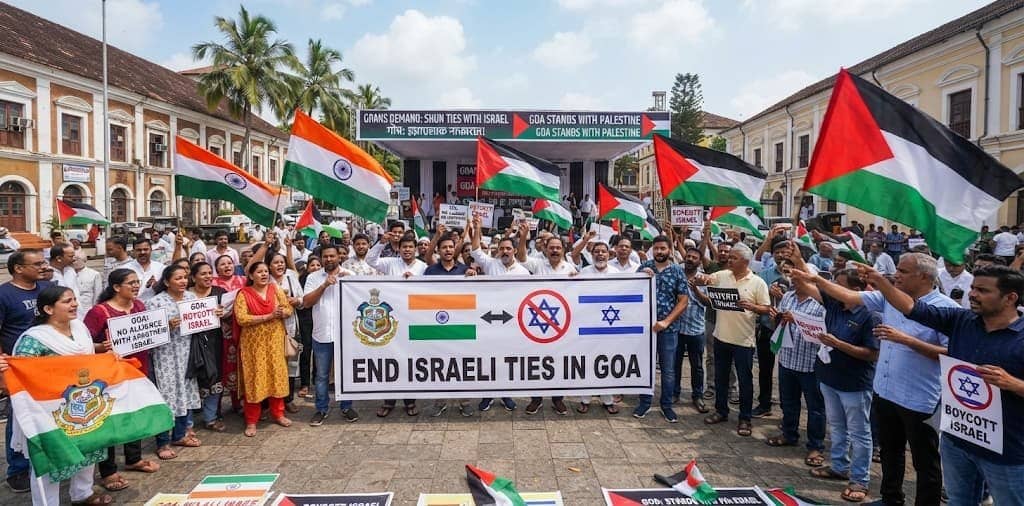
Representative Image
Key Takeaways
1 of 3
Automatically generated. Read full article for complete context.
Agriculture, Tourism and Industry: The Case for Considering Boycott, Divestment and Sanctions
Goa must begin asking a question that its political establishment has largely avoided: Why should the state deepen its economic and institutional engagement with Israel, and what tangible benefits does this relationship bring to ordinary Goans? At a time when Israel faces grave international scrutiny over its occupation of Palestinian territory and its military operations in Gaza, economic cooperation can no longer be treated as a politically neutral matter, divorced from questions of justice, human rights and international law.
For Goa, this is not simply an issue of international solidarity with Palestine, although that solidarity is of considerable moral importance. It is also a question of agricultural priorities, the character of tourism, industrial development and the kind of society Goa wishes to become. The state has its own reasons to question whether its economic relationships with Israel serve the interests of its people. Agriculture, tourism and industry offer particularly important grounds for this examination.
Goa’s historical experience makes such a discussion especially relevant. For 451 years, Goa lived under Portuguese colonial rule. Its liberation in December 1961 was the culmination of a long struggle for self-determination and human dignity. That history cannot remain confined to official ceremonies, commemorative speeches and monuments. It carries a responsibility to recognise the struggles of other peoples whose freedom continues to be denied. The Palestinian struggle is not identical to Goa’s experience, but the fundamental questions of dispossession, domination and the right to self-determination establish a meaningful connection between them.
One of the most frequently repeated justifications for cooperation with Israel is its supposed agricultural expertise. Israeli technology is promoted as an answer to India’s agricultural difficulties, particularly through drip irrigation, precision farming, protected cultivation, horticulture and water management. Under the Indo-Israel Agricultural Project, Centres of Excellence have been established across several Indian states, with the promise that sophisticated technologies will improve productivity and transform farming practices.
But where is the convincing evidence that these programmes have delivered the promised transformation for ordinary farmers? The existence of demonstration centres, government agreements and international technical partnerships cannot automatically be equated with agricultural success. The real measure must be the improvement of farmers’ livelihoods, the affordability of technologies, their ecological sustainability and their suitability for local conditions. Assessments of the Indo-Israel agricultural partnership have identified difficulties in reaching ordinary farmers and ensuring the long-term viability of these centres. While some projects report improvements in horticultural practices and productivity, such achievements do not establish that the model is appropriate everywhere or that its benefits justify the costs.
Goa has particular reasons to be cautious. Its agricultural landscape is shaped by small holdings, traditional paddy cultivation, coconut, cashew, arecanut, horticulture, local seed varieties and farming systems developed over generations in response to the region’s distinctive ecology. Its agricultural difficulties are not merely technological. They arise from shrinking agricultural land, labour shortages, inadequate returns, changing land use, speculative real estate development, weak marketing systems and the declining attractiveness of farming as a livelihood. No imported technology can resolve these structural problems on its own.
Indeed, an excessive fascination with foreign agricultural technology risks distracting attention from the more urgent task of restoring the viability of Goan agriculture. Farmers require assured markets, fair prices, affordable inputs, water security, protection from land conversion and public investment in sustainable agricultural practices. Goa possesses a wealth of traditional farming knowledge, while Indian agricultural universities and research institutions have substantial expertise in locally appropriate technologies. Why should Israeli models enjoy special preference when these resources remain underutilised?
Goa already has an Indo-Israel Centre of Excellence approved under the national agricultural cooperation programme. This makes the question immediate and practical. What has been spent? How many farmers have benefited? What measurable improvements have occurred in productivity and income? What is the cost of adopting the recommended technologies? How much continuing dependence on imported equipment or specialised expertise is involved? These are questions that should be answered through independent public evaluation rather than promotional claims.
Agricultural cooperation must not become an extension of diplomatic fashion. Goa’s farmers should not be treated as experimental subjects for expensive technological models whose relevance to local conditions remains uncertain. The future of agriculture in Goa must be shaped by the needs of its farmers, its ecological realities and the principle of food sovereignty, not by the commercial interests of international technology providers.
Tourism raises another set of concerns, particularly because it has become such a dominant force in Goa’s economy and social life. For decades, Israeli backpackers have formed a visible presence in several coastal areas, including Anjuna, Vagator, Arambol and Morjim. Many young Israelis undertake extended international journeys after completing compulsory military service. This pattern of post-military-service travel is well documented, and Goa has long been among the destinations associated with it.
The implications of this phenomenon deserve careful discussion. Tourism is not merely about arrivals, hotel occupancy and foreign exchange. It also involves the social relationships, behaviour and responsibilities of visitors towards host communities. Goa has already experienced the consequences of poorly regulated tourism, including drug trafficking, substance abuse, excessive commercialisation, environmental destruction, noise pollution and the erosion of local cultural spaces. These problems cannot be attributed to any single nationality, but neither should concerns involving particular tourism circuits be ignored simply because they generate revenue.
Historical reports have documented concerns about drug use among some Israeli backpackers travelling through Goa and other Asian destinations. There have also been individual criminal cases involving Israeli nationals. Such evidence requires responsible interpretation. It does not justify treating Israeli visitors collectively as offenders, and any allegation of criminal conduct must be investigated and prosecuted on its individual merits. Yet it reinforces the larger question of whether Goa’s tourism policies are sufficiently attentive to the social consequences of the markets they promote.
There is also the distinctive issue of tourism undertaken immediately after military service. Following 7 October 2023, reports emerged of Israeli visitors leaving Goa to return home, including some intending to volunteer for military service. This brings into focus the relationship between military experience, international travel and accountability. Military service does not, by itself, establish responsibility for wrongdoing. Nevertheless, where credible evidence links an individual to war crimes or other serious violations of International humanitarian law, international travel should not provide immunity from lawful investigation and accountability.
Goa’s hospitality must remain open to people regardless of nationality, religion or ethnicity. Its tourism policies, however, need not be indifferent to the wider ethical and social implications of international tourism. The state should examine its promotional relationships, commercial partnerships and regulatory arrangements while insisting upon respect for local communities, public safety and environmental responsibility.
For too long, Goa has allowed tourism development to be measured by the volume of arrivals rather than the quality of benefits received by its people. Land has been diverted, coastal ecosystems have been damaged, traditional livelihoods have been displaced and local communities have often found themselves marginalised in decisions affecting their own villages. The debate over Israeli tourism should therefore form part of a larger reassessment of the tourism industry itself. Goa needs visitors who respect its people and environment, and an industry whose economic benefits are distributed fairly rather than concentrated among a few commercial interests.
The question of industrial cooperation is equally important. India and Israel have developed extensive economic relationships in defence, cybersecurity, water management, agriculture, pharmaceuticals, technology and manufacturing. These relationships are frequently presented as evidence of Israel’s technological sophistication and its attractiveness as an economic partner. Yet such general claims do not answer the specific question of what Goa stands to gain from preferential engagement with Israeli businesses.
Goa has serious industrial challenges of its own. It needs employment opportunities for its young people, support for small and medium enterprises, investment in environmentally responsible manufacturing, technological innovation suited to local needs and a development strategy that does not sacrifice its fragile ecology. Industrial policy must be judged by its contribution to these objectives, not by the international prestige attached to foreign investors.
What unique industrial advantages does Israel offer Goa that cannot be obtained from Indian institutions or other international partners? Will Israeli investments create substantial and secure employment for Goans? Will they transfer useful technology and strengthen local enterprises? Will they contribute to ecological sustainability? Or will they primarily create opportunities for external corporations to access land, infrastructure, public incentives and markets?
These questions are particularly relevant because Goa has already experienced the consequences of development strategies in which private profit has taken precedence over public welfare. Mining, real estate speculation, environmentally damaging construction and poorly regulated tourism have demonstrated the dangers of allowing commercial interests to dictate the state’s development priorities. There is little reason to assume that foreign industrial partnerships will automatically produce more equitable outcomes.
Israel is not the only country possessing expertise in water management, technology, renewable energy, pharmaceuticals or advanced manufacturing. India itself has substantial technological capacities, while numerous other international partners offer possibilities for cooperation. Goa should therefore reject the assumption that engagement with Israel is indispensable to its industrial future.
There is also an ethical dimension that cannot be dismissed. The International Court of Justice, in its advisory opinion of 19 July 2024, concluded that Israel’s continued presence in the Occupied Palestinian Territory is unlawful and that other states have obligations not to recognise or assist in maintaining the unlawful situation. The opinion provides an important legal framework for examining economic relationships connected with occupation, settlements and other violations of Palestinian rights.
This does not mean that every Israeli company is implicated in violations of international law. It does mean that public institutions and businesses have reason to conduct serious human rights due diligence before entering partnerships with companies whose activities may contribute to unlawful practices. Corporate accountability should not be suspended simply because a company promises investment or technological expertise.
It is in this wider context that the international Boycott, Divestment and Sanctions movement deserves consideration in Goa. Launched in 2005 following a call from Palestinian civil society organisations, BDS draws inspiration from the international campaign against apartheid South Africa. It seeks to employ non-violent economic, institutional and political pressure in pursuit of Palestinian rights, including freedom from occupation, equality and the rights of refugees under international law.
The movement offers a framework for examining whether economic relationships contribute to injustice and whether institutions have responsibilities beyond commercial profitability. Boycotts can involve withdrawing support from selected companies or institutions implicated in violations. Divestment involves reconsidering investments in such entities, while sanctions are measures pursued through governmental authority and international legal mechanisms.
For Goa, this discussion could begin with a transparent examination of existing agricultural agreements, tourism partnerships, industrial investments and public procurement arrangements. The state government could commission independent assessments of the benefits and costs of its cooperation with Israeli institutions. Educational establishments, churches, trade unions, business associations and civil society organisations could examine their own financial and institutional relationships against credible human rights standards.
Such scrutiny must be evidence-based and consistent. It should focus on identifiable institutional conduct rather than nationality or religious identity. Opposition to Israeli government policies must never be confused with hostility towards Jewish people, and support for Palestinian rights must remain compatible with respect for the rights and security of Israeli civilians.
Goa also operates within India’s constitutional framework. Foreign affairs and international sanctions fall within the Union government’s authority. But that does not prevent Goan citizens and institutions from debating economic relationships, adopting lawful ethical procurement policies, reviewing investments or raising questions about the consequences of international cooperation.
India has historically supported Palestinian self-determination, even as its diplomatic, military and commercial relationships with Israel have expanded. This tension deserves public discussion. A country’s commitment to human rights should not disappear when confronted with the prospect of profitable contracts or technological cooperation.
The moral dimension of the question becomes even more compelling when viewed through Goa’s own liberation history. Goans did not accept Portuguese colonial rule as legitimate simply because it had existed for centuries or because colonial institutions claimed to bring administrative and economic benefits. The struggle for freedom rested upon a deeper conviction: no people should be denied the right to determine their own future.
Palestinians continue to confront the consequences of dispossession, military occupation, settlement expansion, displacement and the denial of self-determination. Their struggle has endured through generations, while international declarations have repeatedly failed to translate into effective protection of their rights. The destruction experienced in Gaza has made the human consequences of this failure devastatingly visible.
Goa’s response need not be confined to declarations of sympathy. Its churches and religious institutions, educational bodies, professional associations, farmers’ organisations, trade unions and civil society groups can contribute to a serious examination of the responsibilities that accompany economic relationships. Palestinian Christian organisations, including those associated with the Kairos Palestine movement, have long appealed to international churches and communities to move beyond expressions of compassion towards concrete forms of non-violent solidarity.
Such appeals deserve engagement, particularly in a state whose religious and civic institutions have historically participated in wider struggles for justice and human dignity.
The debate about BDS should not become a substitute for addressing Goa’s own economic and social problems. On the contrary, its relevance lies partly in bringing those problems into sharper focus. Agricultural cooperation should be judged by the welfare of farmers. Tourism should be evaluated by its contribution to local communities and social well-being. Industrial investment should be assessed through employment, environmental responsibility, technological relevance and public benefit. Human rights considerations should inform all three.
Goa must ask whether its relationships with Israel meet these standards, whether alternative partnerships could better serve its interests, and whether continuing particular forms of cooperation creates unacceptable ethical or legal risks. These are legitimate questions for public debate, not matters that should be settled behind closed doors through diplomatic announcements and commercial agreements.
The central issue is whether Goa wishes to become a society whose economic decisions are guided solely by profitability, or one that also places justice, ecological responsibility, human dignity and public accountability at the centre of development.
Goa’s liberation was not merely the end of foreign rule. It represented the assertion that people have a right to freedom and that political and economic power must be accountable to human dignity. That inheritance invites reflection on the responsibilities of the present.
Goa fought for its own freedom. The question now is whether the values of that struggle will also shape its response to the continuing denial of freedom to the Palestinian people.
Disclaimer:The views and opinions expressed in this article are those of the author(s) and do not necessarily reflect the official policy or position of The Rift.
*International RelationsAgricultureBDS MovementColonialismEconomic PolicyGoaHuman RightsIndustryIsraelPalestineSelf-determinationTourism