Opening The Rift
therift
© 2026 The Rift. All Rights Reserved.
GHMC’s Park Fees: Pricing Out the Poor from Hyderabad’s Green Lungs
A city that prices its poorest residents out of its parks is a city that has lost its moral compass.

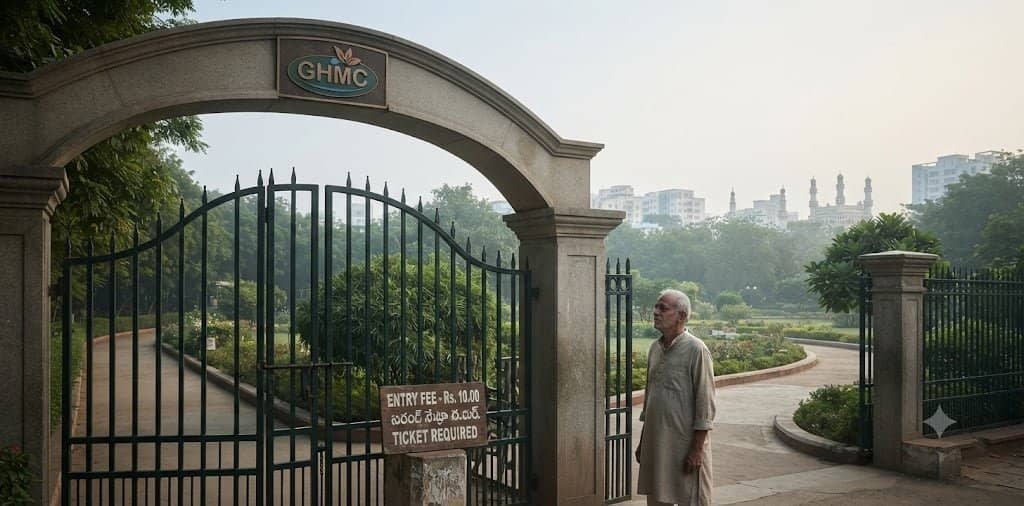
New park fees implemented by GHMC in Hyderabad are increasingly pricing out the city’s less privileged residents from vital green spaces. (Representative Image)
Key Takeaways
1 of 3
Automatically generated. Read full article for complete context.
GHMC’s ₹300 Crore Priorities vs. the ₹20 Barrier to a City’s Green Lungs
The Greater Hyderabad Municipal Corporation (GHMC) is a study in glaring contradictions. On one hand, it presides over a sprawling municipal budget, with allocated expenditures often running into hundreds of crores, including a reported ₹300 crore for peripheral development. On the other hand, it has facilitated the systematic destruction of the city’s green cover, with reports indicating that nearly 3,000 trees were officially taken down around the KBR Park area.
Yet, the most revealing contradiction lies in its latest fiscal policy. Even as the corporation abandons major infrastructure projects around KBR Park : scrapping a ₹1,100-crore corridor project : it has decided to double the entry fees for its public parks, raising adult tickets from ₹10 to ₹20. The stated reason is maintenance, yet the GHMC’s own figures show that Indira Park generates approximately ₹4 lakh monthly against an annual maintenance bill of ₹1.5 crore. The math is not just flawed; it is indicative of a deeper malaise.
GHMC’S CONTRADICTORY PRIORITIES
Budget Allocations vs. Park Accessibility
Peripheral Development Budget
₹300 Cr
Reported Allocation
KBR Corridor Project
₹1,100 Cr
Project Scrapped
Indira Park Monthly Revenue
₹4 Lakh
Against Maintenance
Indira Park Annual Maintenance
₹1.5 Cr
Annual Bill
VISUALS BY THE RIFT
By doubling the cost of entry overnight, the GHMC is not merely adjusting for inflation. It is actively erecting a financial wall around the city’s last remaining public commons.
Hyderabad’s public parks have long served as vital democratic spaces, where a daily-wage worker can find respite, children can play, and senior citizens can walk without spending money.
A coaching centre faculty member from Ashoknagar noted that a daily walk would become expensive at the revised rate, while another visitor, K. Prasanna, warned that higher charges would discourage family visits, particularly for senior citizens and economically weaker sections.
This exclusionary pricing is not accidental; it is a mechanism for social filtering. Studies focused on Hyderabad have explicitly found that park entry fees act as barriers for low-income groups, constraining access to essential ecosystem services and recreational spaces based on income. When the state charges for a service that should be a public good, it creates an artificially entitled elite : those who can afford to treat a walk in the park as a leisure commodity : while pushing the urban poor out of the very spaces meant to provide them with dignity and a healthy environment. The best locations in the city are thus rendered inaccessible to the general public, transforming public parks into gated enclaves of privilege.
The Unconstitutional Nature of Exclusion
This policy of exclusion is not just socially regressive; it is constitutionally suspect. The Supreme Court has explicitly linked urban green spaces to the right to dignity, bringing access to public parks within the ambit of Article 21 of the Constitution, which guarantees the right to life and personal liberty.
By pricing out the poor, the GHMC is effectively denying them their constitutional right to a healthy environment and a dignified standard of living.
The state cannot treat public parks as profit centres while abdicating its fundamental duty to provide equitable access to public spaces. The ghastly condition of these parks, with dry leaves littering walking tracks, damaged toilet fittings, and dead fish floating in polluted lakes, further undermines the justification for the hike. Citizens are being asked to pay double for a deteriorating service, while the corporation boasts of grand green budgets and projects that ultimately result in thousands of trees being felled.
The GHMC must reconsider this anti-poor policy. Public parks are not luxury goods; they are vital components of urban public health and social equity. Instead of nickel-and-diming the common citizen, the corporation should focus on plugging the leaks in its own maintenance budgets and ensuring that its massive expenditures translate into tangible, accessible public goods. A city that prices its poorest residents out of its parks is a city that has lost its moral compass.
Jai Hind
Disclaimer:The views and opinions expressed in this article are those of the author(s) and do not necessarily reflect the official policy or position of The Rift.