Opening The Rift
therift
© 2026 The Rift. All Rights Reserved.
Abraham Accords and Pakistan: The Architecture of Transactional Power
What the Accords actually represent is not a peace architecture in the traditional sense, but a system of managed realignment in which normalization with Israel is decoupled from the Palestinian question and embedded within a broader United States–led strategic order.

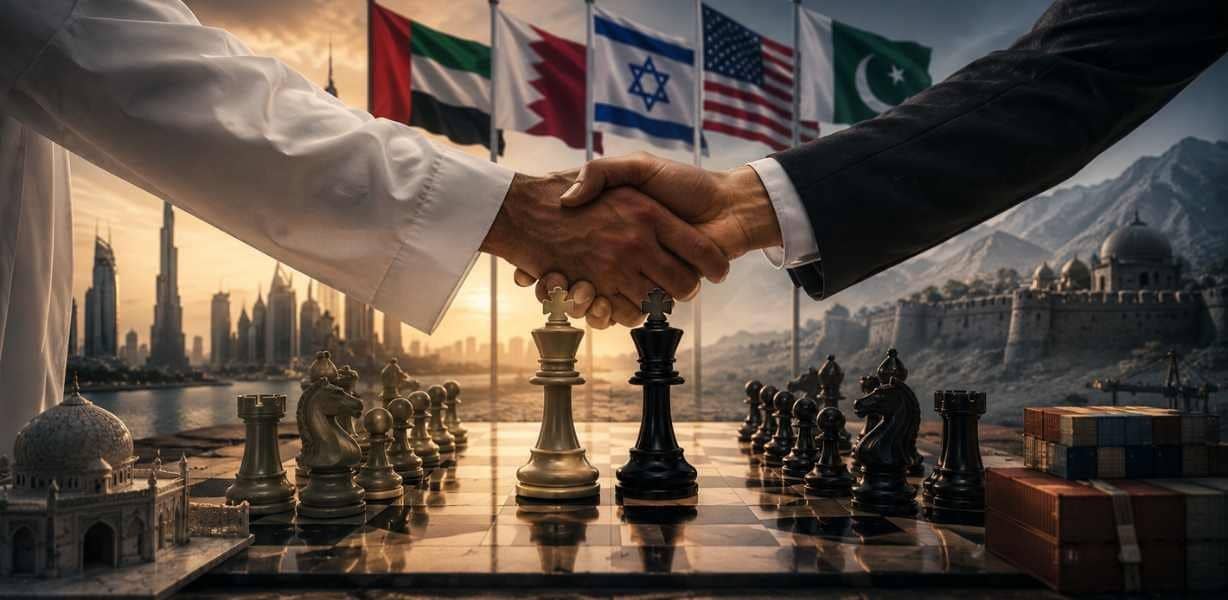
Image | Representative Only
Key Takeaways
1 of 3
Automatically generated. Read full article for complete context.
The Abraham AccordsAbraham AccordsA series of US-brokered joint normalization agreements initially between Israel, the UAE, and Bahrain, signed in 2020. are often narrated as a diplomatic breakthrough that reorders the Middle East toward stability and cooperation. That framing is politically convenient, but analytically incomplete. What the Accords actually represent is not a peace architecture in the traditional sense, but a system of managed realignment in which normalizationNormalizationThe establishment of formal diplomatic, political, and economic relations between states that previously had no such ties. with Israel is decoupled from the Palestinian question and embedded within a broader United States–led strategic order.
At the heart of this order lies not reconciliation but recalibration. The United States has not acted as a neutral mediator between equal parties; it has functioned as an architect of incentives, constructing a regional environment in which states are rewarded for bilateral normalization with Israel and for alignment with American strategic priorities, particularly the containmentContainmentA foreign policy strategy aimed at preventing the expansion of a hostile power or ideology. of Iran and the consolidation of a security corridor linking the Gulf to Israel. In this configuration, Palestine is no longer the organizing principle of regional diplomacy. It remains rhetorically present, but politically displaced.
This shift did not emerge in a vacuum. It reflects a long-standing American approach to the region in which stability is defined not by resolution of core conflicts but by their strategic containment. The Abraham Accords formalise this logic by converting unresolved political contradictions into diplomatically manageable arrangements. States are not required to resolve the Palestinian question; they are only required to bracket it.
To describe this as merely “dividing Muslim countries” risks oversimplification, but it is not wrong to identify fragmentation as a structural outcome. The Muslim world was never a unified geopolitical blocGeopolitical BlocA group of nations acting together for common political, security, or economic interests on the global stage.. It has always been divided by regime interests, security dependencies, sectarian fault lines, and competing alignments with external powers. What the Abraham Accords do is not create division, but institutionalise fragmentation into a functional system of differentiated bilateral relationships with Israel under American sponsorship. The result is a regional landscape in which collective political positioning on Palestine becomes increasingly difficult to sustain.
Within this shifting architecture, Pakistan occupies a particularly revealing position. Historically, Pakistan has maintained a formal stance of non-recognition of Israel conditioned on Palestinian statehood, while simultaneously navigating deep economic dependence on external actors, including the United States, China, and Gulf states. This structural dependence has repeatedly pulled Pakistan into transactional diplomacyTransactional DiplomacyA foreign policy approach focused on short-term, mutually beneficial exchanges rather than long-term alliances or shared values., where strategic alignment is negotiated not on the basis of ideological coherence but on immediate economic and political necessity.
The recent political signalling around Pakistan and the Abraham Accords – particularly the way discussions have reportedly engaged military leadership more directly than civilian institutions—reflects this deeper pattern. It is not simply a question of protocol or diplomatic style; it reflects how external powers read Pakistan’s internal power structure. The privileging of military interlocutors over civilian governments is not accidental. It is a recognition of where effective decision-making authority often resides in matters of security and foreign policy. But it is also a mechanism through which that imbalance is reinforced.
In this context, Pakistan’s engagement with American political figures, particularly during the Trump era and its afterlives, takes on added significance. Trump’s foreign policy style was explicitly transactional, shaped by personal diplomacy, direct bargaining, and the prioritisation of perceived “deals” over institutional consistency. States that adapted to this style were often rewarded with attention, flexibility, or temporary strategic relevance. Pakistan’s political and military establishment proved adept at this mode of engagement, presenting itself as indispensable in managing regional security concerns, particularly in Afghanistan and counterterrorism coordination.
However, this form of “smooth talking” diplomacy comes at a cost. It reinforces Pakistan’s position as a state that is periodically useful rather than structurally anchored in any stable strategic framework. Each engagement cycle produces short-term access but long-term dependency. In the logic of American transactionalism, such states are not allies in a normative sense; they are instruments of situational convenience. Once their utility declines or shifts, they are repositioned accordingly.
The Abraham Accords amplify this dynamic by expanding the field of transactional diplomacy beyond South Asia into a broader Islamic–Israeli normalization framework. In this expanded field, countries are evaluated not by their historical positions or ideological commitments, but by their willingness to align with a restructured regional order. For Pakistan, this creates a recurring pressure point. Even without formal entry into the Accords, the mere circulation of its name within that conversation signals a shift in how its geopolitical identity is being externally constructed.
What is unfolding is therefore not simply diplomatic pressure to normalize relations with Israel. It is a deeper process in which Pakistan is being inserted into a wider architecture of managed alignment, where engagement with the United States and its regional partners increasingly comes with implicit expectations of flexibility on long-standing positions. The danger is not immediate policy reversal, but gradual strategic erosion, where positions once framed as foundational begin to appear negotiable under economic and diplomatic pressure.
The broader significance of the Abraham Accords lies precisely here. They do not resolve the Israeli–Palestinian conflict, nor do they create genuine regional unity. Instead, they reorganize the diplomatic environment in which that conflict is managed, allowing states to pursue normalization with Israel without resolving underlying political questions. The United States remains the central broker of this system, distributing incentives and recognition in ways that reinforce its strategic priorities.
Seen in this light, Pakistan’s role is not that of a passive observer but of a structurally exposed actor within a global system that rewards transactional flexibility. Its historical position on Palestine, its internal civil–military imbalanceCivil-Military ImbalanceA situation where the armed forces hold disproportionate political power compared to elected civilian leadership., and its recurring need for external financial stabilization all converge to make it particularly susceptible to this form of diplomatic incorporation.
The result is a political landscape in which sovereignty is increasingly expressed not through consistent strategic autonomyStrategic AutonomyA state’s ability to pursue its national interests and make foreign policy decisions independently of external pressures or major powers., but through repeated negotiation of access. The Abraham Accords are not an isolated agreement in this process. They are part of a wider architecture in which power is exercised through selective inclusion, and in which states like Pakistan are continuously positioned at the edge of incorporation, always available for engagement, but never fully secure within it.
If there is a unifying logic here, it is not division for its own sake, but the consolidation of a system in which fragmentation becomes administratively useful. The United States does not need to formally divide the Muslim world; it only needs to engage it as a series of separate, negotiable relationships. In that sense, the Abraham Accords are less a peace initiative than a refinement of an older geopolitical method: the management of asymmetryAsymmetryA significant imbalance of power, wealth, or influence between two interacting nations or actors. through transaction.
Disclaimer:The views and opinions expressed in this article are those of the author(s) and do not necessarily reflect the official policy or position of The Rift.