Opening The Rift
therift
© 2026 The Rift. All Rights Reserved.
Youth Clean Up Banas River close to its Source of Origin
Inspired by a scientist’s sacrifice, a group of youth formed Sarva Hith to clean the Banas River, removing over 100 sacks of garbage.

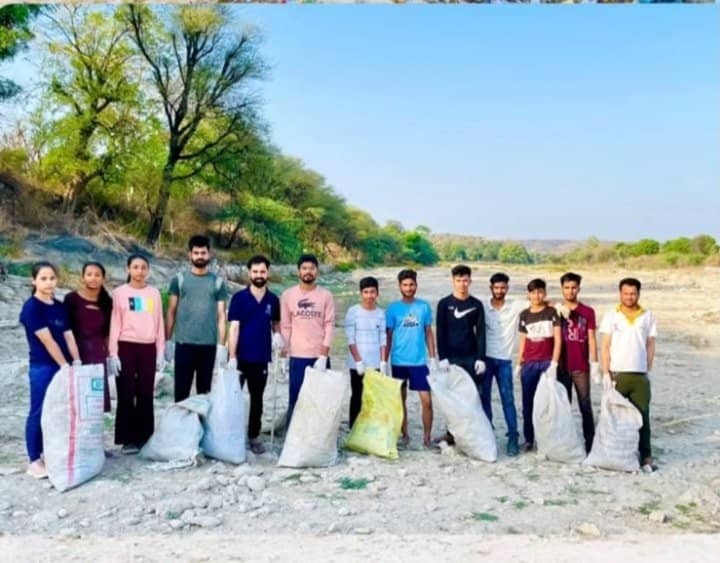
Youth lead efforts to clean up the Banas River close to its source of origin
Key Takeaways
1 of 3
Automatically generated. Read full article for complete context.
The Banas RiverLifeline of RajasthanA major seasonal river in Rajasthan, India, flowing over 500 km and serving as a crucial water source in the arid region. flows for over 500 km in water-scarce Rajasthan, fulfilling important ecological roles and meeting the needs of many people. The Bisalpur projectWater Supply SchemeA significant dam and reservoir project on the Banas River, primarily designed to provide drinking water to several cities in Rajasthan, including Ajmer and Jaipur. has increased its reach further to meet the drinking water needs of many more people in Ajmer. In its upper reach in South Rajasthan, in the Aravalli hills, this seasonal river has been sometimes referred to as Van ki Aas“Hope of Forests”A local term for the Banas River in its upper reaches, reflecting its vital ecological role in sustaining forests and biodiversity in the Aravalli hills. or hope of forests, a reminder of its important ecological role. The river, a tributary of the Chambal River, is closely associated with several mythological tales, which also reflect a recognition of its importance and of the need for keeping it clean and protected.
It is an indicator of the growing neglect of rivers that such an important river and its vicinity became a dumping place for many kinds of garbage and what is more, this happened closer to its source of origin in Khamnor town. If a river becomes so dirty and polluted in its upper stretch, then it has an adverse impact on the river for a considerable stretch downstream.
This situation was being watched with increasing concern by a group of youth from this town, including Suresh Lohar, Pravin, Kajal, Lalita, Rajat, Deepak, Hitesh and others. Kajal says, “It was really worrying to see that even diapers and sanitary napkins were being dumped in the river and its vicinity, along with all sorts of other garbage.”
Suresh Lohar, who emerged in a leadership role in this group of youth, said, ‘I had been very influenced by the sacrifice a scientist G.D. Aggarwal made for protecting the Ganga river when I had read about this earlier. I then started thinking more about this. If an elderly scientist could sacrifice his life for the cause of protecting the Ganga, then surely we younger people should do our bit for reducing pollution in a river flowing close to our home.”
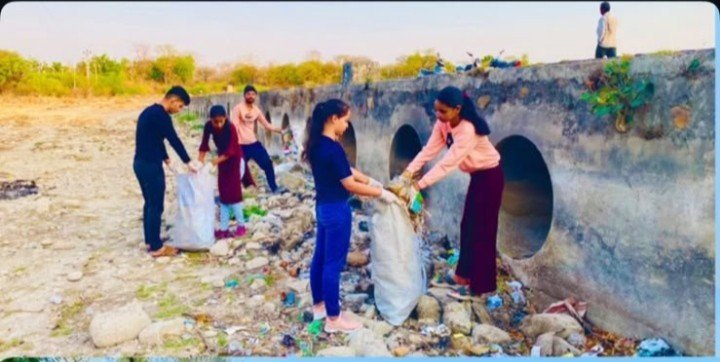
This group formed a small organization called Sarva Hith (meaning welfare of all). True to the name they carried, they decided to take up as their first big initiative the cleaning up of the river which would benefit not just all people but all forms of life. Social media was also used to draw attention to the need for cleaning up the river and to try to get more volunteers for the cleaning work.
The cleaning work finally started with a lot of good intentions but also several difficulties. As many kinds of harmful garbage were being encountered, it was not easy to continue this work for a long time, particularly since most of the youth involved, including young boys and girls, had no previous experience of such work. As students they had heard about such initiatives but had never previously participated in them. Nevertheless about 22 youth participated in this work on most days, and it continued for about 10 days. Thus over 100 sacks of garbage were removed from the river and its vicinity.
This work could have an even wider impact due to a project for creating clean surroundings being implemented by a voluntary organization Seva Mandir in Khamnor. Seva Mandir appreciated and encouraged this work. Some of the volunteers from its various programs also participated later in the cleaning of the river and other water sources in the town and its surroundings.
The youth group also found more conducive conditions for continuing its work due to various initiatives from this wider project aimed at creating a cleaner town. The volunteers from Sarva Hith have also been involved recently in campaigns for reducing polythene use and tree planting. They participated in Seva Mandir’s initiatives to arrange visits to various sites for good solid waste management in places like Indore, Dungarpur and Udaipur, thus opening up new possibilities and ideas for their future work.
The Sarva Hith organization, therefore, has got off to a very good start and it hopes to incorporate more public interest efforts into its future initiatives. The efforts to keep the Banas river clean need to be extended to a wider area and it would be a good idea to follow up the initial effort by exploring whether other garbage accumulation sites are emerging along the flow of the seasonal river in nearby areas. If such sites are detected, then an alert can be raised about them and perhaps more volunteers can be mobilized for clean-up work. There can be a wider mobilization and networking for this, extending over a wider area, with Jan Hith can take the lead, helped by Seva Mandir. Hence a wider initiative for protecting the Banas river can emerge, particularly in its ecologically crucial upper reach, including preventing pollution and protecting forests, drawing inspiration also from mythological stories relating to this but but at the same time guided by a scientific approach.
Disclaimer:The views and opinions expressed in this article are those of the author(s) and do not necessarily reflect the official policy or position of The Rift.