Opening The Rift
therift
© 2026 The Rift. All Rights Reserved.
Thou Shalt Remain Exactly As Thou Wert
A modest proposal for the comprehensive regulation of absolutely everything. All persons, places, directorates, ordinances, inspectors and chutneys in this piece are fictitious. Any resemblance to any authority is sheer coincidence.

Key Takeaways
1 of 3
Automatically generated. Read full article for complete context.
Imagination is a good thing. One must be imaginative.
Imagine an adult citizen wakes up one morning, stares at the ceiling fan for longer than is strictly healthy, and concludes that the answers to his spiritual quest lie in a temple, or a mosque, or a church, or a gurdwara, or an occult cult, or just nowhere in particular. It is a quiet, private contemplative interaction between one person and the universe, conducted in pyjamas.
Or so one might think. One might turn out to be horribly wrong.
In a growing number of jurisdictions, that private negotiation now has a third party, and the third party has both a rubber stamp and a veto, backed up by Orwellian penal consequences. The epiphany must be declared in advance to the District Magistrate, in some versions as much as sixty days ahead, in the prescribed form, with copies.
It may be put up on a notice board so that the neighbourhood, which has never once returned a borrowed pressure cooker or a salaam, may now return its views on your soul and its journey. Inquiries may be made into whether your motives are sufficiently pure. And the consequences of getting the paperwork wrong are serious enough to concentrate the mind of everyone in the vicinity, including the officiant.
The stated purpose of these statutes, usually titled with a confidence that only a Freedom of Religion Act can muster, is to protect the vulnerable from force, fraud, allurement and undue influence. A worthy aim. Nobody is in favour of fraud, except perhaps fraudsters, and they are not taking questions.
Which leaves one small, impertinent question.
If it is the proper business of the State to supervise the precise moment a citizen changes what they believe, why should this tender concern and caring supervision stop at the soul? The soul, after all, is housed in the body, and the body is a clear consumer of public attention. Breakfast is not.
The Prevention of Unlawful Culinary, Sartorial and Follicular Apostasy Bill, 2026
(Bill No. 0 of 2026. Introduced by nobody. Referred to a Select Committee of grandmothers, who have already reported.)
Section 1. Applicability : This Bill when enacted as Law shall apply in the entire territory of India and to all Indians wherever they may reside, voluntarily or serving time.
Section 2. Definitions. In this Act, unless the context otherwise requires:
(a) “ancestral diet” means whatever your grandmother says it was;
(b) “allurement” includes free samples, buy-one-get-one offers, the smell of a bakery at seven in the morning, and any food video exceeding fifteen seconds;
(c) “convert” means to move, directly or by stealth, from one breakfast to another, and includes the pre-conversion state known as “just trying a bite”.
Section 3. Prohibition. No person shall convert, or attempt to convert, from paratha to granola, from idli to sourdough, or from buttermilk to any beverage that requires the customer to pronounce the desired product.
Consider the scale of the problem. Every morning, millions of citizens defect from four thousand years of bajra roti and walk into a café to order an iced oat-milk latte with avocado toast, without so much as a postcard to the tahsildar. Was the customer not seduced by deceptive marketing? By the insidious promise of fibre? By a barista who called him “boss”?
Under the Bill, any switch of staple would require a forty-five-day prior notice period and a public summons at the local registry: “If any person knows any just cause or impediment why Shafeeq should not ingest this burrito, let him speak now or forever hold his chutney.” Should a neighbour suspect that a pizzeria lured someone away from dal-khichdi by undue aromatic influence, the burden of proof would fall squarely on the diner to establish that he was not coerced into the change. Expert evidence on garlic will be admissible.
The wardrobe is graver still. The most successful missionary movement in human history has been conducted by a pair of trousers. Denim arrived quietly, made no promises, and within a generation had converted the dhoti, the angarkha and the nine-yard sari’s more impatient descendants.
The Bill accordingly provides for roadside checkpoints at which Civil Dress Inspectors measure whether your fabric matches an authenticated family tree. Athleisure without a No-Objection Certificate from the Ministry of Forefatherly Garb attracts a fine, community service, and immediate confiscation of the Lycra. You may risk having to go home in underwear.
And then there is hair, the crowning offence. The young now walk into salons and brazenly demand fades, perms and blunt bobs wholly alien to the partings of their parents. Under the Uniform Follicular Maintenance Code, every citizen must produce notarised passport photographs of both biological parents before being permitted within one metre of a pair of scissors. If your father parted his hair sideways with coconut oil from 1974 until his last breath, your asymmetrical undercut is not a haircut. It is a statement of rebellion. And statements of rebellion, as everyone knows, require a permit.
Meanwhile, a look at the Constitution.
The jokes write themselves only because the premise has already been drafted.
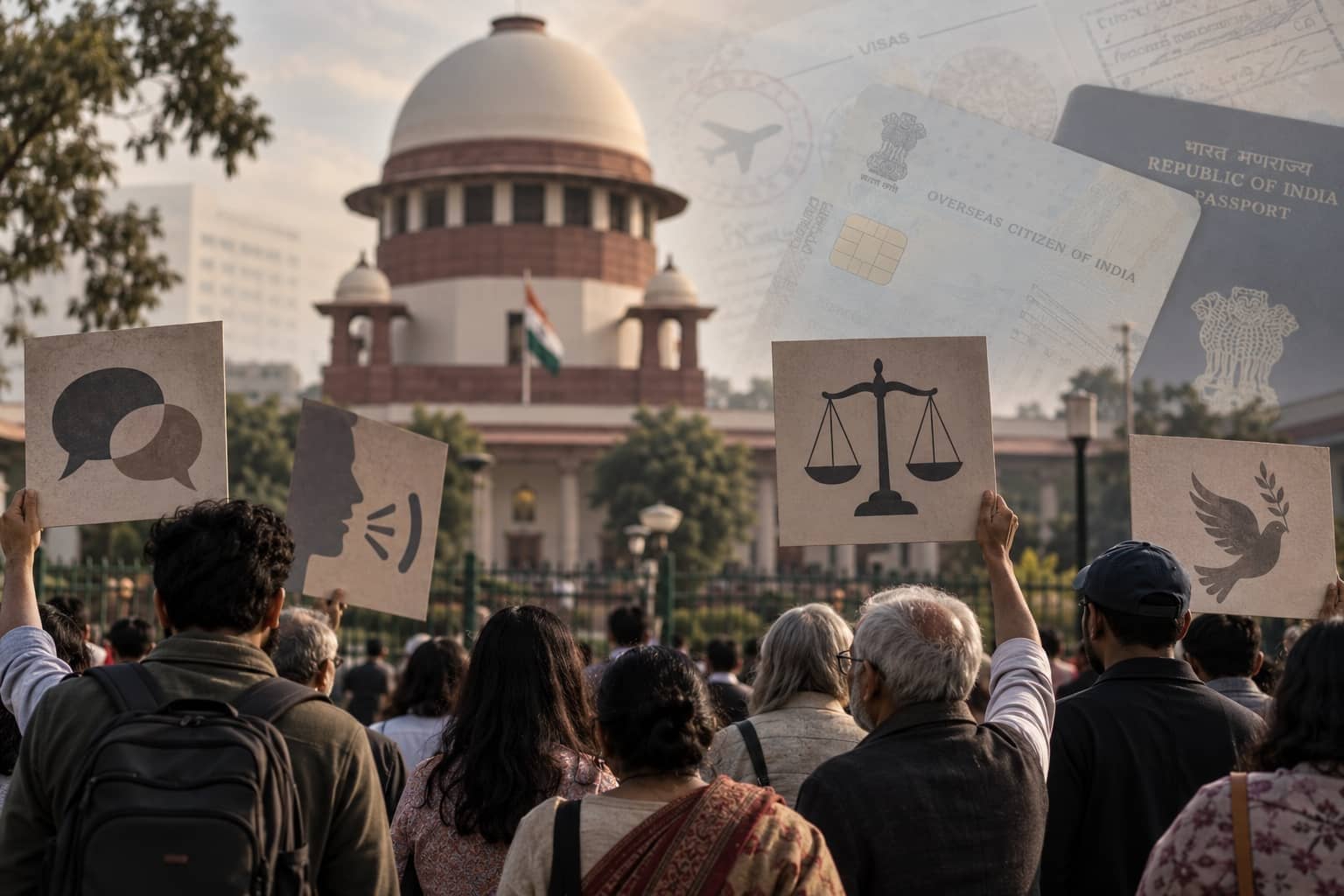
Article 25 guarantees to all persons “freedom of conscience and the right freely to profess, practise and propagate religion.” Notice the order. Conscience comes first, ahead of profess, practise and propagate, and far far ahead of the notice board. The framers put it there, one imagines, on purpose. Conscience belongs to the living individual, not to the census register, the family tree, or the ration card of 1951. Or to the dead.
If forced conversion is wrong because it overrides a person’s will, a fair question follows : what of a procedure that makes leaving so slow, so public and so hazardous that most people simply give up and stay put? A law that makes the exit door heavy enough has not, strictly speaking, abolished coercion. It has only changed who is holding the door. Is it a Collector?
A Brief Interlude for the Lawyers (waiting patiently, and billing accordingly)
The constitutional story of the right to convert is, in essence, the story of the courts slowly turning their head from the person throwing the ball to the person who wishes to catch it.
Rev. Stainislaus v. State of Madhya Pradesh (1977). A five-judge Constitution Bench upheld the early anti-conversion statutes of Madhya Pradesh and Orissa. The Court held that the right to “propagate” means the right to transmit and explain one’s religious tenets, and does not include a fundamental right to convert another person; if A had such a right over B, it would trample B’s own freedom of conscience. Forced, fraudulent or induced conversions were treated as a matter of public order, which brought the legislation within the State List. The Court’s gaze, however, was fixed almost entirely on the converter. The person actually changing their mind was, so to speak, offstage.
Justice K.S. Puttaswamy v. Union of India (2017). Forty years later, nine judges recognised privacy as part of the guarantee of life and personal liberty, and placed a person’s inner life (thought, belief, faith, and the intimate choices of what one eats, whom one marries and what one believes) within a zone where State interference must justify itself. The inner mind became, in substance, a no-parking zone for the State.
Shafin Jahan v. Asokan K.M. (2018). The Hadiya case. The Kerala High Court had annulled the marriage of an adult woman who had converted and married, on the footing that she was vulnerable to influence. The Supreme Court set that aside, holding that an adult’s choices of faith and of partner fall within a sphere where her own autonomy governs, and in which neither family nor State may play guardian.
| The Stainislaus lens (1977) | The Puttaswamy / Shafin Jahan lens (2017 onwards) | |
| Who is in focus | The person spreading the faith | The person choosing the faith |
| Doctrinal anchor | Legislative competence over public order | Dignity, privacy and decisional autonomy (Articles 21 and 25) |
| Role of the State | Protector against exploitation and unrest | Must justify every step into an adult’s conscience |
| Who carries the file | The missionary | The citizen |
The newer statutes, with their advance declarations, public notices and reversed burdens of proof, sit between these two lenses.
The Gujarat High Court in 2021 reportedly stayed parts of that State’s amended law as they applied to inter-faith marriages entered into freely. Challenges to several such statutes are now pending before the Supreme Court, and this column, being both respectful and not moving an inch out of line, careful not to interfere with the course of judicial proceedings or obstruct justice, dare not presume to guess how they end.
The satirist, happily, is bound by no such restraint about the future. Let us visit it, unseen scene by unseen scene.
Unseen Scene One: The Single-Window Clearance Cell
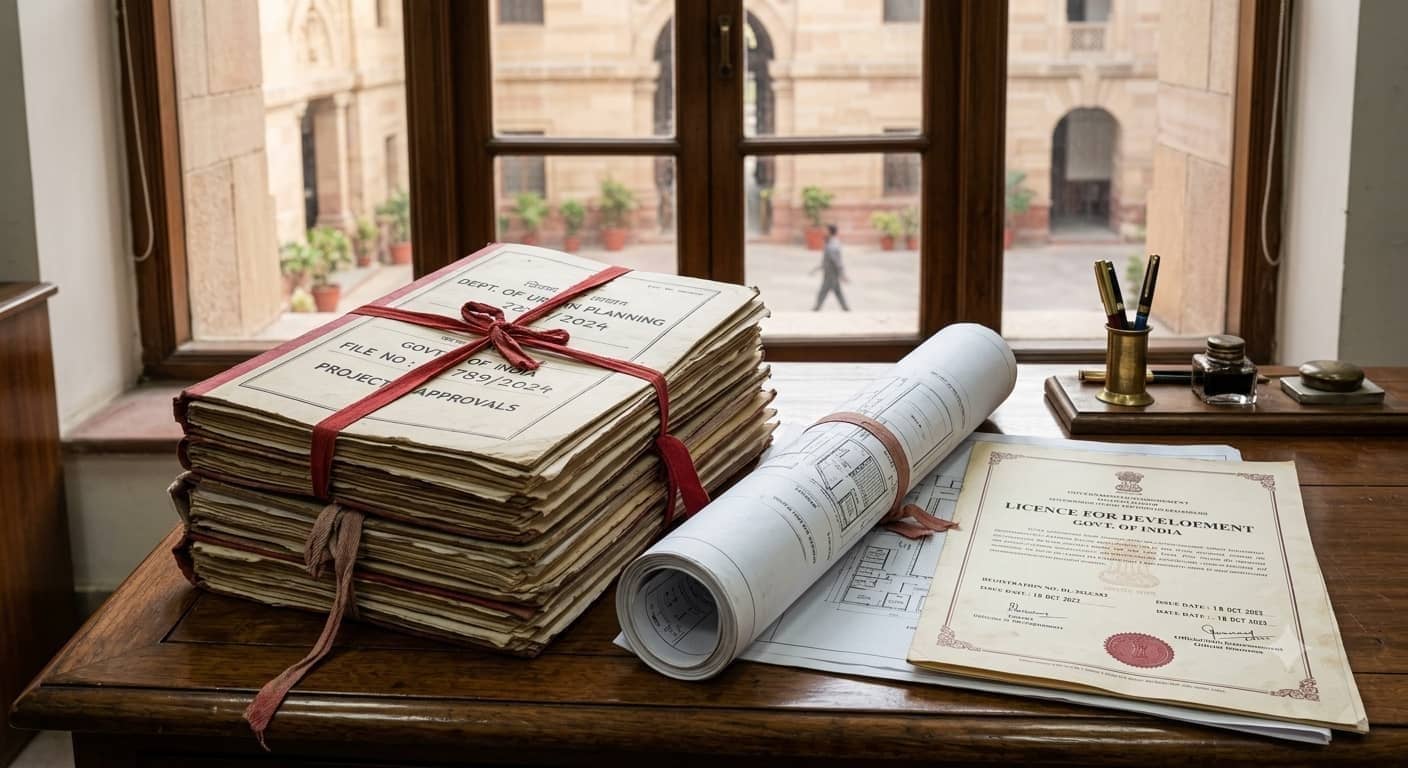
The year is 2037. In the Collectorate of the entirely fictional district of Bhoolbhulaiyapur, the Directorate of Lineage Compliance has inaugurated its flagship “Single-Window Clearance Cell for Cosmic, Culinary and Cosmetological Deviations.” It has eleven counters. Each is a single window.
At Counter No. 4 sits HisaabNavis, a thirty-two-year-old accountant clutching a three-hundred-page ring binder, twenty-eight passport photographs, and the faint hope of being home by lunch. The photographs have been attested by a gazetted notary in a safari suit that has itself been attested by a dhobi. Dhobi because dry cleaners have been outlawed.
“Next!” bellows the clerk, dipping a steel nib into an inkwell that has outlasted two pay commissions and every attempt at digitisation.
“Sir,” HisaabNavis whispers, sliding the file across. “I am applying for a Category C-12 Existential Amendment.”
The clerk peers over his half-moon spectacles. “Dietary apostasy, follicular sedition, or full theological desertion?”
“A little of all three, sir. I had a dream last Tuesday. I wish to change my faith, give up mustard oil for extra-virgin olive, and get a crew cut.”
The clerk inhales so sharply that his tea leaps onto the official stamp. “A crew cut? With your file? Your grandfather’s portrait in Annexure 3 shows a symmetrical centre parting and a generous application of amla oil! Where is the NOC from your late great-aunt?”
“I have her death certificate and an affidavit from a medium, sir!” HisaabNavis taps Annexure 9. “We held a séance before two independent witnesses. She said, and I am quoting her exactly: ‘Do whatever you want, you useless boy, just don’t touch the fixed deposits.’”
“Insufficient! It is not on stamp paper!” The clerk flips furiously to Schedule 7. “You propose to change your god and your cooking medium in the same financial quarter! Did you paste the sixty-day notice regarding the olive oil? What if the District Mustard Growers’ Association objects? What if they allege you were induced by a Mediterranean holiday brochure? The burden is on you, HisaabNavis! Prove to this office that the cauliflower salad did not exercise undue influence over your vulnerable northern-plains constitution!”
“Sir, I have medical bills! The parathas were giving me acidity!”
“Paratha disparagement!” cries a voice from behind a steel almirah. Out steps the Deputy Assistant Inspector (Chutneys), holding a pair of callipers and a magnifying glass. “Step forward, applicant. Let us examine the sides.”
He studies HisaabNavis’s scalp with the gravity of a forensic archaeologist approaching an unexploded land-mine. “Tapering! An unauthorised fade! Attendant, seize the pomade! He has commenced pre-conversion grooming without a permit!”
HisaabNavis drops to his knees. “I’ll stay! I’ll believe whatever is on the 1951 ration card! I’ll part my hair sideways with three tablespoons of warm mustard oil until my ears turn yellow! Just let me go home!”
“Too late,” the clerk beams, unrolling the master register. “Form 42-B has already been stamped Under Observation for Suspicious Cosmological Drift. You will report to this Directorate every Sunday, recite your genealogy back to the Mauryas, consume one bowl of lineage-approved daliya under CCTV, and file a monthly follicular progress report countersigned by an authorised municipal barber.”
The stamp comes down with a thud that sets the ceiling fan wobbling : CONVERSION DENIED. IDENTITY ENFORCED. MUSTARD OIL MANDATORY.
HisaabNavis is escorted out, weeping with gratitude that nobody found the sushi recipe in his phone, while three hundred citizens in the queue quietly slide shampoo bottles and packets of instant noodles into their lungi-dhoti folds.
Scene Two: The Uniform Crisis
The circular is pasted to the school gate with waterproof adhesive and sealed in red wax:
CIRCULAR NO. 994-B
With effect from 08:00 hours this Monday, all grey trousers, pleated skirts, striped ties and polyester polo shirts stand rescinded under the Preservation of Lineage in Pedagogy Ordinance.
Every scholar shall present himself or herself in the authenticated ancestral garments of his or her bloodline. Failure to resemble the year 1842 at the gate shall result in denial of entry, seizure of hall ticket, and remedial instruction in hand-spinning.
By 7:45 a.m., the pavement outside Bright Future Senior Secondary School looks like a period drama, a wedding bazaar and a customs inspection that have collided at a traffic signal.
At the gate stands Vice-Principal Mr. Chikadambam, armed with a brass tailor’s tape, an illustrated genealogy chart and a magnifying glass. Beside him is Inspector Ghadbad Khan of the Directorate’s Apparel Flying Squad, holding a stamp pad of indelible purple.
“Halt!” Chikadambam extends the tape toward thirteen-year-old Crackbir, who is melting inside a gold-brocaded velvet sherwani last seen at an uncle’s 1917 wedding in Lucknow, beneath a pearl-studded topi sliding slowly down his forehead in the thirty-five-degree heat.
“Sir,” Crackbir pants, hauling up a churidar three feet too long and bunched around his ankles like a pair of harmoniums, “I have the Physics mid-term in ten minutes.”
“Silence! What is this thread count? Banarasi weave or micro-poly blend? And the footwear! Inspector, the feet!”
Ghadbad Khan gasps. “High-top basketball sneakers! Beneath an eight-button Awadhi sherwani! He is smuggling comfort into the compound!”
“The curly-toed mojris pinched, sir! I couldn’t run for the bus!” Crackbir hops on one foot as his drawstring snaps with a twang, leaving him clutching his waist with one hand and his geometry box with the other.
The stamp thuds : UNAUTHORISED RUBBER SOLE. RETURN TO ANCESTRAL COBBLER.
Behind him stands Aromanya, whose parents, terrified of fines, have dressed her in a silk salwar kameez with a dupatta so vast and so heavily starched that she can turn her head only by rotating her entire body like a lighthouse.
“Regulation requires two and a half metres across the chest, pinned at thirty degrees,” Chikadambam announces.
“Sir, I can’t breathe,” comes a voice from within the magenta. “If the wind catches this, I’ll be airborne. And I have Chemistry practicals. One Bunsen burner and Section B goes up in flaming silk.”
“Education without lineage is merely smoke, child. But what is this in your ear? A wireless earbud concealed beneath sacred embroidery!”
“It’s the periodic table audiobook, sir!”
“Unauthorised digital osmosis! Get home, traitor!”
In the next queue stands Zinngazang, immaculate in a black abaya and neatly pinned hijab. Ghadbad Khan, determined to find something, bends low over the cuff.
“What does this gold thread say?”
“It’s a jaali pattern, Uncle. Geometric.”
“Geometric, is it? That is clearly the quadratic formula! You intend to cheat!”
“It’s an Islamic pattern!” cries her mother from behind the barricade.
“That is what they said about Pythagoras!” Ghadbad Khan roars, turning the cuff upside down, then sideways, then upside down again. It is later established that the Inspector last passed mathematics during the Telangana Agitation, and sees the quadratic formula in most things, including his wife’s rangoli. The gate, however, has already closed.
Across the road, four tenth-graders have been sewn into starched silk veshtis. Not one of them has ever tied a knot more complex than a shoelace. They stand in a defensive circle as a passing delivery motorcycle whips up a breeze.
“Hold the pleat, Rahul! Do not let go of the pleat!”
“Sir, I can’t sit a three-hour calculus paper like this!” Rahul shuffles forward, knees welded together, moving like a penguin at a funeral. “If I bend down for a dropped eraser, I’ll be prosecuted under the Indecent Representation of %$#@ Act!”
“Then you should have learnt your father’s knot instead of video games! And where is your angavastram, triple-pleated across the left clavicle?”
“Sir, the dog ate it.”
“Then the dog has shown more civic sense than you. Gate closed. Zero in Pre-Boards.”
At 8:15 the bell rings. Inside the seventy-seat examination hall, exactly one candidate is present: nine-year-old Montashve, whose family, after extensive consultation with the archives, discovered that a great-great-grandfather had been a wandering ascetic who wore nothing but a coarse burlap robe tied with jute rope. Montashve sits at desk number one in an identical robe, itching heroically, holding a single 2HB pencil.
At the podium, the invigilator surveys the empty hall with deep bureaucratic contentment. “At last,” he murmurs. “A pure classroom. Not one western hemline. Not one gram of polyester.”
“Sir?” Montashve’s small voice echoes off seventy empty desks.
“Yes, scholar?”
“Who is going to give out the question papers? All the teachers are stuck at the gate, because the Physics master’s ancestral headgear has a plume, and it’s stuck in the doorway.”
The invigilator consults the Ordinance. The Ordinance is silent on plumes. He consults the question papers. They are printed on paper of foreign origin. He reaches, slowly and with great dignity, for the stamp.
Thud EXAMINATION POSTPONED PENDING GENEALOGY OF THE PAPER.
Finally, there the satire runs out of road, because the real thing has a head start. No Constitution worth its preamble asks a citizen to file Form 42-B before changing their mind.
Conscience is not a building plan to be sanctioned, a vehicle to be registered, or a liquor licence to be renewed every March. It is the one possession a citizen carries that no inspector can measure with callipers, however hard he squints.
A Republic that is confident in its people can afford to let them choose their God, their breakfast, their dress and their haircut without a stamp, and to save the stamp for the cheat, the bully and the fraudster, which is precisely where the law was always meant to aim it.
The universe has been informed, and has asked for an extension. Until the matter is finally settled, citizens are respectfully advised to keep their souls, their sourdough and their side-partings exactly where the register says they are. Obituaries are to be scheduled in advance. universe has been informed, and has asked for an extension.
Jai Hind.
Disclaimer:The views and opinions expressed in this article are those of the author(s) and do not necessarily reflect the official policy or position of The Rift.