Opening The Rift
therift
© 2026 The Rift. All Rights Reserved.
The CAA Tells India Who Deserves Citizenship. The Supreme Court Must Decide if That is Constitutional
Today, on May 5, the Supreme Court opens final arguments on 240 petitions against the Citizenship Amendment Act. The government has spent six years making the law a fact on the ground. The court must now decide if it is also a fact of the Constitution.

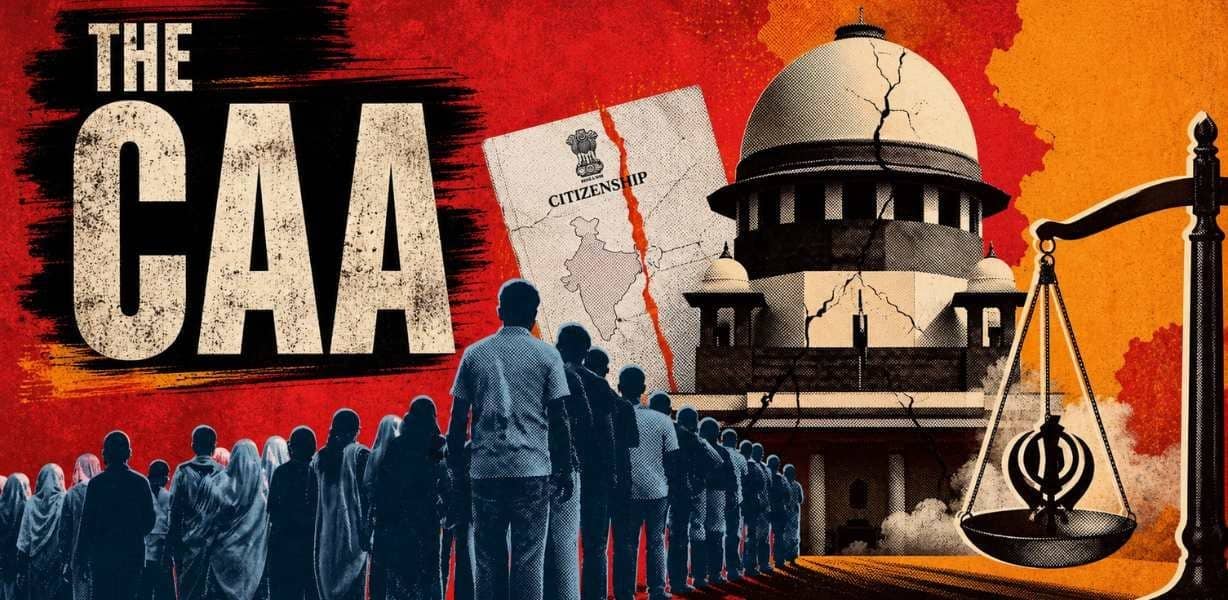
Representative AI Image
Key Takeaways
1 of 3
Automatically generated. Read full article for complete context.
The Citizenship Amendment Act has been law for six years. The Supreme Court of India begins hearing final arguments against it on May 5, 2026. A bench led by Chief Justice Surya Kant, alongside Justices Joymalya Bagchi and Vipul M. Pancholi, will hear over 240 petitions challenging the law’s very foundation. The hearing window runs through May 12. The legal question is simple enough: does a law that picks who gets citizenship based on their religion violate the right to equality? The political reality around that question is anything but simple.
Since December 2019, when the CAA received presidential assent, the government has not waited for the court. It notified the implementing rules in March 2024 and began issuing citizenship certificates by May that year. The court never stayed the law. It never stopped the rules from taking effect. And now, with thousands of certificates already granted, the judges face a question that has quietly changed shape: even if the law is unconstitutional, can you take back citizenship that has already been given?
This is not an accident of timing. It is the logic of delay.
Who Gets In, Who Stays Out
The CAA offers a fast track to Indian citizenship for Hindus, Sikhs, Buddhists, Jains, Parsis, and Christians who fled Afghanistan, Bangladesh, or Pakistan before December 31, 2014. It frames this as a humanitarian measure, a rescue for religious minorities persecuted in countries with official Islamic constitutions. On its face, that sounds reasonable.
The trouble starts with who is left out. Ahmadiyyas in Pakistan face constant violence and legal persecution. Hazaras in Afghanistan have been targeted for decades. The Rohingya, one of the most persecuted groups on earth, are entirely absent from the law. So are Tamil Hindus and Christians from Sri Lanka, who lived through a decades-long civil war. If the point is to protect persecuted people, the list of countries and religions the law chooses does not match that goal. It matches a different one: the political project of treating Muslim migration as inherently different from non-Muslim migration.
The petitioners, led by the Indian Union Muslim League and backed by senior advocates including Kapil Sibal and Indira Jaising, argue exactly this. India’s Constitution requires that any law grouping people into categories must pass two tests. First, the grouping must be based on a real, meaningful difference. Second, that difference must have a logical connection to what the law is trying to do. The CAA, petitioners say, fails both. The grouping is by religion. The stated goal is protecting the persecuted. But the law ignores persecuted Muslims entirely. The religion is doing the work, not the persecution.
The government’s defence rests on a simple claim: Afghanistan, Bangladesh, and Pakistan are constitutionally Islamic states, which makes non-Muslim minorities in those countries structurally vulnerable in ways Muslims are not. That argument has a kernel of truth. But the law itself contradicts it by excluding countries where non-Muslims also face extreme persecution, and by ignoring Muslim sects that face violence precisely because of their faith. The selection is not about who is at risk. It is about who is politically useful.
Two Laws, Two Cut-Off Dates
In Assam, the CAA collides with a much older promise. The Assam Accord of 1985, signed after a six-year student movement led by the All Assam Students’ Union (AASU), set a clear line: anyone who entered Assam after March 24, 1971, regardless of religion, is an illegal migrant and must be detected and deported. That date is tied to the Bangladesh Liberation War. It was the bedrock of the Accord.
The CAA draws a completely different line. It says non-Muslim migrants who arrived before December 31, 2014, can apply for citizenship. That is a gap of over 43 years. For indigenous Assamese communities, this is not a technical discrepancy. It is a betrayal. AASU leaders argue the government is using religion to override a decades-old agreement that treated all migrants the same.
The court has tried to manage this by splitting the cases. It will hear the national constitutional challenge first, and take up the Assam and Tripura-specific petitions separately. But the two questions are not really separable. The national question, whether religion can be a filter for citizenship, is the same question driving the anger in the Northeast. The regional dimension just makes the consequences more visible.
The NRC Trap Door
Then there is the National Register of Citizens. In 2019, Assam completed the only NRC exercise India has ever conducted. It left out 19.06 lakh people. Those excluded were told to appeal before Foreigners Tribunals, quasi-judicial bodies that Amnesty International and Indian civil liberties groups have called deeply flawed. The burden of proof falls entirely on the individual. Many of the excluded are poor, illiterate, or lack documents. Women, married young and never enrolled in school, often have no paper trail at all.
Here is where the CAA and the NRC form a closed loop. If you were excluded from the NRC and you are Hindu, Sikh, Buddhist, or Christian, the CAA offers a second chance. You can apply for citizenship through the fast track. If you are Muslim, there is no such door. You stay in legal limbo, facing tribunals that issue ex-parte orders when people fail to appear, often because they never received the summons. Over 30 people have died in Assam’s six detention centres. The Supreme Court has questioned the state about indefinite detention more than once, but the system continues to operate.
The NRC was supposed to be a register of citizens. Paired with the CAA, it becomes a filter. Non-Muslims who fall off the list get a safety net. Muslims who fall off do not. This is not a gap in the law. It is the design of the law.
What the Court Must Choose
The eight-day hearing beginning today on may,05,2026 is not just about whether one statute survives or falls. It is about whether Indian citizenship will remain a birthright, available equally to everyone born or legally present in the country, or whether it will become conditional, a status the state grants based on your faith.
The court has had this case for six years and never once stopped the government from acting on the law. The 2024 rules were notified weeks before a general election, a timing that was itself a political act. Citizenship certificates have been handed out. Electoral maps have been redrawn. The court now faces a version of the question the petitioners warned about from the start: by the time you rule, the facts on the ground will have already decided the outcome.
But facts on the ground do not amend the Constitution. Article 14 still requires equal treatment. The basic structure doctrine still protects secularism. A law that sorts people by religion and calls it humanitarianism still has to answer to those principles. The court can defer to political reality, as it has done before on questions where the cost of independence felt too high. Or it can do what courts are supposed to do: say what the law actually requires, regardless of who finds it inconvenient.
The petitioners will make their case this week. The Solicitor General will respond. Rejoinders are expected by May 12. But the real question is not what the lawyers argue. It is whether the Constitution still outranks the political calendar.