Opening The Rift
therift
© 2026 The Rift. All Rights Reserved.
The Invisible Ceiling Why the Care Economy is the Real Barrier to the Nari Shakti Vandan Act
The care economy keeps women out of politics, but women in politics are the most likely actors to dismantle the care economy.


Key Takeaways
1 of 3
Automatically generated. Read full article for complete context.
On September 19, 2023, Parliament passed the Nari Shakti Vandan ActWomen’s Reservation BillThe Constitution (One Hundred and Sixth Amendment) Act, 2023, reserving 33% of seats for women in India’s Lok Sabha and state legislative assemblies., the Constitution (One Hundred and Sixth Amendment) Act, reserving 33% of seats in the Lok SabhaHouse of the PeopleThe lower house of India’s bicameral Parliament, composed of representatives directly elected by universal adult suffrage. and state assemblies for women. The political intent is clear and historic. Yet a structural barrier, invisible in legislative text but present in every Indian household, stands in its way: the care economy.
Until Parliament addresses the unequal distribution of unpaid domestic labour, the reservation will remain largely symbolic for millions of women who are too time-poor, too financially dependent, and too structurally constrained from entering political life.
Time Poverty: The Clock That Blocks Political Entry
The MoSPI Time Use Survey 2019 reveals a stark asymmetry. Indian women spend an average of 299 minutes per day on unpaid care and domestic work. The men spend just 97 minutes. That gap of over three hours daily is not a lifestyle preference. It is structural time poverty.
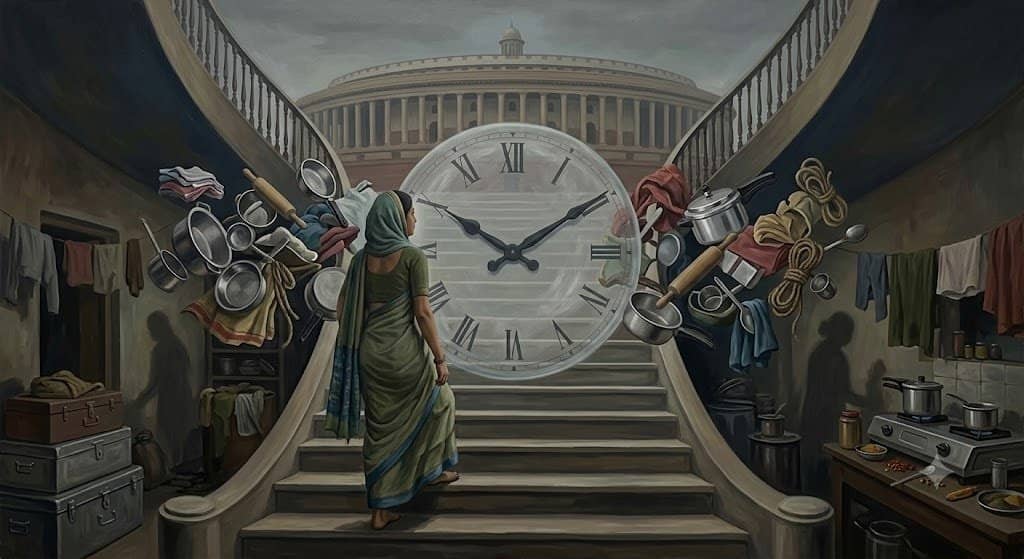
Political participation is time intensive. Canvassing, identity party meetings, building local coalitions, and filing nominations all demand sustained, discretionary time. A woman who wakes before dawn to cook, manages childcare through the day, and tends to elderly relatives in the evening does not have that time. The ceiling is not made of glass. It is a kitchen clock.
Financial Agency: The GDP Contribution That Buys No Campaign Funds
An SBI Ecowrap report estimates that women’s unpaid work contributes 15 -17% of India’s GDP. This contribution is enormous in economic terms. It is invisible in financial ones.
Unpaid labour generates new income, no savings, and no independent credit history. Running a political campaign even at the local level requires funds for travel, outreach materials, and community events. A woman whose economic contribution exists entirely outside the formal market has no financial agency to draw upon. She cannot self-fund a campaign. She must depend on a husband, a party, or a patron, each dependency carrying its own political cost.
The Proxy Problem: When Husband Governs in Wife’s Name
India has already run this experiment at the Panchayati level. The Constitution (Seventy-third Amendment) Act, 1992, reserves a seat for women in the local bodies. What emerged in many cases was a “Sarpanch Pati” phenomena elected women sarpanches attend meetings but whose husbands sign files, conduct negotiations, and exercise actual power.
This is not a failure of women. It is a predictable consequence of pushing women into public roles without dismantling the private ones. When domestic obligations remain unchanged, the elected woman is still expected to manage the household. Her husband steps into the political vacuum she cannot fill. Representations become a formality. Governance remains male.
The Nari Shakti Vandan Act risks replicating this pattern at the national level unless the conditions that produce proxy governance are directly addressed.
The Paradox: Women Who Govern, Transform If They Can Enter
Research on women in governance consistently shows that when women do hold real power, they redirect policy towards care-elevating sectors. A World Bank study on Indian panchayats found that women-led Gram PanchayatsVillage CouncilsThe basic unit of local self-governance in rural India, responsible for local administration and development at the village level. invested significantly more in drinking water, sanitation, and public health infrastructure, precisely the sectors that reduced domestic burdens.
This is the central paradox: the care economy keeps women out of politics, but women in politics are the most likely actors to dismantle the care economy. The reservation creates an opportunity. The opportunity cannot be used until the structural barriers are removed. Policy must break the cycle, not just name it.
The Path Forward: A National Care Policy as a Prerequisite
The Nari Shakti Vandan Act is a constitutional promise. Fulfilling it requires a complementary National Care Policy built on three pillars.
First, infrastructure. Universal, affordable crèche and childcare facilities attached to Gram Panchayat offices, railway stations, and government workplaces would directly reduce the time tax on women’s political participation. The National Creche Scheme exists but remains chronically underfunded and geographically uneven.
Second, redistribution. School Curricula and public campaigns most normalise shared domestic labour. Tax incentives for households that enrol in shared care arrangements and community care cooperatives, supported by VB-G RAM G funds, can accelerate culture change with material reinforcement.
Third, recognition and compensation. Pilot Programme linking unpaid care work to formal society security credits, pensions contributions, and health insurance eligibility would begin to translate invisible labour into tangible financial agency for women entering public life.
The 106th Amendment opens a door. But the door leads into a room that most women, exhausted, financially dependent, and time poor, cannot yet reach. Representations without redistribution are a slogan. A National Care Policy is not a welfare measure. It is a structural prerequisite that makes the Nari Shakti Vandan Act Real.
Parliament legislated the reservation. Now it must legislate the conditions under which women can use it.
Disclaimer:The views and opinions expressed in this article are those of the author(s) and do not necessarily reflect the official policy or position of The Rift.