Opening The Rift
therift
© 2026 The Rift. All Rights Reserved.
Courage of Young Women at Barricades : Constitutional Resolve Honouring the Spirit of Bhagat Singh : a Case for Civil Society Recognition
When citizens, especially those with the least institutional power, insist on these rights, they perform an essential democratic function.

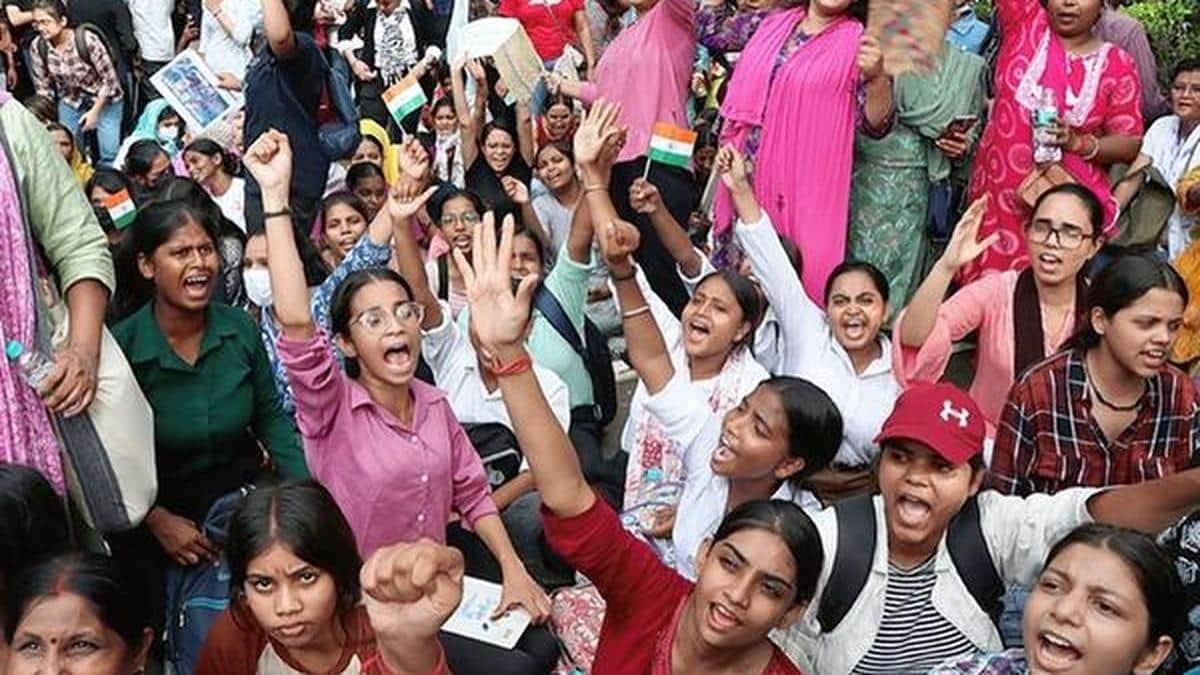
Photo credit (ANI)
Key Takeaways
1 of 3
Automatically generated. Read full article for complete context.
In the summer of 2026, the tents at Jantar Mantar in New Delhi became more than a site of agitation.
They turned into classrooms, kitchens, decision-making spaces and, for many young women, a second home during the Cockroach Janta Party (CJP)-led student protests.
These protests, sparked by repeated examination irregularities including the NEET-UG paper leak controversy, demanded accountability, education reforms, and the resignation of the then Union Education Minister.
Over 36 days, and particularly during the “Sansad Chalo” march toward Parliament, young women stood at the forefront : facing lathi charges, sustaining daily operations, shielding fellow protesters, and refusing to yield.
Their presence was not ornamental.
Women occupied core leadership and spokesperson roles, managed logistics under pressure, and embodied a visible refusal to remain spectators. Reports from the ground describe mothers bringing children, young volunteers who had just finished Class 12 examinations stepping into organising roles, and women from diverse backgrounds : students, professionals, homemakers : sustaining morale when public attention fixed on speeches or clashes.
One lawyer-spokesperson noted that no democratic movement can function without the participation of half the population. In moments of confrontation, young women confronted police lines with composure that many observers later described as unforgettable.
This is not merely a story of youthful defiance. It is a living demonstration of constitutional citizenship.
Article 19 of the Constitution of India guarantees the right to freedom of speech and expression, and the right to assemble peaceably and without arms.
The Supreme Court has repeatedly affirmed that the right to peaceful protest is fundamental and cannot be extinguished merely because an agitation inconveniences the state.
When citizens, especially those with the least institutional power, insist on these rights in the face of physical force, they perform an essential democratic function : they remind the Republic that power remains accountable to the people.
History offers parallel examples. From the women of the Non-Cooperation and Civil Disobedience movements to those who sustained the Chipko and Narmada Bachao Andolan struggles, and more recently the sustained presence of women at Shaheen Bagh, Indian democracy has repeatedly been renewed by citizens : often young women who treat constitutional guarantees as actionable rather than aspirational.
The young women of the CJP protest belong in this continuum. Their courage was not abstract : it was exercised under conditions of risk, fatigue, and institutional resistance.
In doing so, they modelled the kind of civic boldness that a constitutional democracy requires if rights are to remain more than parchment barriers.
Yet recognition remains uneven. Official honours frequently privilege longevity in public office, institutional achievement, or state-sanctioned narratives of service.
Ordinary citizens who risk personal safety to defend constitutional norms rarely receive comparable formal acknowledgement. This gap matters.
Societies incentivise the behaviours they celebrate. When courage in defence of rights is treated as episodic or inconvenient rather than exemplary, fewer citizens are encouraged to step forward the next time those rights are tested.
Civil society therefore has both the opportunity and the responsibility to fill this lacuna.
Independent institutions, universities, bar associations, media organisations, and citizens’ collectives can create awards that specifically honour those who stand up for constitutional rights under pressure.
Suggested names capture the spirit without requiring state endorsement :
Resistance Ratna : recognising sustained, non-violent resistance that upholds democratic norms when they are under strain.
Constitutional Soldier Award : honouring individuals who treat the Constitution as a living mandate and defend its guarantees through disciplined civic action.
Citizen’s Courage Medal or Article 19 Honour : focused specifically on those who exercise the freedoms of speech, assembly and association in the public interest despite personal cost.
Such awards need not be elaborate or expensive. What matters is consistent, transparent criteria : documented peaceful assertion of rights, evidence of risk or institutional pushback, and contribution to public accountability or democratic discourse.
Selection by independent panels of jurists, academics, journalists and civil society figures would preserve credibility.
Annual or biennial presentation, accompanied by public documentation of the recipients’ actions, would create a visible counter-narrative to cynicism and fear.
The effect would be dual. First, it would affirm the young women (and men) who have already acted, telling them their resolve was seen and valued.
Second, it would signal to the broader citizenry : especially students and first-time participants : that constitutional courage is a recognised public good.
In a political culture where power often seeks to normalise silence or compliance, formal civil-society recognition can help tip the balance toward participation.
India’s constitutional project has always depended on ordinary people treating its promises as binding. The young women who stood their ground at Jantar Mantar in 2026 demonstrated that this tradition remains alive. They deserve more than fleeting viral applause.
They deserve institutional memory and structured encouragement so that the next generation understands that defending constitutional rights is not an act of disruption, but an act of fidelity to the Republic itself.
Civil society aided by media platforms can supply that memory : and the incentive : through awards that name and honour precisely this form of heroism.
Jai Hind
Disclaimer:The views and opinions expressed in this article are those of the author(s) and do not necessarily reflect the official policy or position of The Rift.