Opening The Rift
therift
© 2026 The Rift. All Rights Reserved.
Organization, Collective Effort and Self Reliance How the Picture of a Village Changed
Active community organisations can do on the ground what no elderly person could manage alone, proving self-rule is possible even with limited means.

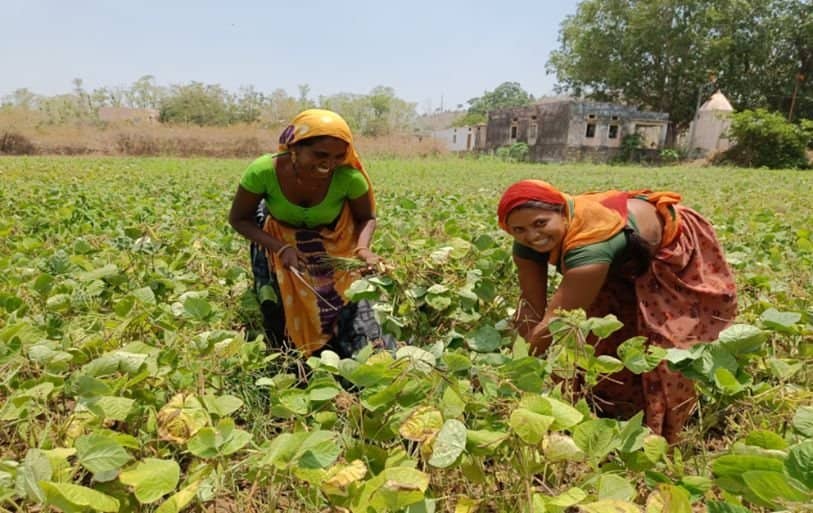
Women tending the crop — the smile of hard work in a lush green field.
Key Takeaways
1 of 3
Automatically generated. Read full article for complete context.
In the tribal heartland of southern Rajasthan, stories of development rarely begin with a gleaming building. More often, they begin with the green bed of a nutrition garden, a stamp on a government paper, or a bag of indigenous seeds. Here, Vaagdhara’s faith rests on a simple idea: change is never imposed from outside; it grows from within the community. Village-level groups are its pivot, places where women and farmers identify their own questions and go looking for their own answers. Among the stories that have flourished in the shade of these groups is that of Saju Devi and her husband Dhanji Meena, whose home is in Dhanela gram panchayat, just five kilometres from the block headquarters of Aspur in Dungarpur district. This family of two sons and two daughters once struggled to balance a month’s needs. Dhanji farmed, and went from village to village selling seasonal vegetables such as tomatoes, okra, bottle gourd, chillies, aubergines, ridge gourd and sponge gourd, but the income barely covered the household’s basic requirements.
The family owns five bighas of land, four of them level and one uneven. The uneven plot could be cultivated only in the kharif season, and its yield went no further than fodder for the animals and grain for the household. The level fields gave a kharif crop, but by the time rabi arrived the water ran out, and wheat and gram could be sown on only a small patch. Two bullocks, two buffaloes and eight goats did not bring in enough to change their circumstances.
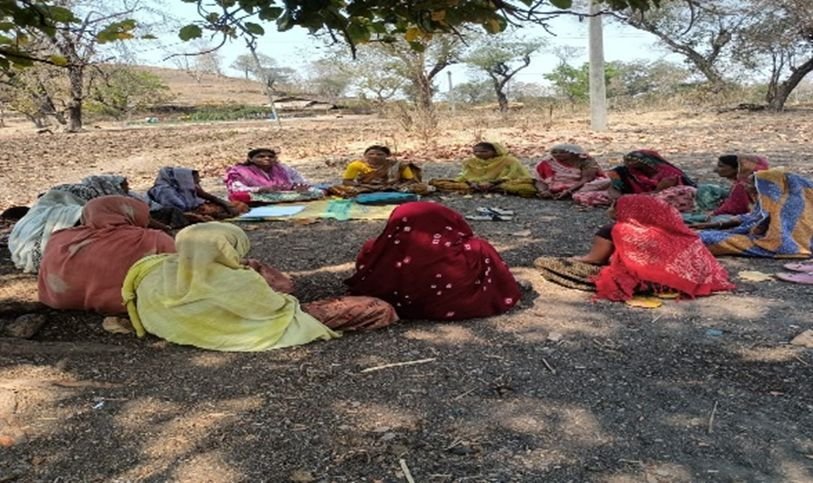
In 2020, Saju Devi joined the ‘Saksham Samuh’ formed by Vaagdhara. As she attended its meetings regularly, she began to see how far dependence on the market could be reduced by relying on local and limited resources. She did not keep this understanding to herself; her own conduct awakened other women as well. She then established a nutrition garden on a small plot near her home, where beds of tomatoes, okra, bottle gourd, spinach and fenugreek began to flourish. The family’s meals became richer in nutrition and their health improved, and by selling the surplus she began earning between one and two hundred rupees a day in season. She no longer had to look to anyone else for small necessities. That self-rule is possible even with limited means was something her garden proved without saying a word.
The real turning point came in 2024. Shailendra Giri Goswami, a Vaagdhara facilitator, told her about the Pradhan Mantri KUSUM solar energy scheme, under which the central and state governments provide farmers with solar-powered irrigation pumps. With her husband’s support and the help of agriculture officer Rekha Meena, she applied online, and in November 2024 a solar pump stood beside her field.
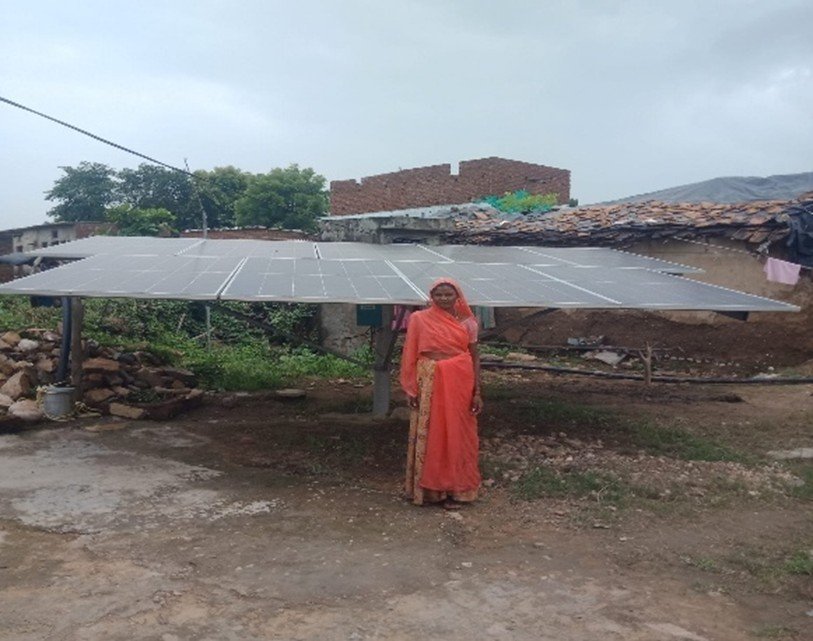
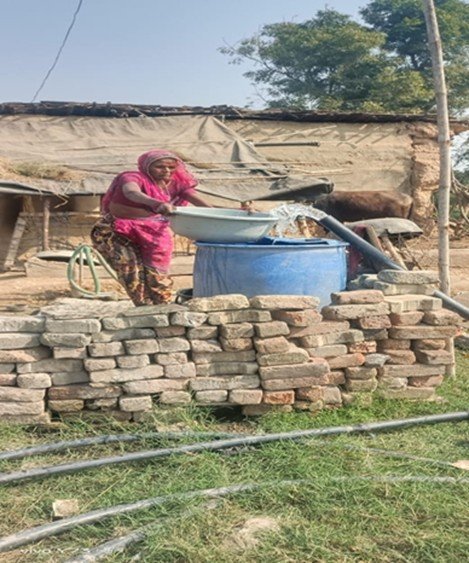
When the water came, the rabi fields came alive too. Wheat, gram, mustard, peas and green vegetables began to grow, and the improvement in income was plain to see. The horticulture department also provided forty mango saplings, which will bear fruit in the years ahead and open a path to steady earnings.
The light that reached Saju Devi’s home she shared with the village. She told Sunil (Valji), Kaluram (Gokalia) and Bhemji (Hakariya) Meena about the scheme and helped them apply. In this way, one family’s success began to turn into shared awareness across the whole village.
Government schemes look as straightforward on paper as they are tangled on the ground, and a small technical slip can sometimes outweigh years of entitlement. Alku Ben, an elderly woman of Chhoti Padal village, is a living example. She spent her whole life in family responsibilities, farming and agricultural labour. When age began to wear her body down, the old-age pension was her hope. Until 2022 it kept arriving in her account; then, suddenly, it stopped.
When she applied again, the answer was always the same: her age did not meet the eligibility criteria, even though by her identity card she was 66 in 2024. The inquiry revealed the mystery: her Aadhaar card wrongly recorded her age as 49. Because of that one number, she was deprived of her pension for almost two years. She could neither understand the cause of the mistake nor see a way to correct it; the rounds of government offices and the maze of procedure were a mountain to her. And this was not hers alone, but the shared pain of countless elderly villagers entangled in documentary errors.
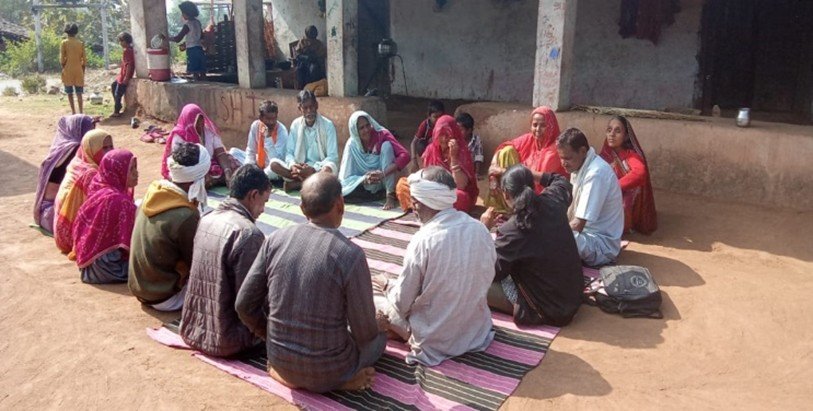
In November 2024, Prakash, a Vaagdhara community facilitator, was holding a meeting of the Gram Swaraj group. Member Manji Bhai mentioned that his neighbour Alku Ben, who was over sixty, had received no pension since 2022, though until then the money had reached her account regularly. The matter did not stay within the meeting room. Prakash and the group’s members went to Alku Ben’s home, spoke with her at length, and identified the real cause: the discrepancy between the ages on her Aadhaar card and her identity card.
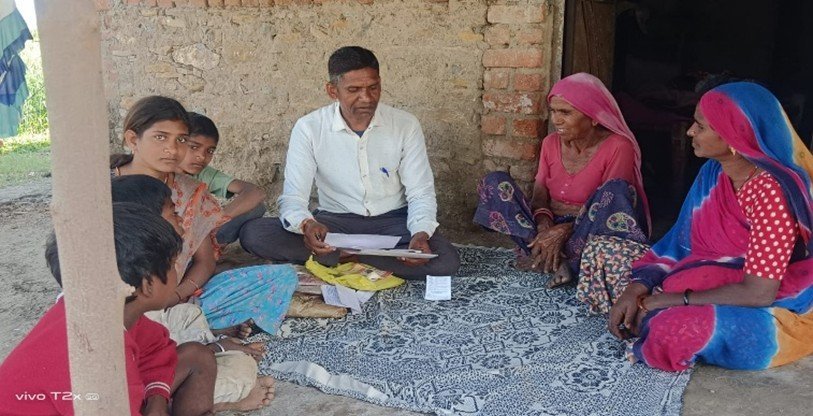
The group’s president Manji Bhai, members Chetan Lal and Hakar Ben, and Prakash first went to the local e-Mitra centre, where they were bluntly told that the age could no longer be corrected. It was a moment of deep disappointment for Alku Ben and her family. But the group did not give up. They went to the tehsil office and laid the whole matter before the officials, who told them that if proof of birth were produced, the age on the Aadhaar could be corrected. A list of documents was drawn up, and the Aadhaar card and identity card of Alku Ben’s brother Gotiya were taken as proof. These were submitted at Bhogoro ka Kheda panchayat, where, with the cooperation of the sarpanch and the secretary, the formalities were completed in time and Alku Ben’s birth certificate was prepared. On that basis, her correct age was entered in her Aadhaar card. The journey was not easy; it demanded constant follow-up, patience and administrative understanding.
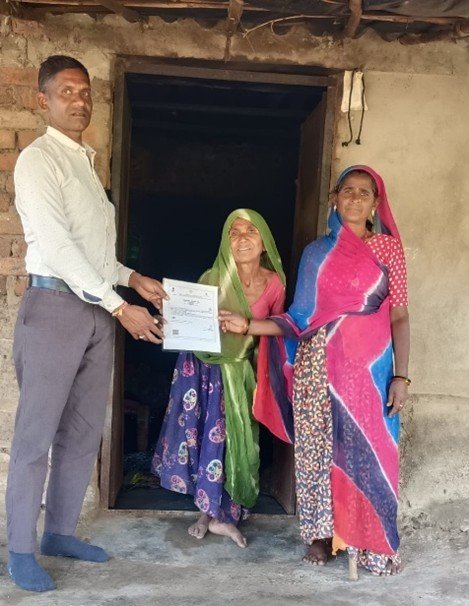
The moment of handing over the certificate — after a long wait, a document of entitlement in her hands.
As soon as the Aadhaar was corrected, the pension file was prepared afresh, and in May 2025 the pension was sanctioned. The arrears of the past two years reached her account in instalments: the first of ₹15,000, followed by two of ₹8,000 each. The pension now arrives regularly. Her family is content and happy today. Alku Ben believes that if the right guidance and support come in time, government schemes can truly reach those in need. The episode shows that active community organisations can do on the ground what no elderly person could manage alone.
Hakru Bhai of Bhun ki Ghati: Trust Restored by the Farming of the Ancestors
In Bhun ki Ghati, a small village in Ghatol development block, thirty-two kilometres from Banswara district headquarters, Hakru Bhai supports his family on four bighas of land. In both kharif and rabi he grew wheat, gram and maize, but his yield never rose beyond four or five quintals. After 2014 he began using chemical fertiliser, because organic produce fetched no fair price in the nearby market. Often, out of compulsion, he had to sell his crop at a low price to the local moneylender. When farming could not keep the household going, he had to travel to the neighbouring state of Gujarat in search of a livelihood, and the family would be left scattered.
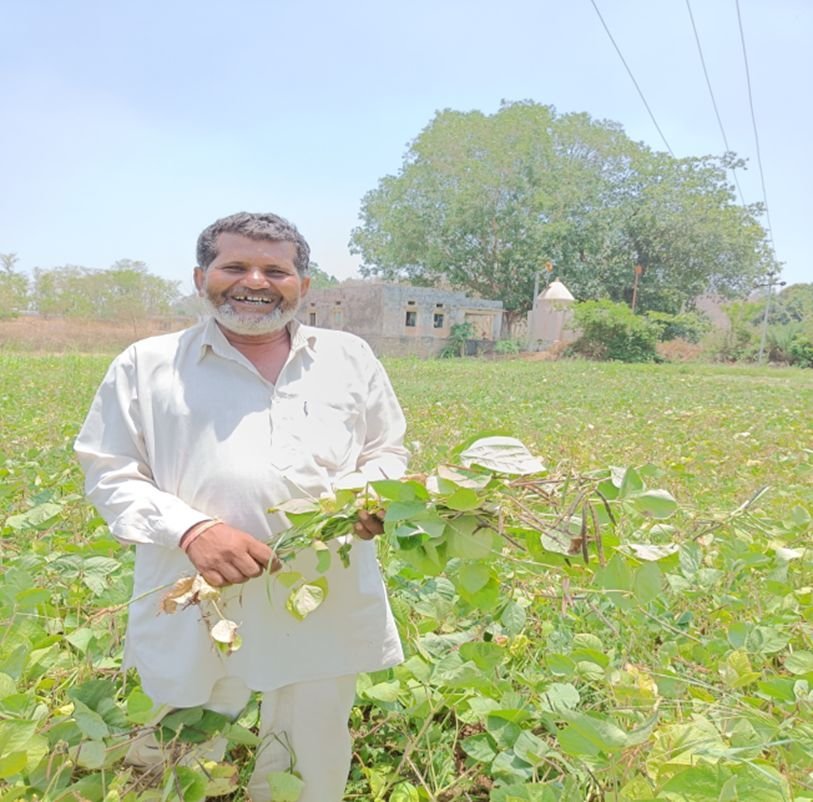
The change showed inside the home as well. As income rose, migration stopped, family members could give one another time, and savings began to provide basic facilities. His daughter is in class twelve and his son in class six. Hakru Bhai says he is now able to give both a higher education, and it is his dream that his children serve in a government department. Meeting other farmers at various forums, he also began growing flowers on his land, which earns him an additional one thousand to fifteen hundred rupees a day during social occasions. On the strength of this assurance, he has begun building a new house for his family.
Reflecting on his journey, Hakru Bhai says he never thought he would reach this point, but he did not give up and kept learning something new all the time. His message to the people of his village and the surrounding area is clear: for good quality and a fair price for your crop, come together, adopt traditional farming, and save water, forest, land, animals and seed.
Disclaimer:The views and opinions expressed in this article are those of the author(s) and do not necessarily reflect the official policy or position of The Rift.
*Community DevelopmentGovernment SchemesRajasthanRural IndiaSelf-RelianceSustainable AgricultureVAAGDHARA