Opening The Rift
therift
© 2026 The Rift. All Rights Reserved.
The Architecture of the Steadfast Soul : Cultivating Inner Resilience in an Age of Disruption
When your roots are anchored in the eternal, no earthly tempest possesses the power to uproot your soul.


Cultivating inner resilience is key to navigating the disruptions of the modern world.
Key Takeaways
1 of 3
Automatically generated. Read full article for complete context.
An Advisory for the Emerging Young Indian Generation on Spiritual Grounding, Metaphysical Depth, and Moral Endurance
In contemporary human development discourse, “resilience” is predominantly defined through psychological, cognitive, and somatic lenses. It is often conceptualized as emotional elasticity : the capacity of the ego to absorb external shock, adapt dynamically to volatile environments, and bounce back to psychological equilibrium. While this therapeutic paradigm provides valuable behavioural tools, it frequently operates on an implicit assumption: that human fortitude is largely reactive, generated in direct response to acute stress.
In contrast, classical Islamic epistemology, Sufi metaphysical psychology (ʿIlm al-Nafs wa al-Sulūk), and prophetic history advance a far more structural paradigm: resilience is not invented during catastrophe; it is uncovered by it.
As illuminated by contemporary educators such as Dr. Ghazala Qadri in reflections on early Islamic exemplars : most notably Sayyidah Zaynab bint ʿAli : adversity operates not as an initial builder of character, but as an uncompromising revealer of the heart’s pre-existing architecture. When a tempest assaults an ancient oak, the wind does not bestow structural integrity upon the wood; it tests whether the subterranean root network was anchored deeply enough to withstand the load. If the roots are shallow, the tree topples, regardless of how lush its foliage appeared.
For youth navigating an era defined by ideological fragmentation, hyper-digitized alienation, socio-political instability, and existential disorientation, reactive coping mechanisms are insufficient. What is required is an architecture of spiritual preparedness (istiʿdād). This advisory treatise synthesizes Qur’anic ontology, classical Hadith literature, and the insights of master spiritual psychologists : including Abu Hamid al-Ghazali, Ibn Qayyim al-Jawziyya, Jalal al-Din Rumi, and Ibn ʿAta’illah al-Iskandari : to present an integrated, comprehensive framework for youth seeking to build genuine moral, intellectual, and spiritual resilience.
Metaphysical Diagnostic : Ontological Reality of Trials (Ibtilāʾ)
To construct endurance, a young person must first demystify the nature of suffering and struggle. Modern culture implicitly promises comfort as the baseline state of existence; consequently, pain is viewed as an unnatural interruption, a systemic failure, or a meaningless cruelty. This mismatch between expectation and reality causes immense psychological collapse among the youth when life inevitably turns difficult.
Divine Teleology of Testing
The Qur’an upends modern hedonistic assumptions by explicitly establishing struggle as an inescapable structural law of created life (Sunnatullah):

The sacred text employs several terms to articulate this condition, each carrying a precise theological and psychological nuance:
- Balāʾ / Ibtilāʾ (Test / Examination): Linguistically connected to wearing out a garment through prolonged usage, indicating that trials test the enduring fabric of a person’s faith.
- Fitnah (Purification through Fire): Originally referring to the metallurgical process of smelting gold ore in a furnace to separate genuine precious metal from worthless slag. The heat is intentional, measured, and purifying.
- Imtiḥān (Heart-Refinement): As in Surah al-Ḥujurāt (49:3), where hearts are described as having been examined and purified for reverent mindfulness (taqwā).
When hardship is recognized not as an arbitrary penalty or cosmic accident, but as a deliberate furnace designed to reveal and burn away impurities, the posture of the youth shifts from victimhood to active spiritual engagement.
The Law of Divine Capacity
A crucial safeguard against nihilistic despair is the Qur’anic principle of calibrated trials:

In the commentary of classical exegetes, this verse is not merely comforting reassurance; it is an ontological law of conservation. If a specific trial has arrived at your doorstep, the latent capacity to endure, navigate, and transcend that trial has already been woven into your spiritual and psychic constitution by Divine decree. The arrival of the crisis is proof of the existence of the capacity, even if conscious awareness of that strength has not yet surfaced.
Historical Archetypes of Unbroken Fortitude
Abstract doctrine remains inert until witnessed in living human beings. When examining how profound crises reveal pre-cultivated sanctity, the household of the Prophet (Ahl al-Bayt) and the noble Companions serve as paramount case studies.
Exemplar of Sayyidah Zaynab bint ʿAli
Dr. Ghazala Qadri’s exposition on Sayyidah Zaynab at the Battle of Karbala and its aftermath illustrates the height of feminine spiritual courage. Following the martyrdom of her brother, Imam al-Husayn, and nearly all male members of her immediate family, Sayyidah Zaynab was thrust into an apocalyptic landscape of grief, violence, and captivity. Marched across deserts in chains to the court of the Umayyad governor Ibn Ziyad in Kufa, and subsequently to the court of Yazid in Damascus, she faced imperial power at its most arrogant and brutal.
When Ibn Ziyad attempted to taunt her by asking how she viewed what Allah had done to her family, her reply shook the foundations of worldly power:
“I saw nothing but beauty (Mā ra’aytu illā jamīlā). These were people for whom Allah had decreed martyrdom, so they went forth to their resting places…”
This declaration is incomprehensible to purely materialistic logic. How could a woman whose family had just been decimated see “beauty”?
It was neither stoic denial nor numbness. Sayyidah Zaynab was gazing through the veil of secondary causes (asbāb) directly at the primary Source (al-Musabbib). She saw honor, uncompromising adherence to truth, and noble sacrifice in the service of justice.
Critically, this level of intellectual poise, moral majesty, and physical courage could not have been manufactured on the dusty plains of Karbala. It was the natural overflow of decades spent absorbing sacred knowledge from her grandfather (the Prophet), her father (Ali ibn Abi Talib), and her mother (Fatimah al-Zahra). It was the fruit of thousands of nights spent in voluntary vigil (tahajjud), rigorous self-discipline, and deep contemplative prayer. When the imperial storm broke, it simply exposed the colossal spiritual fortress that had already been erected within her chest.
Anatomy of Internal Fortification
If resilience must be cultivated before the arrival of hardship, what are the specific faculties that young seekers must develop? Classical Islamic spiritual psychology identifies four foundational stations (maqāmāt) that form the bedrock of the human personality.
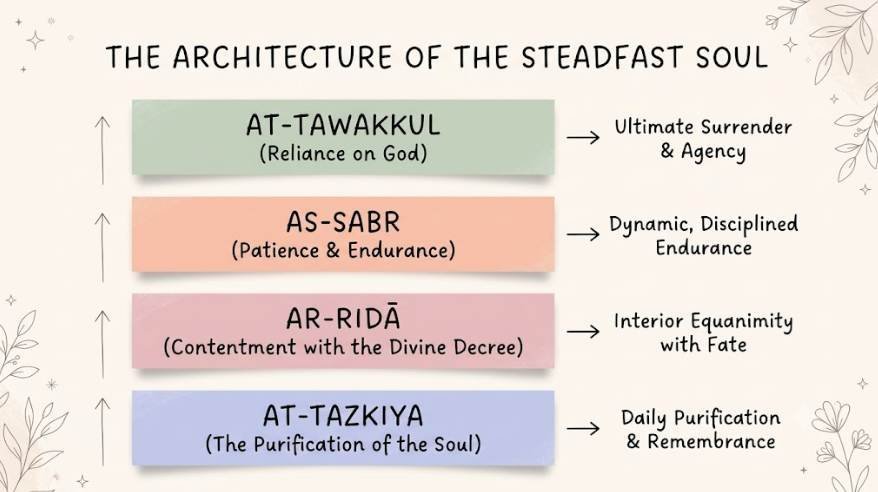
Tazkiyat al-Nafs (Purification of the Heart and Ego)
Abu Hamid al-Ghazali, in his magnum opus Iḥyāʾ ʿUlūm al-Dīn, compares the human heart to a polished bronze mirror (mir’āt). When the mirror is neglected, it accumulates rust, tarnish, and soot : representing the ego’s passions (hawā), distractions, and unexamined worldly attachments. In this clouded state, reality is distorted; minor setbacks appear as existential catastrophes, and worldly validation feels like ultimate salvation.
Tazkiya is the systematic discipline of cleansing this mirror through regular remembrance (dhikr), repentance (tawbah), and vigilance (murāqabah). When a crisis strikes a purified heart, the individual does not experience an internal identity crisis, because their sense of self was never rooted in ephemeral possessions, social standing, or transient comforts to begin with.
Sabr : The Three Dimensions of Patience
In popular discourse, sabr is frequently mistranslated as passive resignation : a fatalistic endurance of suffering. In the lexicon of classical scholars such as Ibn Qayyim al-Jawziyya (ʿUddat al-Sābirīn), sabr is an aggressive, dynamic spiritual force. Etymologically meaning “to restrain and bind,” it functions as the psychological harness of the soul. Ibn al-Qayyim divides it into three active categories:
- Sabr in Obedience (ʿalā al-ṭāʿah): The disciplined stamina to consistently perform good actions even when motivation is low, fatigue is high, and distractions are ubiquitous.
- Sabr in Restraint from Transgression (ʿan al-maʿṣiyah): The impulse control required to withstand temptation, immediate dopamine loops, and societal pressures toward moral compromise.
- Sabr in the Face of Decreed Hardship (ʿalā al-aqdār al-mu’limah): The emotional composure that prevents despair, prevents the tongue from uttering rebellion against God, and maintains proactive agency during disaster.
True resilience requires cultivating all three forms simultaneously. A youth who exercises sabr only when tragedy strikes, but lacks the sabr of daily intellectual and devotional discipline, will find their reserves exhausted when prolonged pressure is applied.
Tawakkul: Dynamic Reliance without Passivity
A profound paradox within Islamic psychology is the pairing of total reliance upon God (Tawakkul) with comprehensive worldly exertion (Tadabbur and Kasb).
Imam al-Qushayri notes in his Risāla that true reliance resides within the secret recesses of the heart, while outward effort belongs to the limbs. The prophetic guidance to “tie your camel and trust in Allah” forms an early blueprint for cognitive resilience:
- Outwardly: Maximize intellectual, technical, educational, and strategic efforts as if everything depends on human diligence.
- Inwardly: Remain completely detached from the outcome, placing ultimate confidence in Divine wisdom, knowing that success and failure are under the sovereign control of God alone.
This mental model eliminates the twin destroyers of youthful ambition: crippling anxiety about the future, and devastating depression following failure. The youth who adopts this stance understands that they are judged on the sincere excellence (Iḥsān) of their endeavor, not on the ultimate result.
Riḍā: The Highest Peak of Emotional Equanimity
Beyond patience lies Riḍā : contentment with the Divine decree. Ibn ʿAta’illah al-Iskandari captures this state in his Ḥikam (Aphorisms):
“When He opens for you a door of understanding regarding hardship, know that He has turned the hardship into a gift.”
Rumi expands on this in his Masnavi through the famous allegory of the Chickpea and the Cook. When the chickpea is cast into boiling water, it leaps and cries out against the agony of the fire. The cook gently pushes it back down with a wooden ladle, explaining:
“I am not boiling you out of hatred or spite. I am cooking you so that you may acquire flavor, become nourishment, and integrate into life. Had you remained raw in the earth or the garden, you would never have fulfilled your highest potential.”
To young people wrestling with pain, betrayal, loss, or disillusionment, the station of Riḍā offers a transformative lens: difficulties are pedagogical tools deployed by the Divine to elevate the human spirit from raw self-absorption into mature, fragrant wisdom.
Part IV: A Practical Blueprint for Contemporary Youth
How does a young person in the 21st century translate these classical, metaphysical doctrines into daily psychological armor? The following four-pillar methodology outlines concrete, daily practices to build root-depth before the inevitable storms arrive.
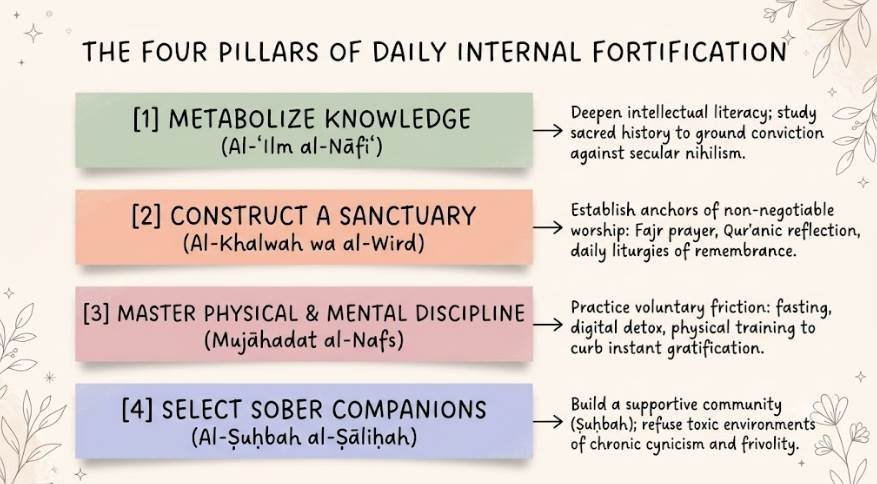
Pillar 1: Developing Intellectual Anchors (Al-ʿIlm al-Nāfiʿ)
Modern youth face an unprecedented war of ideas. Epistemological confusion breeds emotional fragility. If one’s faith is superficial : based merely on cultural habit or inherited assumptions : a single philosophical challenge in a university lecture hall or social media video can destabilize their entire life.
- Move Beyond Cultural Slogans: Study foundational Islamic theology (ʿAqīdah) rationally and systematically. Understand why you believe what you believe.
- Historicize Your Struggles: Read biographies of prophetic figures, the Companions, and civilizational reformers. Realize that persecution, poverty, loneliness, and societal collapse are not novel problems invented in your generation; they have been successfully navigated by giants who preceded you.
Pillar 2: Establishing Daily Spiritual Rhythms (Al-Wird)
Just as an athlete does not step onto the field without foundational conditioning, a believer cannot face the chaos of modern life without a daily spiritual baseline. Spiritual resilience requires non-negotiable anchor points:
- The Unbroken Dawn (Fajr): Reclaim the morning. The discipline required to rise before dawn creates psychological agency and breaks the cycle of lethargy.
- The Silent Space of Contemplation (Tafakkur): Dedicate 15 to 20 minutes daily away from screens, devices, and noise. Practice silent contemplation, reflecting on one’s mortality, one’s purpose, and the majesty of creation.
- Recitation with Presence: The Qur’an is described as Shifāʾ (a cure for what is in the chests). Read daily not as a mechanical chore, but as a direct communication from your Sustainer, extracting diagnostic insights for your internal struggles.
Pillar 3: Voluntary Friction and Physical Discipline (Mujāhadah)
A culture obsessed with comfort, convenience, and instantaneous gratification produces individuals who break at the slightest friction. Resilience requires the intentional introduction of voluntary discomfort into life:
- Fasting (Sawm): Fasting on Mondays and Thursdays or the White Days (middle of the lunar month) trains the prefrontal cortex to assert dominance over animal appetites. When you can say “no” to water and food while fully permitted to consume them, saying “no” to anxiety, panic, or toxic desires during a crisis becomes significantly easier.
- Digital Fasting: The modern dopamine economy fragments focus and magnifies social comparison. Regularly fasting from notifications, social feeds, and constant stimulation rebuilds cognitive endurance and restores emotional tranquility.
- Physical Strength: Cultivate somatic resilience. The Prophet declared: “The strong believer is better and more beloved to Allah than the weak believer, though there is good in both.” Bodily discipline directly impacts emotional and spiritual fortitude.
Pillar 4: Curating Sacred Community (Al-Ṣuḥbah al-Ṣāliḥah)
Solitary trees are the first to be uprooted in a hurricane; forests survive because their root systems intertwine beneath the soil, anchoring one another.
- Audit Your Companions: Surrounding yourself with chronic cynics, hedonists, or individuals living in persistent spiritual heedlessness (ghaflah) will inevitably erode your defenses.
- Seek Vertical Relationships: Find mentors, teachers, and peers whose moral integrity and spiritual presence challenge you to rise. In Sufi literature, the company of the righteous (Ṣuḥbah) is regarded not as an optional luxury, but as the primary catalyst for spiritual transformation.
The Tree and the Storm
The modern world will continue to accelerate in complexity, volatility, and moral disorientation. The economic, technological, and socio-political landscape confronting today’s youth is demanding, and the trials ahead will be real.
Yet, the message inscribed across the centuries by the Qur’an, the lives of exemplars like Sayyidah Zaynab, and the insights of great spiritual masters is one of hope and empowerment:
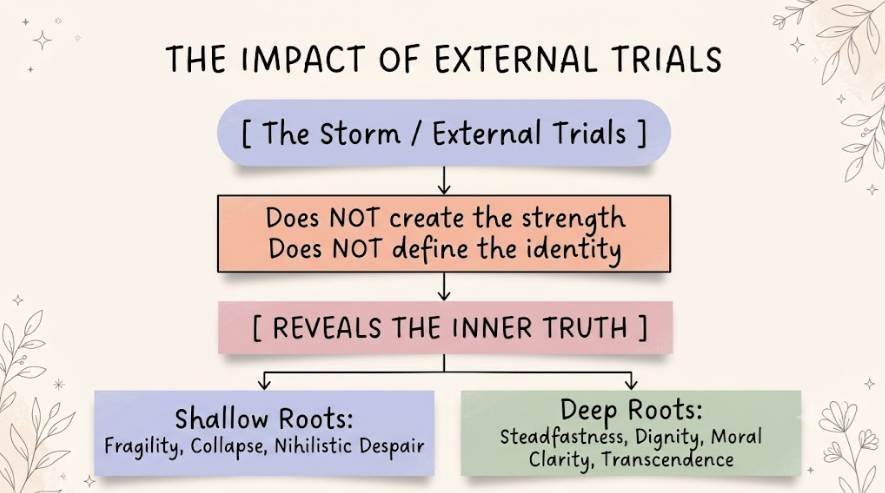
Do not wait for the storm to begin building your foundation.
Begin today, in the hidden quietude of ordinary life. Deepen your intellect through beneficial knowledge; tame your lower ego through consistent self-discipline; anchor your spirit through unshakeable devotion and remembrance; and align your will with the sovereign wisdom of the Divine.
When your roots are anchored in the eternal, no earthly tempest possesses the power to uproot your soul. The winds of hardship will come, but they will not destroy you; they will simply testify to the unyielding strength that God has cultivated within your heart.
All those who stand for the truth, for Satyameva Jayathe, will have the same refrain, for it is in the nature of falsehood to perish, and it is in the nature of truth to prevail : : hum jeethenge, laazim hai ke hum hi jeethenge.
Jai Hind
Disclaimer:The views and opinions expressed in this article are those of the author(s) and do not necessarily reflect the official policy or position of The Rift.