Opening The Rift
therift
© 2026 The Rift. All Rights Reserved.
With the announcement of first on-orbit space weapon, USA has taken a dangerous step towards Space Warfare
Space is the world’s newest war-fighting domain, and its militarization, driven by superpower rivalry and private corporations, risks global conflict and unprecedented pollution.

Key Takeaways
1 of 3
Automatically generated. Read full article for complete context.
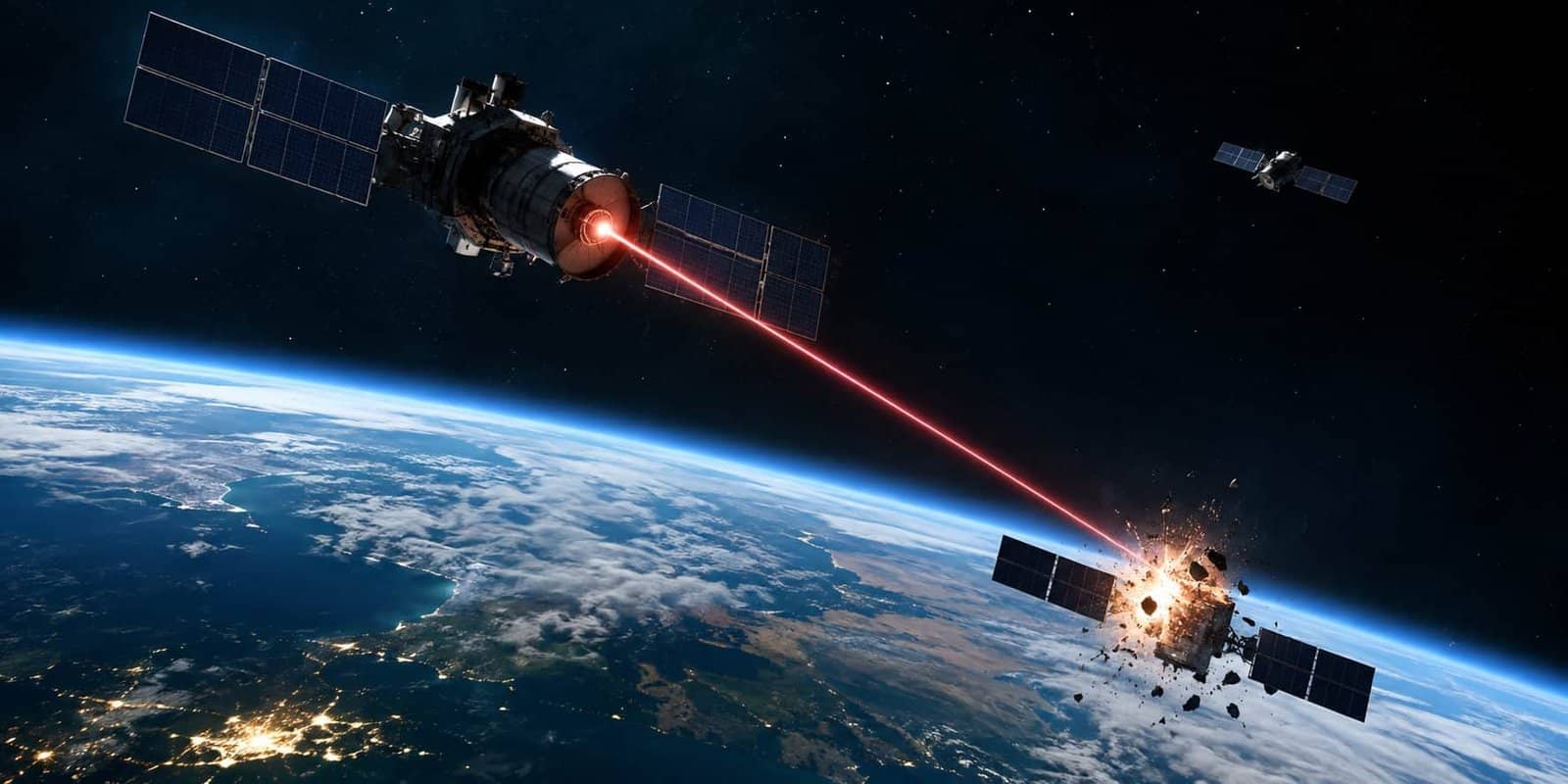
The US Space Force announced on September 15 that the United States has weapons deployed in space. US Air Force Secretary Troy Meink said such an ‘on-orbit’ weapon was necessary to safeguard US forces against enemies.
For the first time, any country has stated that it has weapons in space, despite the increasing trends towards militarization of spaceMilitarization of SpaceThe development and deployment of military assets and capabilities in outer space, including surveillance satellites, navigation systems, and potentially weapons, for strategic advantage. that have been continuing for several years.
In December 2019 when the Space Force was formed in the USA, President Trump, in his first presidency, had called this a big moment and added that there are “going to be a lot of things happening in space. Because space is the world’s newest war-fighting domain.”
Mark Esper, US Secretary of Defense, had added, “Maintaining American dominance in that domain is now the mission of the United States Space Force.”
These statements were then regarded as official confirmation that the militarization of space has started. It is now generally agreed that billions of dollars are being spent on this annually with the USA leading, China and Russia following in the next two places, and several other countries also joining the dangerous race.
Hence, the Outer Space Treaty of 1967 is is being increasingly violated, taking advantage of its vagueness on some points. As there are several meeting points in research for civilian and military uses, this is also used to make steps towards the militarization of space less obvious.
Some recent discussion points from the USA include reports of a classified contract being awarded to Elon Musk’s space company SpaceX to build an extensive network of spy satellites. This company already operates over half the active satellites orbiting Earth, and its reach is getting bigger still.
A number of other US companies—established ones as well as ambitious start-ups—are also in the race to obtain lucrative contracts related to space militarization. Hence, these contracts can also become a driving force for space militarization, a new and expanding part of the military-industrial-political complex.
These include orders for space-based weapons, surveillance systems, space vehicles, and supersonic rockets. A big deal that has been talked about is called PWSA—Proliferated Warfighter Space Architecture—a constellation of hundreds of satellites.
Karl Grossman, a US professor who has long been warning against this very serious, fast-increasing danger, has stated, “The US is seeking to control space and from space dominate the Earth below.”
The growing extension of superpower rivalry for dominance of outer space can relate to economic, technological, and military aspects. Ultimately, this may lead not only to new kinds of space pollution but also to very big disasters.
The extent to which private corporations are being given a significant role in the space race, particularly by the USA, makes a mockery of the great sense of responsibility and careful regulations needed in all developments relating to human activity in outer space. Private corporations may act in entirely profit-motivated, narrow ways, and in the process, wider responsibilities and concerns may see serious violations.
Although direct space warfare has not taken place so far, the militarization of space has been increasing at several levels to such an extent that the possibility of space warfare becoming a reality is now quite high.
Space warfare can take place in several forms. One object placed in space can attack, destroy, damage, or disable another object placed in space by another country. A missile from Earth can destroy a satellite of another country in space. Or a weapon from space can destroy a target on Earth. One such hostile act is likely to lead to one or more hostile acts by the affected party (if the capacity for retaliation exists), and from here on, the situation can escalate with unknown implications and results too frightening to comprehend.
These possibilities of warfare will increase as rival powers try to catch up with the present day dominance of space presence and technology by the USA. A review of space warfare possibilities published in the Scientific American by Lee Billings said, “As China and Russia aggressively seek to challenge US superiority in space with ambitious military space programs of their own, the power struggle risks sparking a conflict that could cripple the entire planet’s space-based infrastructure. And though it might begin in space, such a conflict could easily ignite full-blown war on Earth.”
The biggest danger will no doubt come if nuclear weapons are taken to space or used in space. This is of course strongly prohibited by the Outer Space Treaty, but still, the risk exists.
Over 90 percent of countries worldwide favor strong demilitarization of space, and this has already been reflected in several resolutions of the General Assembly of the United Nations. But the veto power at the Security Council hinders the strong directions needed for this, which are acceptable to big powers.
Dr. Michio Kaku, world-renowned physicist, has written, “The weaponization of space represents a real threat to the security of everyone on Earth. …It will greatly accelerate a new arms race in space…”
In addition, there is the increasingly serious problem of space pollution, and more prominently, Earth’s orbit.
The first aspect relates to space debris, or space junk. or space junk. This can be in the form of dysfunctional satellites or the various junk contributed by them or generated in the process of launching them. This junk has been increasing rapidly. The number of smaller debris, in particular, is extremely high. As even very small objects can result in serious collisions in space, the presence of smaller debris cannot be ignored.
This number of space debris is now set to increase as never before, as the number of satellites in Earth’s orbit is entering a pace of unprecedented escalation. This will pose many problems for constructive use of satellites for development purposes by late-entering developing countries, apart from increasing the danger of collisions.
The second aspect of space pollution is related to light pollution. This did not become a very serious issue until recently, as long as the pace of sending satellites into space was within manageable limits. But with the very rapid pace seen recently, the situation is changing, and the number of satellites in space, particularly in Earth’s lower orbit, are likely to multiply by several times within a decade, according to present projections.
Some senior astronomers have said that astronomy, as practiced so far, will be severely jeopardized, as it will become difficult to study space and images as they have done so far due to this excessive light pollution.
Clearly, there is a very urgent need to check the militarization of space and space pollution, but the unfortunate reality is that these problems appear to be getting worse in recent times.
On the positive side, networks for drawing attention to this increasing and very serious danger are also emerging. Karl Grossman (quoted above) teamed up with the Florida Coalition for Peace and Justice and Citizens for Peace in Space to set up the Global Network Against Weapons and Nuclear Power in Space. Such efforts will be increasingly needed as the dangers of space militarization escalate.
Disclaimer:The views and opinions expressed in this article are those of the author(s) and do not necessarily reflect the official policy or position of The Rift.
*Space MilitarizationArms RaceElon MuskOuter Space TreatySpace ForceSpace PollutionSpace WarfareSpaceXUnited Nations