Opening The Rift
therift
© 2026 The Rift. All Rights Reserved.
DARR-matology : The Politics of Fear-steering Misdirection : Competitive Populism, Governance Deficits, and India’s Lost Trajectory
The pursuit of short-term electoral hegemony through communal fear-mongering and fiscal populism has exacted a heavy toll on the republic.

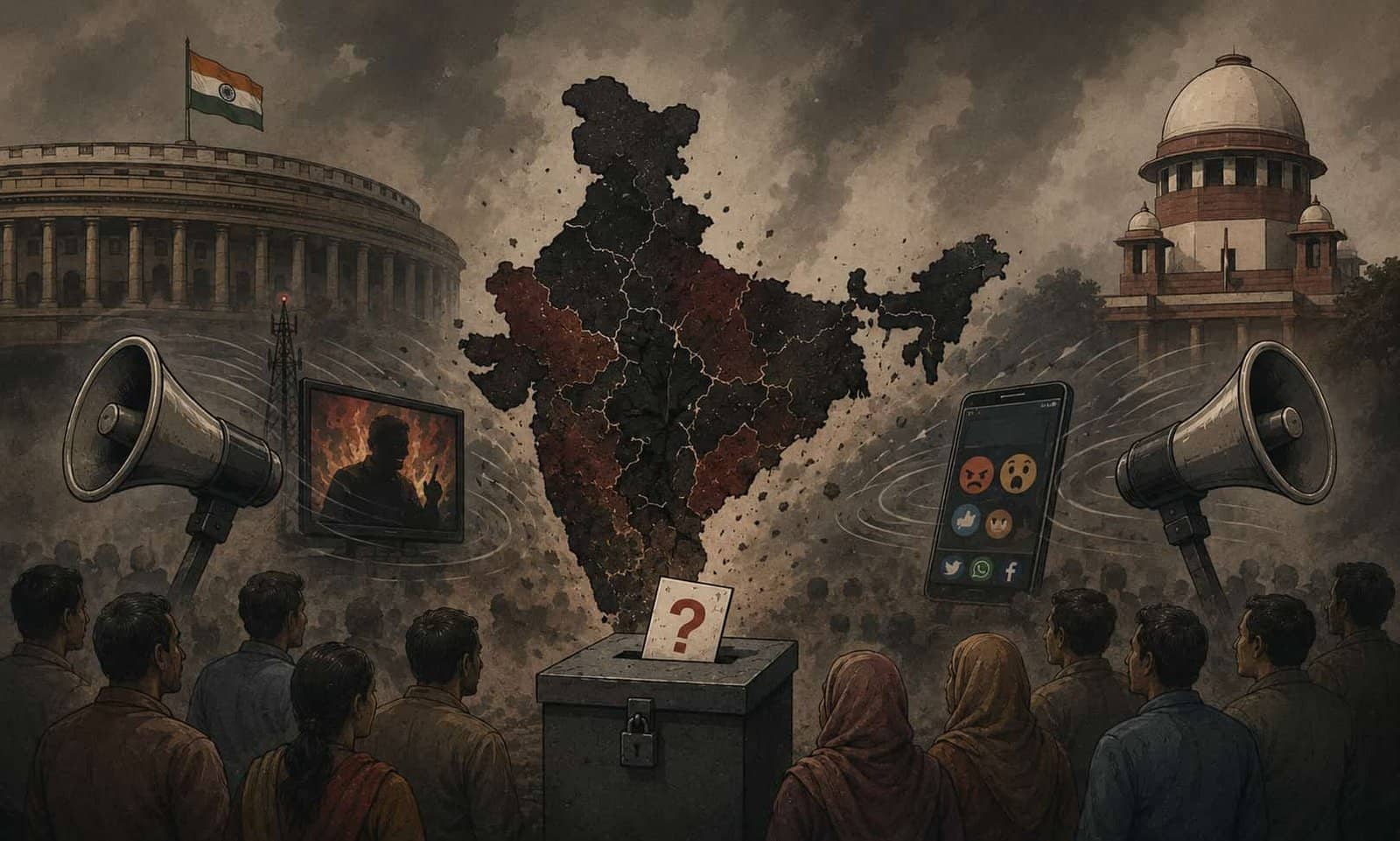
(Representative Image)
Key Takeaways
1 of 3
Automatically generated. Read full article for complete context.
There is a science called dermatology. There was a movie called Darr. “Fear”. Unlike beauty, which is skin deep, the science of dermatology has undergone profound metamorphosis, infiltrated much deeper, penetrating every subcutaneous national tissue. It is now called Darr-matologyFear-based PoliticsA neologism coined in the article, combining ‘darr’ (Hindi for fear) and ‘dermatology’ (study of skin), to describe the deep, pervasive, and politically orchestrated cultivation of fear within a society.. Its practitioners are seasoned politicians, dazed patients carefully selected are its victim-citizen groups “treated” by a very special, deliberate, geographically localized, centrally controlled, politically orchestrated, projected as “spontaneous” but carefully timed and calibrated, allegedly police-supported, allegedly State-sponsored hostile “othering” action.
Hospitals (read mohallas/localities) where darr\-matology as fine-tuned art form is meticulously and precisely practised are presided over, in jurisdictional terms, at temples of justice where doctors …of jurisprudence, of course… exercise great judicial restraint compelling confining legal acumen (and awareness shared by everyone else, never spoken aloud) within straitjackets.
Shocked citizens perceive unseemly haste in seeking to destroy everything that has been assiduously built over decades of deliberated effort as culmination of centuries of culture, educated thought and reflection, in the primitive belief that all that provided value so far must be pulled down, give way, to be replaced by something else supposedly ushering in eras of gratification of legitimately suppressed illegitimate political yearnings… while no thought is given to consider what would substitute and replace what was being pulled down and (with universities under attack, dissent crushed, freedom of thought meriting physical attacks, opinion meriting jail terms for sedition) how anything could ever be created by uneducated minds… as a result of which great institutions of thought and evolution are attacked, sought to be neutralised, neutered or altogether destroyed.
In contemporary democratic discourse, the deliberate cultivation of fear along communal lines and the deployment of fiscal populism have evolved from transient electoral strategies into structural impediments to national development.
While political factions frequently employ polarization to consolidate constituencies and manufacture artificial majorities, this tactic inflicts profound irreversible damage upon the social and political, and essentially national, fabric.
Beyond its immediate consequences of social friction and alienation, this form of politics operates as a constitutionally prohibited offense and an act of institutional self-sabotage.
Most critically, it functions as an effective smokescreen, diverting public attention, state capacity, and legislative will away from existential challenges such as chronic unemployment, ecological collapse, public health deficits, and educational decay.
Constitutional Foundations and Judicial Precedents on Communal Polarization
The jurisprudence of the Supreme Court of India consistently underscores that the deliberate cultivation of sectarian division is anathema to the foundational design of the Constitution.
The Supremacy of Fraternity and Secularism: In landmark rulings such as Kesavananda Bharati v. State of KeralaBasic Structure Doctrine CaseA landmark 1973 Supreme Court of India ruling that established the ‘basic structure doctrine,’ holding that certain fundamental features of the Constitution cannot be amended by Parliament. and S.R. Bommai v. Union of IndiaSecularism as Basic StructureA landmark 1994 Supreme Court of India judgment that reinforced secularism as a fundamental feature of the Constitution’s basic structure and laid down guidelines for the imposition of President’s Rule (Article 356)., the Supreme Court established that secularism forms an unalterable part of the basic structure of the ConstitutionUnalterable Constitutional PrinciplesA doctrine established by the Supreme Court of India, stating that certain fundamental features of the Indian Constitution (like secularism, democracy, federalism) cannot be altered or destroyed by parliamentary amendment..
Furthermore, the Court has repeatedly observed that hate speech and communal polarization stem from an “us versus them” mindset that directly corrodes constitutional fraternity, which is mandated in the Preamble and reinforced under the Fundamental Duty in Article 51A(e) to promote harmony and a common spirit of brotherhood.
Statutory Enforcement and Criminal Accountability : Addressing the legal dimensions of sectarian agitation, the Supreme Court in decisions such as Tehseen S. Poonawalla v. Union of IndiaAnti-Lynching Directives CaseA 2018 Supreme Court of India judgment that issued a series of preventive, remedial, and punitive measures to curb mob lynching and hate crimes across the country. and subsequent directives on hate speech emphasized that penal provisions penalizing the promotion of enmity between different groups (such as Section 196 of the Bharatiya Nyaya Sanhita, 2023New Indian Penal CodeA new criminal code enacted in India in 2023, intended to replace the Indian Penal Code of 1860. It revises and consolidates provisions related to criminal offenses., and corresponding laws) must be strictly enforced through suo motu executive and police action to protect the social fabric from communal toxins.
The Four-Decade Playbook : Competitive Populism Across Party Lines
Over the past forty years, India’s primary national political formations : the Indian National Congress and the Bharatiya Janata Party (BJP) to name two : along with various regional entities, have institutionalized competitive populism in states across the subcontinent. While rhetorical branding varies, governance models have frequently relied on short-term transactional distributions rather than long-term capital formation.
The Congress and Legacy Populism
In states where the Congress or its alliance partners held extended governance terms (such as Rajasthan, Chhattisgarh, Punjab, and Karnataka), policy frameworks frequently prioritized broad fiscal redistributions and immediate debt reliefs.
Farm Loan Waivers : Broad-based agricultural debt cancellations deployed across various states served to address acute rural distress, yet systemic evaluations noted that such measures heavily burden state exchequers, crowd out capital expenditures on long-term agricultural infrastructure like irrigation, and create systemic moral hazards within financial institutions.
Reversion to the Old Pension Scheme (OPS) : Administrative reversions to the Old Pension Scheme in states like Rajasthan, Chhattisgarh, and Himachal Pradesh drew sharp critiques from financial regulators and economic analysts for mortgaging future state budgets to service legacy liabilities at the expense of educational and health capital investments.
Direct Subsidies and Resource Transfers : Escalating allocations toward untargeted or broad utility subsidies frequently constrained the fiscal capacity required to upgrade state-run universities, technical institutes, and public healthcare networks.
The BJP and Paternalistic Welfarism-cum-Nationalism
In jurisdictions governed by the BJP (such as Uttar Pradesh, Madhya Pradesh, Gujarat, and Assam), governance models fused right-wing ideological mobilization with high-visibility direct benefit transfers.
Targeted Direct Benefit Transfers (DBTs) and Freebies : State-level administrations deployed large-scale conditional cash transfers and welfare packages, such as Madhya Pradesh’s Ladli Behna frameworkMadhya Pradesh Welfare SchemeA welfare scheme launched by the government of Madhya Pradesh, India, providing financial assistance to eligible women in the state. ‘Ladli Behna’ translates to ‘Dear Sister’. or Assam’s pre-electoral financial assistance schemes, to secure electoral consolidation.
Farm Loan Exemptions and Utility Subsidies : Mirroring cross-party trends, prominent state-level loan waiver packages (such as Uttar Pradesh’s 2017 agricultural debt relief initiative) and free utility distribution programs frequently strained sub-national fiscal discipline.
The Fusion of Majoritarian Mobilization and Paternalism : Crucially, this model combined economic welfarism with identity-based polarization, ensuring that voters remained engaged in cultural binaries that deflected scrutiny away from structural economic indicators like job creation and price stability.
The Economic Cost : Judicial Warnings and Missed Opportunities for a Sovereign Power
The cumulative consequence of two decades dominated by communal friction and competitive populism is a tragic squandering of India’s demographic and historical moment.
The Supreme Court of India, in observations regarding the unchecked proliferation of state-level fiscal freebies (S. Subramaniam Balaji v. Government of Tamil Nadu and subsequent fiscal-administrative hearings), explicitly cautioned that the unbridled distribution of largesse and irrational freebies places an unsustainable burden on public finances, drives revenue-deficit states deeper into debt, and directly hampers national development. The bench noted that state resources ought instead to be channeled into creating robust infrastructure, schools, hospitals, and sustainable employment avenues that foster civic dignity rather than distributing perpetual doles.
The Infrastructure of Ignorance vs. Knowledge Economy : While competitive global economies aggressively invested in automated manufacturing, advanced semiconductor ecosystems, and artificial intelligence, state budgets domestically remained constrained by recurring revenue expenditures on waivers and short-term doles, leaving foundational public schooling and research infrastructure underdeveloped.
The Unemployment Crisis and Capital Scarcity : Capital that should have been deployed toward building high-tech industrial corridors, green energy grids, and universal public health networks was diverted to manage fiscal deficits caused by populist bidding wars, leaving millions of youth facing structural underemployment.
Loss of Global Stature : On the world stage, a nation bogged down by periodic communal polarization and a political class consumed by vote-bank engineering struggles to project consistent moral and economic leadership.
Rather than serving globally as an undisputed anchor of technological innovation and democratic maturity, misdirected domestic priorities risk transforming the nation’s immense potential into a cautionary tale of a polarized polity trapped in internal distractions.
The pursuit of short-term electoral hegemony through a combination of communal fear-mongering and fiscal populism has exacted a heavy toll on the republic. Both major national political forces share the institutional responsibility for prioritizing immediate electoral cycles over the long-term balance sheet of the nation’s future.
If India is to transcend its current limitations and surge forward from a position of true strength, the political class must align with constitutional mandates and judicial warnings.
The true measures of national greatness are found not in the volume of sectarian noise or election-eve doles, but in the quality of classrooms, the resilience of public healthcare, the dignity of gainful employment, and the inviolable strength of constitutional fraternity.
An Appeal to the Youth: Reclaiming the Republic from the Politics of Division
Listen, young citizens of India : you stand at the most critical crossroads in the modern history of the republic.
You inherit a nation brimming with unmatched potential, an enviable demographic dividend, and a rich constitutional legacy of pluralism and resilience. Yet, you are being handed a hollowed-out landscape : a theater of manufactured communal paranoia, endless identity polarization, and cynical competitive populism where the future of your generation is consistently bartered for the short-term electoral survival of self-serving political factions.
For decades, mainstream political formations across the spectrum have treated governance as a game of distraction.
While they feed you the poison of mutual suspicion, erect artificial walls between communities, and bankrupt state exchequers on election-eve doles, the foundational pillars of your future are crumbling.
Chronic joblessness, decaying public education, overburdened medical systems, and a planetary ecological crisis are not accidents of governance; they are the direct consequence of a political class that refuses to address real issues because real issues require competence, integrity, and long-term vision.
Engaging in communal fear-mongering and anti-national diversionary politics for mere political perpetuation is not just a moral bankruptcy; it is an active betrayal of the Indian Constitution. It reduces you, the sovereign citizens of this country, into mere pawns in a perpetual cycle of manufactured outrage.
It is time to break the cycle.
It is time for you to take the reins of this country into your own hands.
The Strategy for National Redemption : The Weapon of the Ballot : Rejecting the Politics of Division
Refuse to vote for any political party, faction, or candidate that relies on communal polarization, hate speech, or hollow, debt-inducing populist freebies to capture power.
Make your vote strictly conditional on tangible metrics of human development: quality jobs, world-class public schools, robust healthcare infrastructure, and transparent fiscal responsibility.
When parties realize that bigotry and distraction no longer win elections, they will be forced to compete on competence.
Forge Grassroots Camaraderie Across All Lines : Actively dismantle the walls of estrangement that political actors have built between communities.
Reach across religious, regional, and social divides to build deep, authentic bonds of human solidarity.
True national security does not stem from mutual hostility; it stems from an unbreakable civic fraternity where every citizen feels secure, valued, and invested in the collective destiny of the nation.
Consolidate Power Behind Merit and Public Service : Shift the locus of political influence away from dynastic brokers, ideological extremists, and corrupt opportunists.
Support, elevate, and empower leaders : from student unions to national parliaments : who demonstrate a genuine, technocratic, and moral inclination to build the country rather than enrich themselves.
Do not allow your futures to be squandered by politicians who offer you division when you demand dignity, and anxiety when you deserve aspiration.
The nation does not belong to those who divide it for power; it belongs to those who unite it to build.
Take the reins, reject the architects of decay, and steer India toward the sovereign, prosperous future it was always meant to claim.
Jai Hind
Disclaimer:The views and opinions expressed in this article are those of the author(s) and do not necessarily reflect the official policy or position of The Rift.