Opening The Rift
therift
© 2026 The Rift. All Rights Reserved.
A Graduate Woman in Bhubaneswar’s Slum Struggles to Reclaim Her Electoral Identity After SIR-2026 Exclusion
A genuine elector can become excluded from the electoral process due to failures at multiple levels, raising concerns about safeguards for vulnerable citizens.
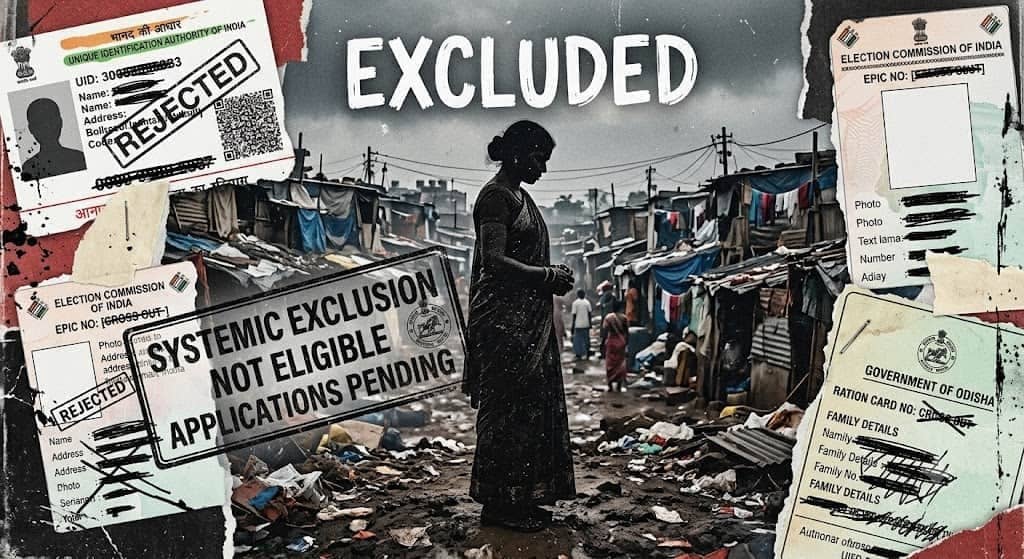
A graduate woman in Bhubaneswar’s slum struggles to reclaim her electoral identity after SIR-2026 exclusion (Representative Image)
Key Takeaways
1 of 3
Automatically generated. Read full article for complete context.
Bhubaneswar, Odisha: The case of a 37-year-old slum resident from Bhubaneswar has highlighted the challenges that vulnerable citizens—including migrant workers, economically marginalized persons, transgender persons who have been alienated from their families, digitally illiterate individuals, persons affected by family disputes, and those living in temporary shelters or slums—may face during the Special Intensive Revision (SIR)-2026 of electoral rolls in Odisha.
Sarika Jena (pseudonym), a 37-year-old woman currently residing in a slum in Bhubaneswar, was married to Siba Mohanty (pseudonym). Following her marriage, her surname changed from ‘Jena’ to ‘Mohanty’, and this change has been duly reflected in her Voter ID, Aadhaar Card, Ration Card, Bank Passbook, Residence Certificate, and other official documents. Her name changed from “Sarika Jena” to “Sarika Mohanty” after her marriage. She is a graduate; however, her educational certificates continue to bear her maiden name, Sarika Jena.
A pseudonym has been used to protect the identity of the excluded individual, who did not provide consent for her personal details to be disclosed publicly.
Due to prolonged family disputes, she has been living separately from her husband for several years. She currently resides in a Bhubaneswar slum with her 15-year-old daughter and struggles to provide for her daughter’s education and basic needs. As a marginalized urban poor woman, she has been living in extremely difficult circumstances for over a decade.
Although her name remains enrolled in the electoral roll of her matrimonial village (her in-laws’ address), and her Ration Card was originally issued at that address, she has been receiving ration in Bhubaneswar. All her other entitlement documents reflect her current slum address in Bhubaneswar.
Electoral Roll Deletions Without Enumeration Forms: Concerns About the Verification Process
Sarika’s name was not included in the Special Intensive Revision (SIR)-2002 because she had not attained the age of 18 at that time. However, during the SIR-2026Special Intensive Revision 2026A planned or ongoing process by the Election Commission of India to update and verify electoral rolls for the year 2026. exercise, no Booth Level Officer (BLOBooth Level OfficerAn official appointed by the Election Commission of India, typically a local government employee, responsible for maintaining and updating the electoral roll for a specific polling booth area.) visited her residence in Bhubaneswar or delivered an Enumeration Form to her doorstep for verification or enrolment.
According to Sarika, at her matrimonial village, her in-laws’ family members neither included her name during the enumeration process nor provided her contact details, including her mobile number, to the BLO, reportedly stating that they had no contact with her. Consequently, the BLO deleted her name from the electoral roll on the grounds that she could not be contacted or was absent.
Subsequently, the BLO, the Supervisor, the Booth Level Agent (BLA) appointed by only one political party (BJP), along with other village-level representatives and officials, conducted the BLO-BLA meeting and approved the deletion of her name from the SIR-2026 draft electoral roll.
Beyond Voting Rights: The Wider Impact of Electoral Roll Deletion
Sarika had no knowledge of the SIR-2026 process or the consequences of the deletion of her name from the electoral roll. She was unaware that removal from the voters’ list could affect not only her constitutional and democratic right to vote but also create practical difficulties in accessing certain government entitlements and welfare benefits, including the Public Distribution System (ration), as well as establishing eligibility for certain land, property, and other rights or benefits available to slum dwellers under the relevant provisions of the Municipal Corporation Act, 2003 (as amended up to 2022).
Only after a concerned activist enquired whether she had completed the SIR process, she realized that something was wrong. Upon verification of the SIR-2026 Draft Roll, it was confirmed that her name was missing. Further verification revealed that her name appeared in the ASDD (Absent, Shifted, Dead and Duplicate) list, which had been approved during the BLO-BLA meeting.
Roadblocks to Restoration: Alleged Non-Cooperation by BLO and Matrimonial Family
She immediately approached the BLO requesting restoration or addition of her name. However, the BLO informed her that since the Draft Roll for SIR-2026 had already been published, her name could no longer be added through the ongoing enumeration process. Instead, the BLO insisted that she should apply online for enrolment at her Bhubaneswar address, without providing the Voter ID (EPICElectoral Photo Identity CardCommonly known as a Voter ID card, it is an identity document issued by the Election Commission of India to eligible voters.) number or electoral details of her husband, which were necessary for establishing her existing enrolment.
This approach was contrary to the prescribed procedure. As per the Election Commission’s guidelines, any aggrieved person whose name has been omitted from the Draft Roll is entitled to submit a claim in Form 6, along with the prescribed Declaration Form and supporting documents, during the claims and objections period from July 5, 2026, to August 4, 2026. Her experience demonstrates the practical difficulties faced by genuine electors at the ground level and has eroded her confidence in the fairness of the process. She now believes that she has little chance of restoring her name at her matrimonial address because the BLO compelled her to seek enrolment only at her Bhubaneswar address.
To establish her identity as Sarika Mohanty, wife of Siba Mohanty, she is required to produce supporting documents and details of her husband’s EPIC. However, the BLO did not provide these details. She also does not possess a marriage certificate. Consequently, she faces considerable difficulty in proving her marital identity.
Alternatively, she considered enrolling at her parental village. However, this too presents significant challenges. Her EPIC records her name as Sarika Mohanty, whereas her educational certificates record her as Sarika Jena, daughter of Srikrushan Jena (changed name). She possesses no supporting document linking these two identities. Furthermore, her father has passed away, and his name has also been deleted from the electoral roll, making it difficult to establish her relationship with her father’s SIR-2002 records.
Similarly, it is equally difficult for her to secure inclusion of her name in the electoral roll at her Bhubaneswar address, as she lacks the necessary documents to establish the linkage between her marital identity, her previous electoral records, and her current place of residence.
This case illustrates the hardships that may be faced by a genuine Indian citizen who, despite being educated, has become socially and economically marginalized after migrating from her native village to the state capital. If a graduate woman with multiple government-issued identity documents encounters such significant obstacles in securing inclusion in the electoral roll, it raises concerns about the challenges that may confront many other vulnerable citizens, including the urban poor, rural poor, members of Scheduled Castes (SCs), Scheduled Tribes (STs), Dalit and minority communities, people residing on forest land without formal land titles, and others who lack adequate resources, access to internet facilities, digital literacy, general literacy, or sufficient documentary evidence to establish their eligibility for enrolment.
While many children as young as two or three years are growing up with exposure to digital technology, a significant number of educated adults, including graduates, continue to have limited digital skills or remain digitally excluded. Moreover, many economically marginalized citizens do not own smartphones or have reliable access to internet services. These digital and resource gaps may create additional barriers for vulnerable sections of society in accessing online-based processes and exercising their rights effectively.
If Booth Level Officers (BLOs) require such citizens to submit online claims for inclusion in the SIR-2026 electoral roll without providing adequate offline assistance, and if public authorities place the primary responsibility on citizens to establish their eligibility through a predominantly digital process, there is a risk that genuine eligible voters may face exclusion. In such circumstances, the process could have the unintended effect of reducing electoral inclusion rather than facilitating it, particularly among vulnerable groups such as the urban poor, migrants, elderly persons, women, persons with disabilities, and those with limited digital access or literacy.
Critics argue that unless accessible offline mechanisms, proactive field verification, and adequate assistance are ensured, a heavily digital-dependent SIR process could disproportionately disadvantage genuine eligible citizens, increasing the risk of their exclusion from the electoral rolls rather than promoting their inclusion.
According to Sarika, the Booth Level Officer (BLO) informed her that a family member of her in-laws had stated they could not provide any information about her during the SIR-2026 verification process. However, she points out that her husband’s name does not appear in the ASDD (Absent, Shifted, Dead and Duplicate) list.
This, according to Sarika, raises questions about the consistency of the verification process. She alleges that if the BLO was able to verify or retain her husband’s name in the electoral roll despite his also residing in Bhubaneswar and being away from the village for a considerable period, it remains unclear why her name was deleted on the grounds that she could not be contacted or was absent.
The apparent difference in the treatment of the two electors has led her to question whether the verification process was applied consistently. She has called for a transparent review of the circumstances that resulted in the deletion of her name while her husband’s enrolment was reportedly retained. This indicates that neither her matrimonial family nor the Booth Level Officer (BLO) cooperated in facilitating her inclusion in the electoral roll.
The Human Cost of Electoral Exclusion: Psychological Distress and Institutional Failures
Today, Sarika is under immense psychological stress due to the exclusion of her name from the draft electoral roll through SIR-2026. In addition to coping with family disputes, financial hardship, and social vulnerability, she is now required to repeatedly establish her identity and citizenship in order to exercise her democratic rights. Her case demonstrates how a genuine elector can become excluded from the electoral process due to failures at multiple levels. The actions and omissions of her in-laws, the Booth Level Officer (BLO), village-level officials, local representatives, and the Booth Level Agent (BLA) participating in the verification process collectively resulted in the deletion of her name. It also raises broader concerns regarding the absence of effective safeguards for vulnerable citizens during the SIR process, particularly where only one political party had appointed a BLA while other political parties failed to do so, leaving genuine electors like Sarika without adequate institutional support during electoral verification.
Alleged Failure to Provide Enumeration Forms and Form 6 to Eligible New Voters
Without disclosing his identity, an eligible first-time voter (18+) residing within the Bhubaneswar Municipal Corporation (BMC) area stated that although he had attained the qualifying age for enrolment, no Booth Level Officer (BLO) visited his residence or provided him with an Enumeration Form or Form 6 during the SIR-2026 exercise.
According to him, when he approached a local political worker who was actively involved in the SIR process and requested assistance for the inclusion of his name in the electoral roll, he was informed that new voters were not being enrolled at that stage and that his name would be added later.
Relying on this assurance, he waited for the BLO to visit his residence and provide the necessary forms. However, according to him, the BLO neither visited his residence nor provided the required form for the inclusion of his name in the electoral roll. So, his name has not been included in the Draft Electoral Roll 2026, leaving him uncertain about the procedure for securing his enrolment as a first-time voter.
This experience raises concerns about whether eligible new voters were uniformly reached during the enumeration process. If similar accounts are found to be widespread, it would suggest that door-to-door enumeration was not conducted effectively in some areas and that eligible first-time voters may not have received the necessary forms or guidance for enrolment.
The author of this article also states that no BLO visited his residence or supplied the required enumeration form during the SIR-2026 exercise. In contrast, during the previous Special Intensive Revision (SIR)-2002, BLOs reportedly conducted door-to-door physical verification and personally interacted with households to verify voter details.
Public Perception and Media Coverage of SIR-2026
The implementation of SIR-2026 has also attracted significant public attention. Much of the media coverage has focused on the deletion of names from the electoral rolls, creating a perception among sections of the public that the exercise has emphasized identifying and deleting electors rather than ensuring the inclusion of every eligible voter. Whether this perception reflects the actual implementation of the revision can only be determined through official data, transparent disclosure of the verification process, and independent assessment.
Reaction of Human Rights Activist
Noted human rights activist Biswapriya Kanungo said that Sarika’s case is ‘only the tip of the iceberg.’
“There may be many more people like Sarika—including migrant workers, economically disadvantaged families, transgender persons who have been alienated from their families, digitally illiterate citizens, individuals affected by family disputes, and people living in temporary shelters or slums—whose names may have been excluded from the Draft Electoral Roll during the SIR-2026 process without their knowledge,” he said.
“I am concerned not only about their voting rights and their ability to establish their electoral identity but also about the hardships they may face if exclusion from the electoral roll affects their access to government welfare schemes and other entitlements. If vulnerable and marginalized citizens have been excluded because Booth Level Officers did not follow the procedures prescribed under the SIR-2026 guidelines, the matter deserves urgent attention and independent scrutiny to ensure that no eligible citizen is deprived of democratic rights or public benefits,” Kanungo added.
Referring to the publication of electoral rolls under SIR-2026, Kanungo further said that media reports based on information provided by government authorities have highlighted the deletion of around 22 lakh voters from the previous electoral roll, while details regarding the number of newly included voters have not received similar public attention.
“This situation has created a perception among sections of society that SIR-2026 has focused more on identifying and excluding ineligible voters rather than ensuring the inclusion of all eligible citizens, including first-time voters and those who may have been left out earlier,” he said.
He emphasized that transparent disclosure of both deletions and additions, along with effective grievance redressal mechanisms, is essential to maintain public confidence in the electoral revision process and ensure that genuine eligible citizens are not excluded.
Conclusion
There is a need for stronger safeguards to ensure that genuine electors, particularly those from marginalized communities and first-time voters, are not excluded from the electoral process due to documentation gaps, migration, family circumstances, or procedural shortcomings. It also emphasizes the importance of ensuring that Booth Level Officers (BLOs) strictly follow the guidelines issued by the Election Commission of India so that eligible citizens are provided a fair opportunity for inclusion in the electoral rolls.
Disclaimer:The views and opinions expressed in this article are those of the author(s) and do not necessarily reflect the official policy or position of The Rift.