Opening The Rift
therift
© 2026 The Rift. All Rights Reserved.
What exactly is Foreign Covert Regime Change Operation?
Regardless of success, Foreign Covert Regime Change Operations inflict tragic human costs and erode ethical strength, making their abandonment the best policy.

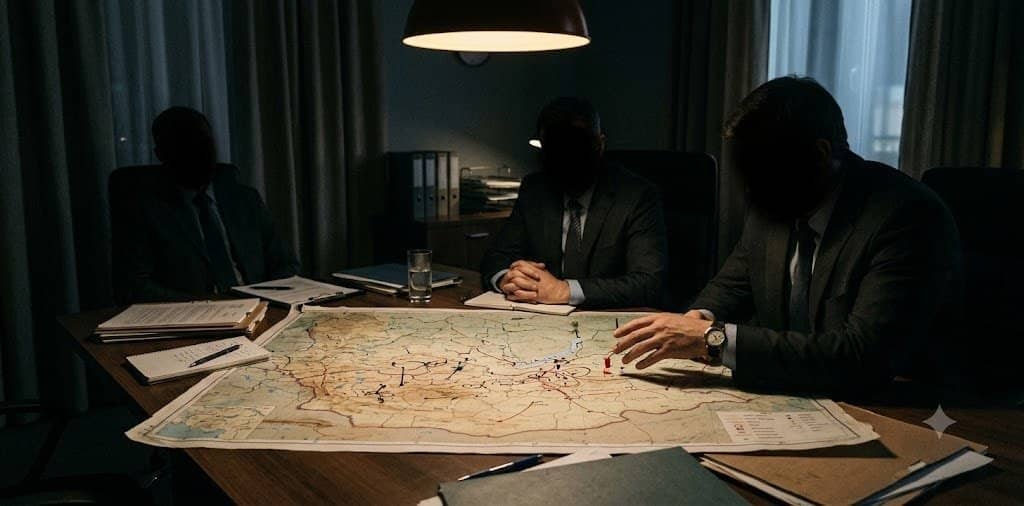
An abstract representation of the hidden tactics and geopolitical complexities involved in foreign covert regime change operations. (Representative Image)
Key Takeaways
1 of 3
Automatically generated. Read full article for complete context.
In the context of ongoing debates in several countries on foreign covert regime change operations (FCRCO), it is useful to seek more clarity on what exactly is meant by this. Historically, there are many instances of the more powerful regimes trying to change weaker regimes in nearby territories if the latter do not follow the dictates or desires of the former, or fail to meet their requirements. Fast forward to present times, and regime change operations have become possible for the most powerful countries even in distant places. A covert or secretive regime change operation can be attempted by any major power or larger power, but most prominently, this has been discussed in the context of FCRCOs attempted by the USA (although, ironically, even the USA has accused Russia of interfering in some of its elections in the last decade.).
A quote from an important document of the \\National Security Council (NSC)\\ of the USA can be helpful for understanding the USA’s official perception of this phenomenon:“The National Security Council …has determined that, in the interests of world peace and US national security, the overt foreign activities of the US Government must be supplemented by covert operations…so planned and executed that any US government responsibility for them is not evident to unauthorized persons and if uncovered the US Government can plausibly disclaim any responsibility for them. Specifically, such actions shall include covert activities related to propaganda; economic warfare; preventative direct actions, including sabotage, anti-sabotage, demolition, and evacuation measures; subversion against hostile states, including assistance to underground resistance movements, guerillas, and refugee liberation groups, and support of indigenous anti-communist elements in threatened countries of the free world.” (Reference: National Security Council Directive 10/2, May 12, 1948, ‘Draft Report by the National Security Council,’ \Foreign Relations of the United States (FRUS), 1945-50, Emergence of the Intelligence Establishment\, ed. C. Thomas Thorne Jr. and David S. Patterson., May 12, 1948, ‘Draft Report by the National Security Council,” Foreign Relations of the United States (FRUS), 1945-50, Emergence of the Intelligence Establishment, ed. C.Thomas Thorne Jr. and David S. Patterson).
This quotation has also been given a prominent place in the widely discussed book, \Covert Regime Change\, written by Lindsey A. O’Rourke. This learned academic also provides her own definition: “Covert regime change denotes an operation to replace the political leadership of another state where the intervening state does not acknowledge its role publicly. These actions include successful and failed attempts to covertly assassinate foreign leaders, sponsor coups d’étatDefinitionA sudden, violent, and illegal seizure of power from a government, typically by a small group within the existing state apparatus, often the military., influence foreign democratic elections, incite popular revolutions, and support armed dissident groups in their bids to topple a foreign government.”
In recent years, the aspect of ‘inciting popular revolutions’ has been emphasized, as seen in the attempts to dislodge President Lula in Brazil by inciting fierce, widely publicized movements based on corruption charges (which were later annulled by the Supreme Court due to judicial bias and procedural flaws, but only after the veteran leader had suffered a long imprisonment in 2018-19 and the country’s political stability had been badly disrupted). One model is to instigate endless protests until the object of regime change is reached. However, there are other models too.
Clearly, foreign covert regime-change operations should be distinguished from overt ones. Foreign overt regime-change operations can be in the form of initiating a full-blown war (though no such war has been initiated in Iran recently for regime change) or else these can be in the form of a much more limited attack, as seen recently in the attempted attack on Venezuela which aimed to kidnap its President and First Lady but was foiled. However, it is important to realize that overt operations are often accompanied or preceded by covert operations as well, and this could be seen more recently in Venezuela as well as in Iran.
Last but not least, it must be clear that FCRCOs include failed attempts as well as successful attempts. In fact, failed regime-change attempts are likely to be higher than successful ones, given the many complexities involved. What is important is to realize that regardless of whether the FCRCO is successful or not from the point of view of the attacker or instigator, the human costs are almost always tragic for the targeted country and its people. On the other hand, there can be harmful impacts for the habitual offender or attacker too, in terms of widespread loss of trust and ethical strength, which in turn also has adverse domestic impacts. So, no one really benefits from FCRCOs; everyone is a loser if we take a broader view, and the best policy option is to entirely discard them.
As, by their very definition, FCRCO activities are highly secretive and, as explained in the US National Security document quoted above, a lot of care is taken to avoid identifying the perpetrators and their various linkages, great caution has to be exercised in the targeted country to escape from the harmful impacts of FCRCOs, and people should be alert regarding this.
Disclaimer:The views and opinions expressed in this article are those of the author(s) and do not necessarily reflect the official policy or position of The Rift.