Opening The Rift
therift
© 2026 The Rift. All Rights Reserved.
Gadag’s Cardoz Library: The Forgotten Chapter of Karnataka’s History
With a remarkable history spanning nearly 146 years, this historic institution now finds itself on the verge of decline due to neglect and lack of proper maintenance.

Key Takeaways
1 of 3
Automatically generated. Read full article for complete context.
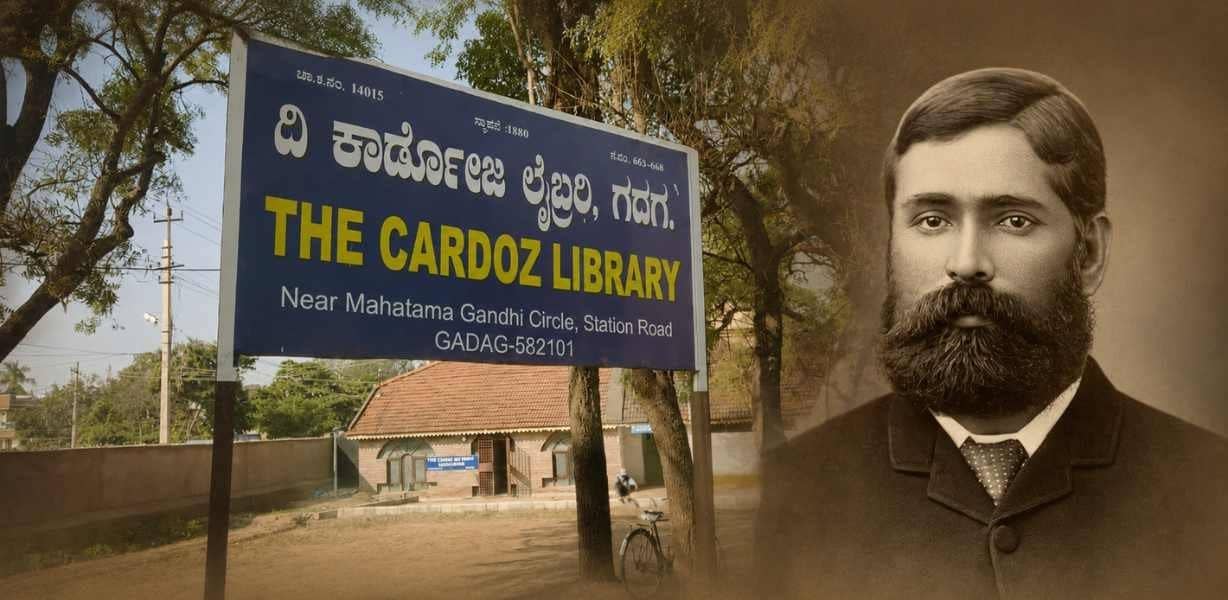
Those were the years between 2006 and 2008, when I was pursuing my PUC at J.T. College of the KLE Education SocietyK.L.E. SocietyKarnatak Lingayat Education Society is a major educational organization in Karnataka, founded in 1916, which runs over 250 institutions. in Gadag. Every time I passed through the Mahatma Gandhi Circle area, an old library named “Cardoz Library” would catch my attention. During our free hours, it had become a routine for us to visit the District Central Library located inside the municipal premises and then wander towards this old Cardoz Library.
There was another reason that drew us there in those days. In the adjacent building stood a billiards board, and out of youthful curiosity we would often stop to watch the game. Yet, more than anything else, it was the unusual name of the library that continued to fascinate me. Like most people of Gadag, I too knew absolutely nothing about the history behind the name “Cardoz” or the story of the man associated with it.
Years later, while documenting the history of old printing presses and libraries, I happened to visit the library again. As I was examining a few termite-infested old books inside the neglected building, my eyes fell upon an old portrait of Dr. Diego Cardoz, which had reportedly been donated to the library in 1939 by a physician named Dr. Umachagi. Curious to know more, I asked the librarian about the man in the portrait. Unfortunately, even the librarian could provide very little information.
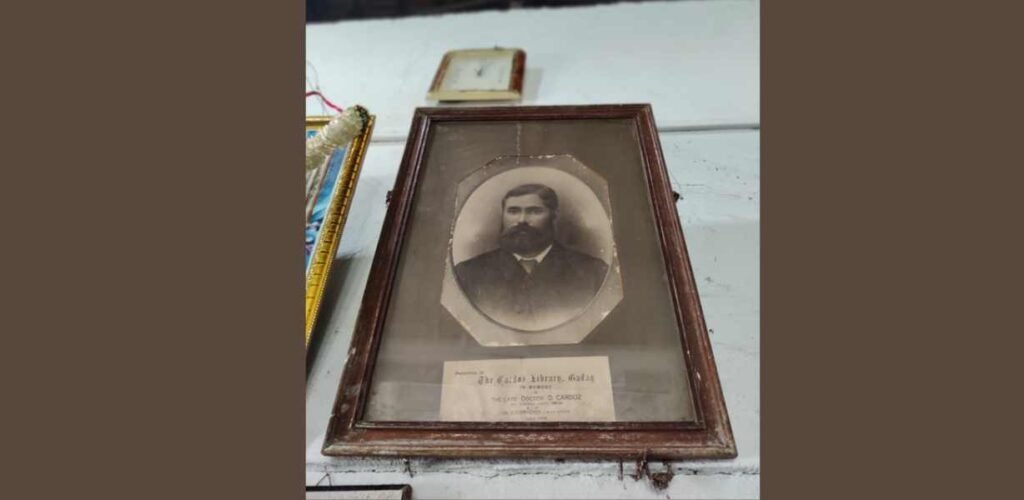
What truly astonished me, however, was the registration plaque inside the library. On it, the year of establishment was inscribed as 1880. From that moment onwards, my search for Dr. Cardoz became relentless. Though references to the library appeared in gazetteersGazetteersGeographical dictionaries or directories that historically contained vital administrative, historical, and social records of districts in British India and later independent India. and archival records, none clearly answered the question: Who exactly was Dr. Cardoz?
After years of searching, I finally found a clue in the Journal of the Society of ArtsRoyal Society of Arts (RSA)A prestigious London-based organization founded in 1754 committed to finding practical solutions to social challenges. dated December 1, 1905. It contained a brief obituary note mentioning Dr. Cardoz’s death and recorded that he had been an active member of the prestigious Society of Arts from 1900 until his final days.
So, who was Dr Cardoz?
Dr. Diego Cardoz was a surgeon by profession who entered medical service in 1872. Later, during the historic period of the Russo-Turkish conflictRusso-Turkish War (1877–1878)A major conflict between the Ottoman Empire and an Eastern Orthodox coalition led by the Russian Empire, leading to significant border changes in the Balkans. and the Berlin peace negotiations of 1878, he was deputed as Chief Medical Officer along with Indian troops stationed on the island of Malta.
Upon returning to India, he served as Assistant Surgeon at the Gadag Dispensary from 1880 to 1886. During his years in Gadag, he emerged not only as a respected physician but also as an influential civic leader. He later became the Vice President of the Gadag-Betageri Municipality and played a significant role in improving sanitation and public infrastructure in the town.
Having spent years healing the physical suffering of people, this compassionate doctor also sought to cure the intellectual stagnation of society by nurturing a culture of reading. With that vision, he started a small library in his own residence in 1880. Later, with official permission from the municipality, he acquired land in the heart of the city and constructed a dedicated library building through his own efforts.
Not stopping there, Dr Cardoz donated more than 400 valuable books from his personal collection, along with cupboards and furniture, to the library. Through his efforts, the institution became one of the oldest public libraries in the entire Karnataka region.

Dr Cardoz’s contributions extended beyond literature. Alongside the library, he also founded a social club and personally donated a billiards table. Through this gesture, he introduced a game like billiards to a small town like Gadag during that era — a remarkable cultural contribution for its time.
His service was not limited to Gadag alone. Later, as Senior Assistant Surgeon in Hubli-DharwadHubli-DharwadA twin city in North Karnataka, often considered the commercial and educational hub of the region., he played a vital role in the establishment of the city’s Water Works, Municipal Hall, Civil Hospital, and Lamington High SchoolLamington High SchoolA prominent historical educational institution in Hubli, named after Lord Lamington, a former Governor of Bombay..
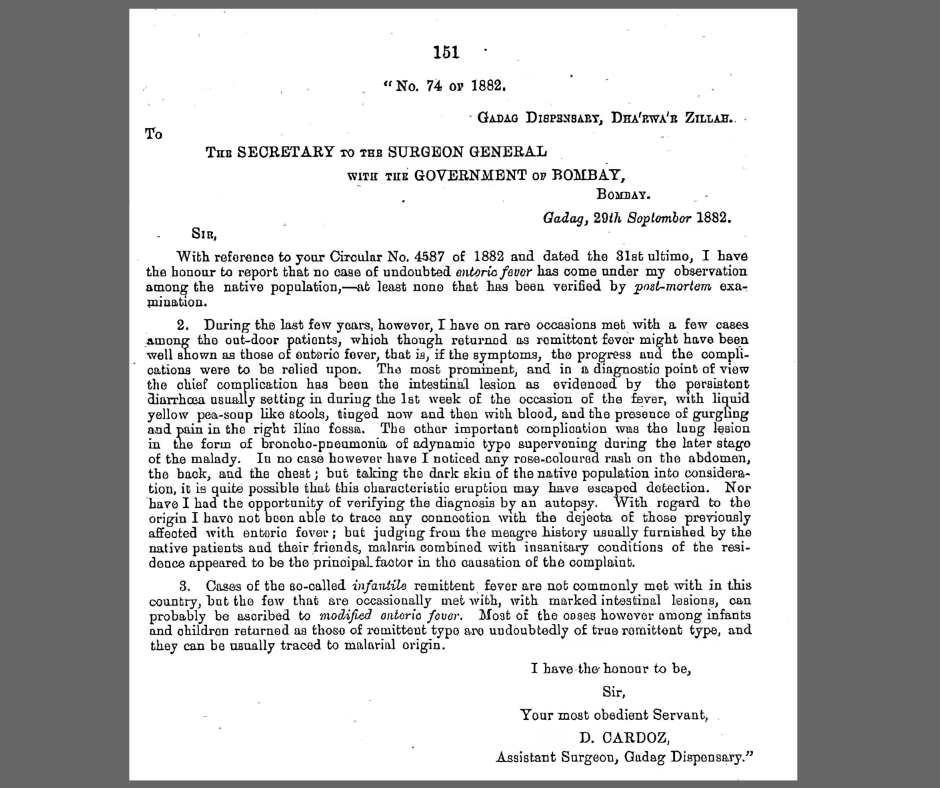
Most notably, during the devastating plague epidemic of 1897–98Bombay Plague EpidemicA devastating bubonic plague outbreak that started in Bombay in 1896 and spread across western and northern India, causing massive casualties. that shook the Bombay Presidency region, Dr Cardoz stood at the forefront and successfully implemented vaccination programmes to control the outbreak. In recognition of his extraordinary public service, the British Viceroy honoured him with the prestigious Kaiser-i-Hind MedalKaiser-i-Hind MedalA prestigious medal awarded by the British monarch between 1900 and 1947 to individuals who rendered distinguished public service in British India..
After dedicating decades of his life to the welfare and development of Gadag and Hubli-Dharwad, Dr Diego Cardoz passed away on May 13, 1905, at the age of just 54 in Hubli.
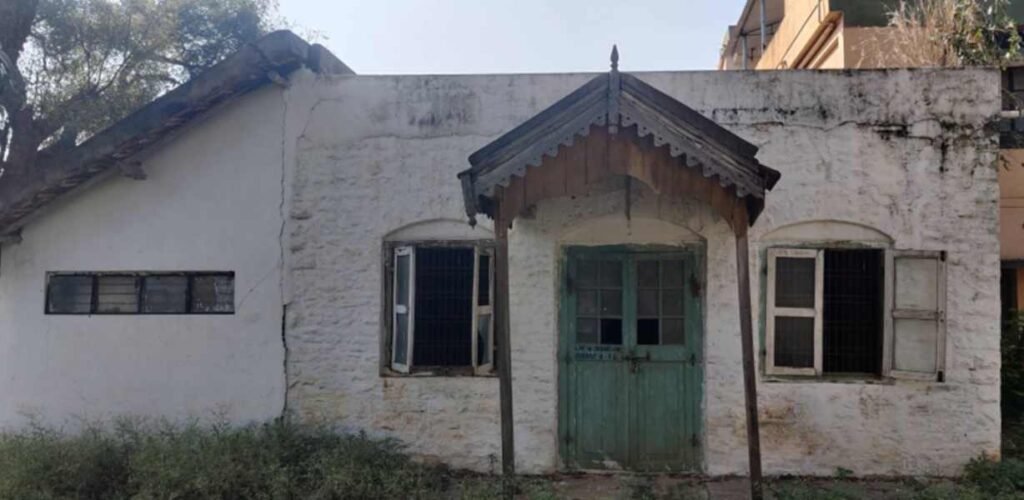
Today, though time has pushed his memory into the shadows of history, the legacy of Dr Cardoz still stands quietly in the heart of Gadag-Betageri – opposite the Gandhi statue – in the form of the Cardoz Library. With a remarkable history spanning nearly 146 years, this historic institution now finds itself on the verge of decline due to neglect and lack of proper maintenance.
As a living symbol of Gadag’s reading culture and an important part of Karnataka’s intellectual heritage, the Cardoz Library urgently deserves restoration, preservation, and government support.
The fading walls of this old library still echo the memory of a forgotten doctor – a man who not only healed bodies but also illuminated minds.
Disclaimer:The views and opinions expressed in this article are those of the author(s) and do not necessarily reflect the official policy or position of The Rift.