Opening The Rift
therift
© 2026 The Rift. All Rights Reserved.
Hunger Strike, the Government’s Silence, and Democracy’s Test
The government’s silence on the NEET exam crisis and Sonam Wangchuk’s hunger strike reveals a deep insensitivity and irresponsibility within the system.

Key Takeaways
1 of 3
Automatically generated. Read full article for complete context.
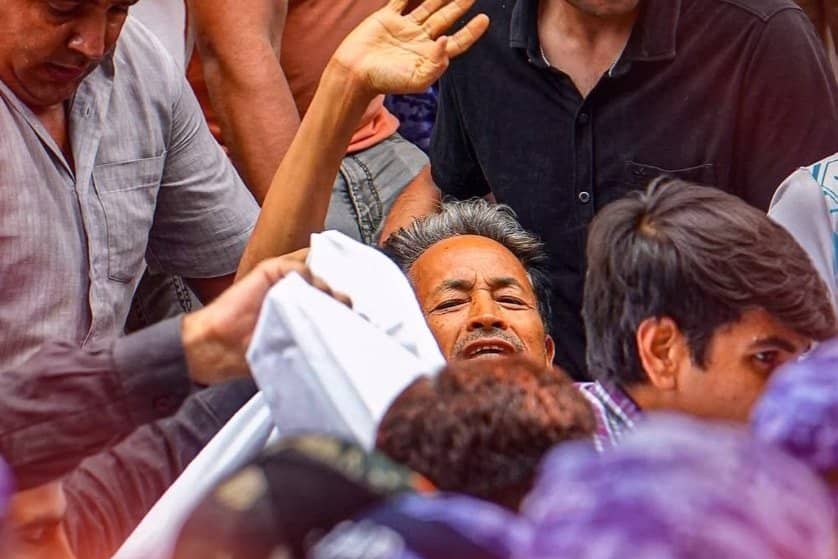
Sonam Wangchuk’s hunger strike has shaken the entire nation, and this movement now stands at a decisive turning point. On Thursday, July 16, the Delhi High Court directed the central and Delhi governments to ensure the activist on hunger strike is examined daily by government doctors and that all possible medical efforts are made to save his life. This order was given by the bench of Chief Justice Devendra Kumar Upadhyay and Justice Tejas Karia, when the central and Delhi governments assured that Wangchuk’s condition would be monitored regularly.
Solicitor GeneralSolicitor GeneralThe second-highest law officer of the country, assisting the Attorney General in the performance of their constitutional and other legal duties. Tushar Mehta told the court that, on doctors’ advice, all necessary medical treatment would be provided to manage Wangchuk’s deteriorating health. The court noted that a citizen’s life is priceless and that government machinery must make every possible effort to save it. Praising the Solicitor General’s stance, the court also directed continuous monitoring of Wangchuk’s medical condition at both the clinical and other levels.This order came while hearing a public interest litigation. The petition, filed by social activist and lawyer Rakesh Kumar Saini, demanded that Wangchuk be admitted to hospital immediately and, if necessary, force-fed. Wangchuk has been on an indefinite hunger strike since 28 June at Jantar MantarJantar MantarAn 18th-century astronomical observation site in New Delhi, India. It is a popular location for public protests and demonstrations., as part of an agitation organised by the Cockroach Janata PartyCockroach Janata PartyA satirical political party formed by youth on social media in response to a remark by the Chief Justice of India comparing protesters to cockroaches. It has become a symbol of youth dissent and activism. over the NEETNEETNational Eligibility cum Entrance Test, a standardized entrance examination in India for students seeking admission to undergraduate medical and dental courses. exam paper-leak issue, demanding the resignation of Union Education Minister Dharmendra Pradhan.
On Wednesday, the court had treated the matter as urgent and sought a response from the central and Delhi governments by the following day. At that time, Saini argued that it was regrettable that a social activist exercising his fundamental right to protest was risking his life before the nation. to protest was risking his own life before the entire nation. The hearing had been postponed because of the absence of the central government’s lawyers, though the court had assured that the petition would be taken up seriously.
Sonam Wangchuk’s Health Status
19
Days on Hunger Strike
8.5 kg
Weight Loss
109/70
Blood Pressure
VISUALS BY THE RIFT
Today, 18 July, marks the nineteenth day of Wangchuk’s hunger strike. According to reports received, his body is growing continuously weaker, he is experiencing muscle pain, and he has lost eight and a half kilograms in weight. His blood pressure has been recorded at 109/70. Actress Sonakshi Sinha has expressed support for Wangchuk and the Cockroach Janata Party on social media, demanding government accountability for alleged examination irregularities. Congress MP Shashi Tharoor also wrote an open letter to the protesters, earnestly appealing to Wangchuk to end his hunger strike. He noted the strike had awakened the nation’s conscience and that the fight should now proceed through parliamentary means. He also underlined that this issue, concerning students, deserved wider discussion through democratic institutions.
Meanwhile, the Cockroach Janata Party has announced that on the very first day of Parliament’s monsoon sessionMonsoon SessionOne of the three parliamentary sessions in India, typically held from July to September, coinciding with the monsoon season., 20 July, a peaceful march will be taken out from Jantar Mantar to Parliament House. These developments have shifted the focus from an individual’s hunger strike to a larger question about the credibility of the country’s education system. The events at Jantar Mantar and the lack of societal sensitivity should be a matter of national concern. Our government should have tried to understand the anguish of the country’s youth, but silence has been adopted instead. The media too should have raised its voice on this important issue, but there as well the same silence prevails.
The Cockroach Party’s agitation has been going on in the national capital for nearly a month now. Groups of young men and women across the country have taken to the streets demanding the education minister’s resignation. Their contention is that someone must take responsibility for the chaos surrounding the NEET examination and the suicides of several students that resulted from it. The question is not limited merely to the education minister’s resignation; it also concerns the neglect being shown toward this movement at Jantar Mantar. It has now been more than nineteen days since the hunger strike began by Ladakh’s well-known social activist and education reformer Sonam Wangchuk. Even as these words are written, news of Wangchuk’s worsening health is spreading rapidly on social media. Astonishingly, despite this prolonged youth movement and Wangchuk’s declining health, the government has paid it no heed.
NEET Examination Irregularities (2021-2026)
90+
Cases Reported
~20
Student Suicides (Alleged Link)
2.3 Million
Students Appeared This Year
VISUALS BY THE RIFT
Is it not true that more than fifteen young people took their own lives because of the chaos surrounding the NEET examination? The government has still not given a satisfactory answer as to who is responsible for this chaos and the deaths that resulted from it. While it is true that the NEET exam was conducted again, it is equally true that lakhs of students had to sit for it once more under tremendous mental stress. Someone must be held responsible for this entire situation. Since this is a matter of disorder within the education system, why should responsibility not be fixed on the education minister? In truth, the country’s education minister should have taken the initiative himself and set an example by resigning on moral grounds. However, nothing of the sort happened. Instead, BJP leaders proudly declare their government has no tradition of resigning.
The question ought to be asked as to why the concerned minister should not accept responsibility. The Prime Minister’s Office, which responds promptly to minor incidents, has issued no statement on this important matter. Are the suicides of nearly twenty students connected to the NEET examination such a trivial issue that the country’s Prime Minister felt no need to say anything about it? It would not be out of place to mention here that more than ninety cases related to the NEET examination have come to light between 2021 and 2026. This year, nearly twenty-three lakh students appeared for the medical entrance examination. Everyone knows that preparing for this exam is no small matter; students remain under enormous pressure. The unfortunate students who took their own lives could not bear this strain. One cannot even imagine what their parents must have gone through. Did their suffering not even deserve two words of consolation from senior leaders in government? Then what is this silence for?
This silence is not something to be taken lightly. It is true that after the Chief Justice of India compared the youth to cockroaches, the formation of the Cockroach Party was not initially taken very seriously. A young man named Abhijeet Deepke, studying in Boston, had perhaps posed a question on social media in jest what would happen if all the cockroaches came together? In answering that question, thousands of young supporters criticised the Chief Justice’s remark and raised their voices, and the matter reached a serious turning point. It is also true that this movement has still not achieved the institutional success it deserves. Yet the support it is receiving from across the country is certainly not so small that it can be ignored.
What the youth are ultimately asking is this: who is responsible for the chaos in the examination? Why is no action being taken against the circumstances that are driving students to suicide? Why did Wangchuk and so many students alongside him have to sit on hunger strike? And the biggest question of all how did our entire system become so insensitive and irresponsible?
Another matter of concern is the insensitivity of our media. Thousands of young people have been protesting against the education minister at Jantar Mantar for nearly a month now. These students are enduring summer heat and monsoon rain in the open. Many of those on hunger strike have had to be hospitalised because their health deteriorated. This issue is directly connected to the future of the country’s youth. Protests are continuing steadily, yet the country’s mainstream media shows little concern about it. The same criminal silence being maintained by the government has, it seems, been adopted by our media as well. Why exactly is this happening? It is a shameful truth that had social media not been active, news of this movement at Jantar Mantar would not even have reached the country.
Had social media not remained active on this matter, questions about how the movement is progressing, how society views it, and what lies behind the government’s silence would all have remained unanswered. For a month now, the country’s youth have been restless. Alongside the capital, Delhi, young people have taken to the streets in many other cities across the country too, yet this finds little coverage in newspapers. Our media shows great eagerness in displaying crowds of people of Indian origin during the Prime Minister’s foreign visits, but the young people who keep gathering steadily in the capital, Delhi, seem invisible to the media altogether. In the world’s largest democratic nation, one that cites democratic values and ideals as its example, this role played by the media is not merely surprising but shameful and worrying as well.
It is the media’s duty to help society understand the seriousness and gravity of the situation. It is equally the media’s job to ask why the government keeps avoiding this serious issue. The question is not just about the education minister’s resignation; it concerns evaluating the entire situation that has made students’ futures look bleak. Questions are also being raised about the very rationale of our education policy. Medical and engineering entrance examinations too have come under a cloud of suspicion. The education minister says that by 2027 all these examinations will be made computer-based. But why does no one ask him whether computer facilities will reach students in the country’s rural areas by then? The current state of affairs is that only sixty per cent of government schools in the country have computer facilities available. Will students in the remaining forty per cent of schools not be left at a disadvantage because of this?
Computer Facilities in Indian Government Schools
60%
Schools with Facilities
40%
Schools Without Facilities
VISUALS BY THE RIFT
Indian democracy’s beauty has always been its respect for differing opinions and dissent. There is no doubt that this approach strengthens democracy further. When we say that India is the world’s largest democracy, policymakers too must show a large-heartedness in listening to voices of resistance. Today, as questions are being raised over alleged irregularities in the competitive examinations that decide the futures of millions of children, this very spirit is once again being put to the test. The hunger strike of education expert and innovator Sonam Wangchuk, undertaken to preserve the integrity of the examination system, has reached a critical juncture. Setting political affiliations aside, his deteriorating health should certainly be a matter of concern for all of us. It is equally true that Wangchuk is not affiliated with any political party, and that he is not carrying out this movement for any personal gain. Although he has stood in support of the Cockroach Janata Party, which came into existence over the issue of students’ futures, at the heart of his concern lie the futures of those lakhs of students who are expressing distrust in examination practices. At the root of his movement lies the anxiety of those countless parents whose faith is being shaken again and again by repeated paper leaks and irregularities in the examination process. While it may be difficult to assert with certainty that every single allegation is true, it cannot be denied that public trust in many of the country’s important entrance examinations has diminished. In such circumstances, the country’s policymakers need to restore this broken trust as soon as possible through transparent reforms and greater accountability.
Democracy demands that those in power listen to citizens questioning policy flaws, regardless of political allegiance. There is no doubt that in any country, the government stands in the role of guardian of its people. Prolonged neglect of peaceful protest deepens public distrust in the government. Initiating dialogue with protesters is not a government weakness. It must not be forgotten that a hunger strike carries both a moral and a medical dimension. It is the government’s responsibility to protect the life of the person protesting while honouring their freedom of expression, and it is equally necessary that any medical intervention adhere to the law and to medical ethics. No one benefits from the present deadlock. In truth, the government does not need to accept every single demand in order to begin dialogue; the protesters, for their part, must also remain committed to making that dialogue meaningful. A trustworthy committee and a time-bound roadmap could bridge this trust gap. Serious thought must also be given to the human dimension of this movement that is, the government must try to understand the emotions behind why this movement was born in the first place. The government must uphold the fundamental democratic right to peaceful protest. Any sincere effort toward dialogue can certainly prove useful in breaking this deadlock. And it is equally important that sensitivity be maintained so that the cost of the administration’s negligence and indifference is not paid by Sonam Wangchuk’s health.
Disclaimer:The views and opinions expressed in this article are those of the author(s) and do not necessarily reflect the official policy or position of The Rift.
*Sonam WangchukEducation SystemGovernment AccountabilityHunger StrikeIndian DemocracyMedia SilenceSonam Wangchuk