Opening The Rift
therift
© 2026 The Rift. All Rights Reserved.
NEET 2026: Leaked, Again.
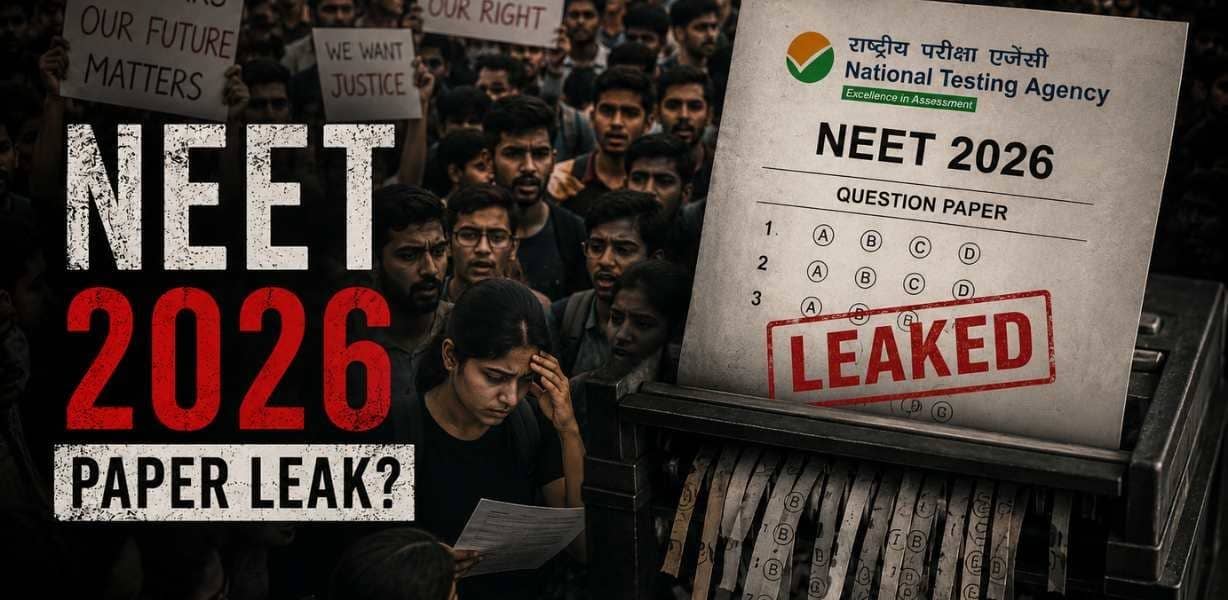
The NEET-UG paper has leaked again. Two years after Parliament passed a law specifically to prevent this, the exact same thing happened. With 22.8 lakh students affected, a cancelled exam, and a CBI probe that feels like it runs on a yearly subscription.

Key Takeaways
1 of 3
Automatically generated. Read full article for complete context.
On May 3, 2026, approximately 22.8 lakh students sat down across thousands of centres to take the NEET-UG examination. They had studied for two years. Some had studied for four. A significant number had relocated to Kota, Rajasthan, at the age of fifteen, leaving behind their families to live in cramped hostel rooms with a hotplate and a dream of cracking a test that would let them become doctors.
Nine days later, on May 12, the NTA cancelled the entire exam. The reason was a paper leak. The question paper for the biggest medical entrance examination in the country had been circulated before the test via a guess paper that turned out to be the actual paper. The CBI has been called in. Investigations are underway and reportedly ‘Master Mind‘ named Manish Yadav has been arrested in Jaipur. The NTA has assured candidates that a re-exam will be conducted. Fresh dates will be announced with no new registration and additional fee.
The Pattern Nobody Calls a Pattern
Here is the thing about the NEET 2026 cancellation that should alarm you. It is not new and is no longer an aberration. There seems to be a pattern emerging despite an especial law enacted to prevent such leaks and corruptions with stringent punishments. Here is the timeline showing previous instances of the paper leaks.
Previous Leaks
Examination integrity failures — AIPMT / NEET (2015–2026)
2015 — AIPMT
Bluetooth earpieces. Solver rackets. Full cancellation.
Supreme Court called exam “vitiated to the core.” Ordered re-test.
2016–2022
Solver gangs. Proxy candidates. Forged IDs.
Annual busts across Bihar, Rajasthan, Delhi. No structural reform.
2024 — NEET-UG
Paper leaked from Hazaribagh. 67 perfect scores. Grace marks scandal.
CBI probe. NTA DG removed. Anti-cheating law passed.
2026 — NEET-UG
Paper leaked again. Full cancellation. CBI again.
22.8 lakh affected. Re-exam pending.
NTA / SC / CBI | The Rift

therift.in
therift.in
The Bottleneck
But the leak is not the disease. The leak is a symptom of something structurally worse: the ratio.
The Bottleneck
NEET 2026 — Candidates vs. Seats
17:1
Rejection rate: 94%
← 1.29L seats
22.05L candidates
█ seats available (5.87% of candidates)
| Year | Students | Seats | Ratio |
|---|---|---|---|
| 2017 | 10.9L | 65K | 16.8:1 |
| 2021 | 15.4L | 90K | 17.2:1 |
| 2023 | 20.4L | 1.07L | 19.1:1 |
| 2026 | 22.1L | 1.29L | 17.0:1 |
NTA / NMC | The Rift
therift.in
therift.in
When the stakes are this high and the legitimate pathway this narrow, leaking the paper stops being an anomaly. It becomes rational market behavior as the timeline shows. It is arbitrage on a broken system. The demand for doctors is enormous, the supply of seats is artificially scarce, and the gap between the two is filled by whoever has the cash and a contact in the NTA supply chain. Until the root cause is addressed, such leakage will continue to happen.
The Kota
While we are on the subject of systemic failure, here is a fact the outrage cycle will not touch: the coaching industry. India’s test preparation market is valued at approximately $11.6 billion as of 2025, according to Technavio. Kota alone hosts upwards of two lakh students at any given time, packed into a city whose infrastructure was built for a fraction of that population. Allen Career Institute, FIITJEE, Physics Wallah, and Aakash are not tutoring centres. They are parallel education systems that exist because the formal school system produces students who cannot pass the exams it designed.
Between 2023 and early 2025, at least 57 students preparing for competitive exams died by suicide in Kota, according to reports citing local police data. The district administration responded with Dinner with Collector , an initiative under the “Kamyab Kota” campaign where District Collector Dr. Ravinder Goswami eats dinner with coaching students at their hostels every Friday to boost morale. Coaching centres responded by installing anti-suicide nets on hostel balconies.
The student died studying for an exam whose paper was being sold on Telegram at the same time.
Nobody in the NEET outrage discourse connects those two facts. The leak and the suicide net exist in the same ecosystem. One is about the scarcity of legitimate access. The other is about the human cost of pretending the access is legitimate.
A Law That Arrived Late
The Public Examinations (Prevention of Unfair Means) Act, 2024 was supposed to fix this. It was passed specifically after the 2024 NEET disaster. All offences under it are cognizable, non-bailable, and non-compoundable. Individuals face 3 to 5 years imprisonment and fines up to ₹10 lakh. For organized operations, the penalties go up to 10 years and ₹1 crore. Service providers involved face debarment for four years.
You cannot imprison your way out of a structural supply crisis. You can arrest the person who leaked the paper. You cannot arrest the reason they had a buyer.
What We Made
22.8 lakh students will now prepare for the same exam again. Some of them will take leave from jobs they had already taken to pay for coaching. Some of them will return to hostels they had just left. Some of them will sit down in examination halls knowing that the paper might leak again, because it has leaked before, and the law that was supposed to prevent it did not.
They will do it anyway, because there is no alternative. NEET is the only gateway. The system has exactly one door, and that door has a combination lock, and the combination is being sold before the exam starts.
India did not build a medical entrance examination. It built a recurring annual crisis with a ₹200 application fee and a CBI investigation as a runtime error.
The paper leaked. The exam was cancelled. The CBI was called. The re-exam will happen. The paper might leak again. If it does, the CBI will be called again. This is not a scandal. This is a calendar event.