Opening The Rift
therift
© 2026 The Rift. All Rights Reserved.
Suffering on Both Sides—How Efforts to Destroy, Dominate or Harm Others Also Harm the Aggressor
Deliberate efforts to destroy others have the seeds of self-destruction in them, leading to internal distress and societal decay for the aggressor.

Key Takeaways
1 of 3
Automatically generated. Read full article for complete context.
When a powerful person keeps trying to dominate, harm and destroy an apparently much weaker person, then the weaker person obviously suffers a lot, but is it also true at the same time that in this process the aggressor also suffers and is harmed?
If in a general way people are asked this question then, despite any economic or other gain the aggressor may have acquired, many people will reply from a strong moral viewpoint that such a person who torments others will also suffer, he can never be happy. However more precise answers on how, why, to what extent and in what ways such a tormentor will suffer are generally not forthcoming.
If we further pose this question in the context of not an aggressor person but instead an aggressor country or society (without the country being named or identified) then the answer may be even less precise, partly because people may not have thought much along these lines, although moral overtones may still remain strong in the response of some people (no, such a country which seeks to destroy others can’t be happy).
It is useful to try to find more detailed answers to these questions because once it is more firmly established that the process of trying to constantly dominate, harm and destroy others is self-destructive, then this can provide a very strong support to those who are trying to reduce the very strong trends of aggression, domination and destruction.
Recognizing the importance of this issue, in a small and humble way I have tried to contribute to its study and understanding over the decades. An early effort resulted in the publication of a commentary in Economic and Political Weekly titled ‘Relations of Dominance’ (March 7, 1998). I wrote a small book titled ‘Burning on Both Ends’ on this subject. In subsequent books like ‘Another Path Exists’ and ‘Planet in Peril’ I emphasized that not only in human relationships, but even in human and nature relations, the urge to dominate is a very serious problem which needs correction. I raised this issue also in detail in my books on the Iraq War written in English and Hindi.
I have tried to continue exploring this issue, regarding this as a key issue of the overall efforts to create a safer and better world. Here I try to bring together some of the important aspects of this issue in this article in two parts—in the first part in more general terms and in the second part more in the specific context of the USA’s much-discussed forever wars and aggressions which have been very destructive not just for other countries but also internally for the USA. I try to provide more details on some aspects of this issue that are generally accepted (such as the extent to which military and war expenditure may cut essential welfare and health expenditure within the USA) but I also include additional aspects and seek to make less discussed connections between external aggression and internal harm. The first part of the article helps in the wider understanding of this issue which is helpful in the second part for contextualizing more specific details and data.
Part I—Deliberate Acts of Destruction Carry Seeds of Self-Destruction
Those who seek to destroy others must realize that deliberate efforts to destroy others have the seeds of self-destruction in them.
While this can be understood at several levels, the most obvious is that all human beings have varying levels of human sensitivity which seeks to prevent them from causing serious and unreasonable harm to others or being unjust, destructive and cruel towards others. When defying their innate sensitivity, certain persons choose to be destructive towards others, then they need to curb or suppress their inherent human quality of being sensitive to the suffering of others.
When a larger number of such persons are carrying out destructive and unjust acts repeatedly as a matter of policy, then they need to make such attempts repeatedly to curb their sensitivity, or even to kill or murder their own sensitivity. This is a self-destructive act which facilitates the acts of destruction. Moreover, once sensitivity is deliberately suppressed or even killed, then this lack of sensitivity can spread to almost all aspects of life of the persons so affected so that they also become insensitive in their dealings with those close to them, at workplace, elsewhere and above all at home.
Of course not all persons are affected in the same way and to the same extent, and some persons also make strong efforts to resist such impacts and to provide better outlets for their pent up tensions and feelings. Here we are only describing some general and widespread trends.
The adversely affected persons would like to confine their lack of sensitivity only towards those they deem to be hostile but sensitivity does not exist like a button on human body which can be switched on and off. Once sensitivity is deliberately curbed or even killed in a particular context, this loss of sensitivity spreads like a poison to almost all aspects of life, resulting in the affected persons having an increased tendency of inter-acting in close relationships in selfish, deceitful, aggressive and violent ways. This inevitably increases distress and stress in daily life and in personal life. This in turn leads to increase of substance abuse. Increase of substance abuse is also related to efforts to seek escape from memories of cruel and unjust acts. All this can also lead to increase of suicidal tendencies or tendencies of self-harm. When this occurs among several people of a society, then at a wider level high rates of suicides, suicide attempts or suicidal thoughts, social disintegration, substance abuse and mental health problems are reported, although such inter-linkages are seldom explored adequately in the conventional approach to studying such issues.
In fact to draw attention away from all these unpalatable aspects, such societies also makes efforts to deny important truths, to deny injustice and aggression, hoping that such widely propagated denial will be widely accepted. However in reality what often happens is that while denial can be practiced at the more apparent surface level using vast resources, at a deeper level the realization of the reality continues to prevail widely; leading to increased cynicism, absence or rejection of idealism, social vacuum, high levels of escapism and substance abuse. This can tragically affect even more the young people whose higher sensitivity, not yet corrupted, really needs some ideals and struggles to cope with disturbing realities, leading to bursts of protests followed frequently by more enduring escapism and compromise of varying levels, as carefully crafted policies push them towards this.
While individual responses can vary greatly, the overall impact at a wider societal level of trying to destroy others is of self-destruction. One indication of such adverse impacts is available in some statements of the veterans of US armed forces. One of these statements, after describing the immense cruelties and killings of the Vietnam War said, “ We know what Post Traumatic Stress Disorder looks , feels and tastes like because the ghosts of over two million men, women and children still haunt our dreams. More of us took our own lives after returning home than died in battle.”
This is confirmed by a more detailed account of the life of a pilot whose napalm bomb had led to the burning of a Vietnamese girl Kim Phuc. After returning home, this pilot kept looking at the picture of Kim in flames. This girl was roughly the same age as his son. “He could almost smell the child’s burning flesh”. He had nightmares of screaming children pointing accusing fingers towards him. There was a breakdown in family. He began drinking heavily. “He drank to put the bombing out of his mind, and the drinking made him more obsessed.”(Reader’s Digest, November 1997).
This is by no means an isolated case. Problems of breakdown in close relationships, substance abuse, domestic violence, self-violence and suicide attempts have been found to be very high among soldiers who return home after fighting highly unjust wars. More commonly, anyone who performs unjust and exploitative actions over a period of time is likely to be able to continue this only by giving up on the sensitivity needed for care, compassion and love. Hence this person’s ability to fulfill close relationships based on this declines steadily, as also his ability to experience those forms of happiness associated with real love, caring relationships and compassion.
At a wider level, a group or society which seeks to enrich itself by plundering and exploiting others has to spread value systems which makes their members insensitive to the sufferings of others, but in the process of making them insensitive the foundation for breakdown of internal social relations (including the closest ones), internal violence, self-violence and falsehoods is also prepared. This can be seen in exploiter and conqueror societies (from the days of the Roman empires to present times) and also at individual levels, in the hollow lives of those who cause or promote unjust aggressions.
To give one example of such impacts, the case of Columbus may be cited. Extreme cruelties driven by endless greed of this explorer are well-known. What kind of personality this turned him into is best revealed by a reputed doctor Sigmundo Feliz who attended to him in his last years—“To be without roots, without a sense of home and place is one of the most serious, though one of the least emphasized, psychological disorders. This patient suffered from this to an unusual degree…This patient appears from all evidence to be someone who found it difficult, even in non-threatening circumstances, to tell the truth, a habit of delusion that at times turned into self-delusion.” This tendency can be seen even today at top levels in conquering and dominating societies, as widely reported in recent times too.
At the level of wider societies or rather wider society segments, those societies which lead by aggression towards others, culminating in wars, are often involved in spreading falsehoods and self-delusions, media and education systems being two commonly used channels. The big lies cooked up to justify aggression for plunder or domination get transferred also to almost equally big lies cooked up to justify internal exploitation by big business interests. Hence people are exposed to serious health hazards by big business interests; in some cases the toll in the longer term may be higher than that of even destructive wars. The extremely high number of cancers and other serious diseases linked to proliferation of hazardous products and technologies is well-known, but the situation relating to this may be much more serious if all facts are known or investigated properly.
The aggression abroad is also reflected in internal violence, with many societies known for pursuing externally aggressive policies also known for very high levels of internal violence. Those known for instigating external coups and assassinations may also cause the internal assassination of those top leaders who are dedicated to the cause of peace, justice and sincere reform, and internal democracy may be seriously harmed by the same agents and forces that are in the forefront of promoting external aggression. In certain situations, external wars may lead ultimately to internal civil wars as well as wars among friendly countries which had earlier colluded for attacking and exploiting others. History has several examples, which can be repeated.
In fact if the history of the past over 500 years is to be captured in just one sentence, then basically what has happened is that highly destructive colonial exploitation and wars ultimately led to extremely destructive wars among and within colonial powers themselves, and those who rose from ruins with the same destructive (and self-destructive) dominance agenda have now brought the world very close to possibilities of total ruin.
This writer has been emphasizing the linkages between destruction and self-destruction, between conquest and internal distress, dominance and self-harm for several years with the hope that wider realization of such linkages will lead to higher sense of urgency for reform that can integrate moving away from external aggression with internal reform aimed at reducing social disintegration/violence and improving welfare. In this context my small book titled ‘Burning on Both Ends’ had argued that the tendencies of domination, exploitation and conquest involve ‘burning’ or extreme suffering on ‘both ends’ i.e. at the level of not just the victim but also the perpetrator. While I tried to establish this at wider levels of international situations, I also argued that in understanding social, family and individual distress also it is helpful to remember that those who are aggressive and unjust towards others become more prone to self-harm and even self-destruction without realizing this.
Some of the social data for conquering societies points to a deep internal social crisis that can arise within an exploiter and conqueror society known for its invasions and aggressions. Careful research is likely to reveal more links of external aggression and internal distress. Such research should be used to convince more and more people about the futility of paths based on exploitation, dominance and conquest, and hence paving the way for integrated reform, aimed at increasing peace and reducing distress.
Part II—USA’s External Aggression and Internal Distress
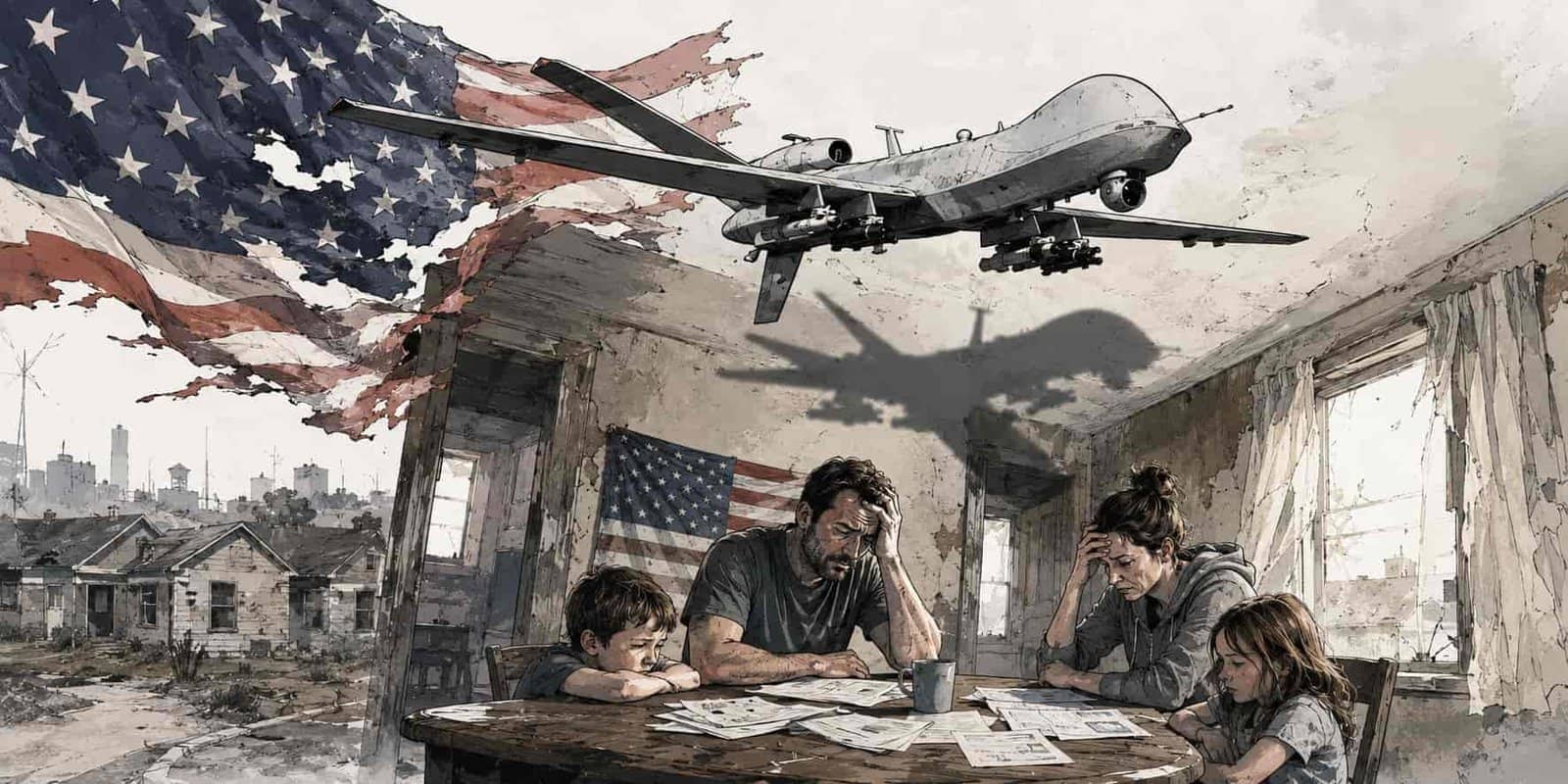
Several well-intentioned persons in the USA have increasingly made the obvious point that very high and increasing military budget and highly avoidable war spending have often been responsible for taking away substantial funds from badly needed health and welfare spending. This is increasingly relevant in Trump times with their heavy cuts for many kinds of welfare spending and increasing demand of funds for highly unjustified wars. The Yale School of Public Health presented fresh estimates in mid-2026 that a universal single-payer system (such as Medicare for All) can prevent 114,000 deaths. Arbitrary external economic aggression seen in Trump tariffs of 2025 raised daily costs and economic difficulties for many ordinary Americans.
However analysis of external aggression and internal distress in the USA should go much beyond this to cover many economic, social and political aspects, such as several of those mentioned in the preceding part of this article. At a time when President Eisenhower was giving his important warning about the increasing dominance of the military-industrial complex, the external aggression in the form of regime change operations and assassinations was also increasing, as seen in the extremely tragic assassination of DR Congo Prime Minister Patrice Lumumba, executed without informing the incoming President John Kennedy. The same forces which took the life of Prime Minister Lumumba, a leader from whom his country and the continent had very high hopes, also later took the life of President Kennedy. In fact we can go a step further and say that broadly similar forces soon took the life of two other great men representing the pursuit of peace and justice in the USA—Civil Rights and Peace leader Martin Luther King and strong Presidential candidate Robert Kennedy. So this is a clear example of the close linkage between externally aggressive forces coming back to haunt internal peace and stability.
At a broader level, those forces which seek to control or grab resources abroad with aggression are the same that prevent justice and equality at home, those that promote forever wars are the same that deny essential welfare funds, those that promote false discourse to justify aggression and plunder abroad are the same as those who create conditions for curbing truth and ideals at home, leading to escapist trends, social disruptions and substance abuse, all of which is linked, as shown in the preceding section. These multi-dimensional, many-sided linkages of external aggression and internal disruption and distress should be known widely as from this understanding important solutions can emerge.
Very few people in the world associate the USA with poverty related deaths, but the highly distressing, although clearly avoidable reality of tens of thousands of poverty related deaths annually in this most resourceful and powerful country cannot be denied. This, moreover, is part of a much wider tragedy, again clearly avoidable, of denial of basic needs to tens of millions of people. In fact a recent study found that as many as 183,000 poverty linked deaths took place in USA in 2019. As this study only covered population higher than 15 years of age, and as child poverty is higher than adult poverty, the total number of poverty-related deaths is likely to be around 200,000 or more.
The reference here is to a study published in JAMA Internal Medicine (Journal of the American Medical Association) on April 17, 2023. This research paper titled ‘Novel Estimates of Mortality Associated with Poverty in the US’ has been authored by David Brady of the University of California, Ulrich Kohler of the University of Potsdam and Hui Zheng of the University of Ohio. This estimate of mortality linked to poverty is regarded to be a conservative estimate by them. This study was based on 2019 data and after that there was the increased mortality of the pandemic which is likely to have affected poor people more. The overall decline in life expectancy reflected more mortality among the poor. Questions have been raised why life-expectancy in the USA in recent years has been consistently lower than in comparable wealthy countries. If the life expectation in the USA was the same as the average of these countries, then how many less deaths would take place in the USA in a typical year? A paper by Jacob Bor, Andrew C Stokes et al published in the journal PNAS Nexus dated May 29, 2023 found this excess mortality or number of deaths in 2019 to be 622,534. Most of this excess mortality is likely to be from the bottom half of the population, particularly in conditions of the kind of extreme inequality that prevails in the USA where the bottom 50% of the population has only about 2% of the country’s wealth.
However in the context of some population groups, including those that need special care, the situation is even worse. The facts relating to maternal mortality rate are perhaps the most shocking. At a time when maternal mortality rate in most countries was declining (in terms of deaths per 100,000 live births), in USA there was shocking increase in MMR from 12 in year 2000 to 21 in year 2020 ( this MMR of USA of 21 may be compared to Australia and Netherlands which is between I and 2).
Instead of initiating remedial actions, some recent anti-poor steps may result in increasing poverty related mortality. The New Humanitarian reported in early 2026 (at a time of preparing for increasing external aggression) that recent scrapping of subsidies for health insurance can lead to up to 51,000 preventable deaths annually in the USA. The same report said that malnutrition related deaths among the elderly are soaring.
A particularly worrying aspect relates to the inability of a very large number of people to meet emergency expenses. A Federal Reserve Report of 2018 on the economic well-being of US households stated that about 40% of adults in the country would not be able to meet a $400 emergency with cash, saving or even a credit card charge that they could quickly pay off. About 27% of those surveyed would need to borrow money or sell something to find the $400 needed, while 12% would not be able to arrange this at all. Four years later, in year 2022 an You Guv survey for the Economic Security Project found a higher number– 49%– saying that they would be ill-equipped to manage a $400 emergency. Around the same time Bankrate’s Annual Emergency Fund Report said that 57% of US adults are unable to afford a $1000 emergency expense. This report also stated that 68% of people are worried they wouldn’t be able to cover their living expenses for just one month if they lost their primary source of income. At the same it is well-known that such sudden loss of income can happen in many situations.
A study by the Urban Institute in 2018 found that nearly 40 per cent of non-elderly adults and their families in USA struggled to afford at least one basic need for health care, housing, utilities or food in 2017. In this study based on a survey of the age-group 18-64, 23% said that they were food insecure in the last 12 months. 18% struggled to pay medical bills while almost the same percentage had to go without some required medical treatment due to inability to pay for this.
Millions of people in USA have been finding it increasingly difficult to afford basic utilities like water (and sewerage) or electricity. A headline in the Guardian ( 23 June 2020) said—Revealed—Millions of Americans can’t afford water as bills rise 80%. This report, based on a study by this newspaper in collaboration with Consumer Reports and others, said that in some city neighborhoods over 40% of residents may be saddled with unpaid water bills. A Washington Post report dated October 1, 2020 was headlined—Millions of Americans risk losing power and water as massive unpaid utility bills pile up—17.9 million may be at risk of shut-offs as many state-protections end. Latest figures indicate that 17 to 40 per cent of households are struggling to access utilities, pay their bills, while about 20% are in ‘water-debt’.
In recent times child poverty levels have been found to be 1.5 times higher than adult poverty levels. As for senior citizens, the Elderly Economic Security Standard Index informed that in 2016 a majority of them lacked the “financial resources required to meet basic needs.”
The Eviction Lab, Princeton University, has estimated that there are 3.7 million eviction cases in the USA in a typical year, or 7 per minute. The number of homeless people in many US cities is at much higher levels compared to many other high income countries.
Distress related to economic problems gets enhanced and more difficult to bear when accompanied by adverse social conditions such as loneliness and alienation, mental health problems and violence. Nearly 28 per cent of US households are single person households and several surveys have found that feeling of loneliness is widespread. A survey by Cigna before the onset of the COVID pandemic revealed that almost half of the adults felt lonely, while some surveys after the pandemic mentioned a higher figure.
According to the National Centre for Injury Prevention and Control nearly 4.8 million intimate partner related assaults take place in a year. A report on child abuse is made every 10 seconds. Authorities trace 656,000 victims of child maltreatment in a year.
The incarceration rate is the highest in the USA. Certain minority ethnic groups particularly blacks, who also suffer several other injustices, are the biggest sufferers in this context. About 10 million people face incarceration in a year. The USA has 5% of the world’s population but 25% of its prisoners. Over 50% of prisoners suffer from mental health problems.
According to the data-base of the Centers for Disease Control and Prevention, USA, more than 50% of the people in the USA will be diagnosed with a mental health illness or disorder at some point in their lifetime. Nearly 20 per cent people are affected by mental health problems in any given year. Leading organizations of mental health professionals have stated that conditions of child mental health emergency already exist in the country.
The official statistics of ‘Youth Risk Behavior Survey’ (YRBS), USA, 2011-2021 released by the Centers for Disease Control and Prevention, (CDC), informed that in year 2021 42% of US high school students “experienced persistent feelings of sadness or hopelessness”. In the case of female students in 2021 as many as 57% of female high school students experienced persistent feelings of sadness and hopelessness. What is even more alarming in the YRBS data is that in 2021, as many as 22% high school students in the USA “seriously considered attempting suicide”. In the case of female students this number was as high as 30% in year 2021. Most sadly, the YRBS survey revealed that as many as 10% of high school students in the USA actually attempted suicide in 2021.
Hence if the burden of economic deprivation or inability to meet basic needs is considered along with distressing social conditions, then the burden of socio-economic distress and stress in the USA is revealed to be even more unacceptably high. It is also very disturbingly high among children and younger people, as well among women and among minority groups like blacks.
One aspect of this relates to the very high levels of inequality in the USA, with the bottom 50% having only about 2% of the country’s wealth, while the top 1% have 35% of the country’s wealth. In fact the top 1% have more than 20 times the wealth compared to the bottom 20% of the population. In terms of income share, the top 1% grab 20%, while the top 10% corner 50% of the income. Even a relatively modest redistribution of wealth and income can result in availability of significant resources to meet the basic needs of all people of USA, but instead of this being done, the inequalities have been increasing and the richest have been getting more and more tax relief. This indicates the need for more systemic reform in the direction of equality and justice.
The massive, and increasing, military expenditure of about a trillion dollars can easily be reduced by about a half to take care of all essential defense needs while at the same time making much needed reductions in wasteful spending and corruption. The levels of corruption and waste in defense spending are known to be extremely high and the Pentagon has never passed a proper audit so far. This can release more than adequate funds for meeting all priority needs of food, health, housing and utilities for people. However here again instead of reducing and saving, there is strong lobbying to go on increasing military and war budget.
During the greater part of the 21st century so far over 8000 billion dollars have been spent on the so-called war on terror, widely and justly criticized for its many distortions, amounting to expenditure of 365 billion dollars per year or 42 million dollars per hour, while hunger and homelessness worsened in the USA. These wars caused millions of deaths abroad, directly and indirectly, but the external aggression is also related to millions of deaths and disruptions internally, when seen in terms of the broader linkages I have emphasized here between external aggression and internal distress. At the same time that this spending on the so-called War on Terror stole money from meeting the essential needs of people within the USA, the war financed by it led to the death of 4.5 million people (counting both direct and indirect mortality) and over 38 million displaced (Brown University estimates).
Hence there is urgency for converting ‘swords to ploughshares’ or bringing the kind of changes that will lead to diverting huge funds from military to essential development expenditure. This increased development expenditure should meet essential needs of people of USA, but significantly higher funds should also be made available for helping the millions of people caught in humanitarian crisis situations (instead there was a big cut in 2025). In addition there is clearly pressing need for overdue significant reductions in income and wealth inequalities to increase very significantly the resources available for meeting all basic needs of the bottom half of the population, the 50% who at present have only 2% of the wealth, in satisfactory ways. However broadly the same forces that push for external aggression also favor policies that perpetuate internal inequalities.
Hence the best way forward for the USA is to combine an agenda of externally pursuing justice-based peace with broad-based internal reform based on peace and justice. A strong, sustained effort for protection of environment can best co-exist with this, while it is not just possible in the middle of present day external and internal aggressions.
Disclaimer:The views and opinions expressed in this article are those of the author(s) and do not necessarily reflect the official policy or position of The Rift.
*AggressionEconomic InequalityForeign PolicyMental HealthSelf-destructionSocial IssuesUSAWar on Terror