Opening The Rift
therift
© 2026 The Rift. All Rights Reserved.
If the West Rejects Holy Wars, Why Is It Backing One in Jerusalem?
While the West obsesses over radical clerics across the Islamic world, they routinely ignore the biblical mandates of extermination driving military policy in Jerusalem.

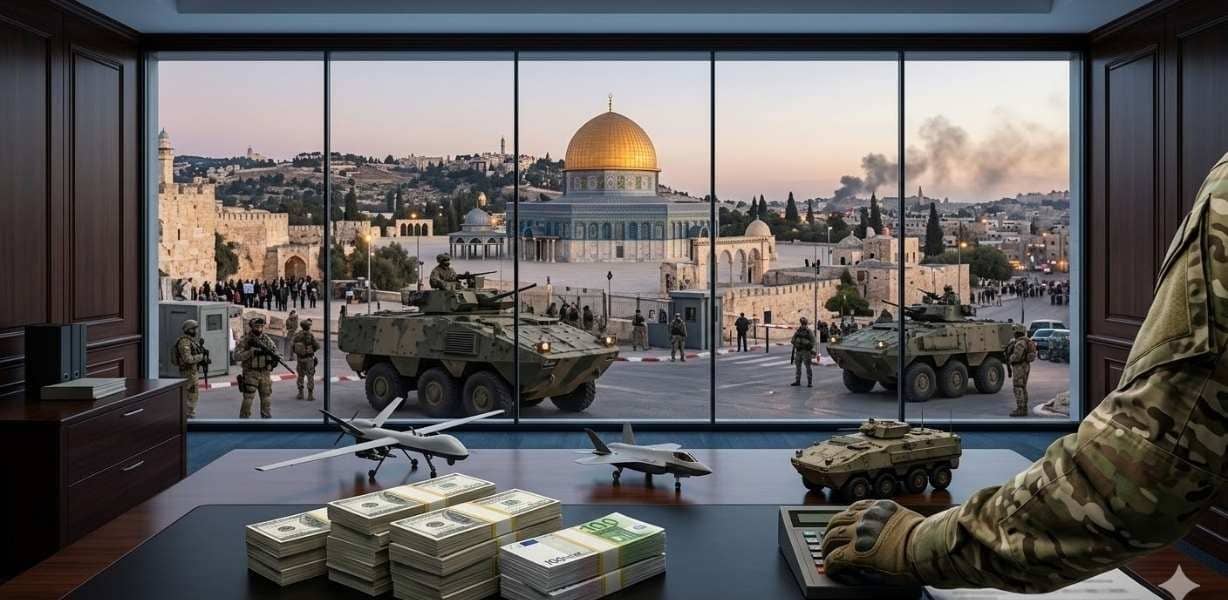
Illustrative Image
Key Takeaways
1 of 3
Automatically generated. Read full article for complete context.
The label of “radical cleric” or “religious extremist” is almost exclusively reserved in the Western lexicon for Muslim leaders and figures across the Islamic world, often relying on the flawed premise that only certain kinds of religious governance inherently lead to extreme violence. For decades, the narrative of theology driving military aggression has been applied to the Middle East with a highly selective brush. Yet, if one listens closely to the rhetoric emanating from the highest echelons of Israel’s current government, it becomes clear that the instrumentalization of religion for state-sponsored destruction is thriving elsewhere. While Western media focuses compulsively—and entirely by default—on Islamic fundamentalism as the region’s defining religious menace, it has developed a profound, voluntary deafness to how messianic rhetoric is systematically utilized to bypass secular legal constraints and dictate military policy in Jerusalem.
While Western columnists obsess over radical clerics across the Muslim world, they routinely ignore the biblical mandates of extermination driving military policy in Jerusalem.
To understand the sheer gravity of this asymmetry, one must look at the specific language used to prosecute the ongoing destruction in the Gaza Strip. On November 3, 2023, as ground troops pushed deeper into the enclave, Israeli Prime Minister Benjamin Netanyahu issued an official missive. He urged his forces to remember what Amalek did to you. For the uninitiated, the biblical Amalek is the ancient enemy of the Israelites, against whom God commanded a literal war of extermination—an injunction that explicitly mandated the killing of men, women, infants, and livestock. This was not a passing rhetorical flourish or a clumsy historical analogy. It was the deliberate invocation of holy war by the leader of a nuclear-armed state.
The Sanctioned Extremism
The invocation of Amalek transforms what is fundamentally a territorial and political conflict into a cosmic, zero-sum war of annihilation. The oft-cited defense that Israel faces an unrelenting existential threat from all sides ignores the modern geopolitical reality: numerous Arab nations—from Egypt and Jordan decades ago to the UAE, Bahrain, and Morocco more recently—have formally accepted Israel’s existence and normalized diplomatic relations. The core unresolved issue remains the establishment of a sovereign Palestinian state. Yet, once Palestinians are collectively designated under the sweeping existential mandate of Amalek, the rules of proportionality, international humanitarian law, and the Geneva Conventions do not merely become inconvenient; they become blasphemous. To spare the enemy, in this specific theological framework, is to directly defy the will of God. It is a mindset that permits no negotiation, no compromise, and actively rejects the very concept of peaceful coexistence that much of the surrounding Arab world has already embraced.
Far-right Finance Minister Bezalel Smotrich has been unflinching in his application of this doctrine against the Palestinian population. He did not merely express anger over localized violence; he argued openly that the village of Huwara should be “wiped out” by the Israeli state apparatus. Months later, when demanding aggressive military operations in Rafah and Deir al-Balah, Smotrich called for total annihilation, again explicitly quoting the biblical command to “blot out the remembrance of Amalek from under heaven.”
When National Security Minister Itamar Ben-Gvir echoes these exact sentiments, instructing his followers not to forget the divine mandate to eradicate their enemies, it ceases to be the isolated demagoguery of a few fringe radicals. It becomes the operational philosophy of the region’s most heavily armed military. We are witnessing the fusion of state power, advanced Western weaponry, and Iron Age theology. If an Iranian Ayatollah or a militia commander used 3,000-year-old scripture to explicitly justify wiping out an entire population center down to the infants, the Western press would unanimously feature it on every front page as definitive proof of an irredeemable, genocidal fundamentalist regime. In Israel, however, such language is routinely sanitized, treated as a regrettable domestic political strategy rather than a genuine statement of intent.
The Fundamentalist Mirror of the Islamic World and Tel Aviv
There is an epistemological paradox in how the international community, led by Western columnists and foreign policy think tanks, evaluates the Middle East. When the Western gaze falls upon the Muslim world, it consistently sees inherently fundamentalist states, operated by “bloodthirsty clerics” who suppress their populaces and export terror. The critique of human rights abuses, the subjugation of women in various Islamic nations, and authoritarianism is thoroughly documented and legitimate. The West correctly identifies these actions as inherently tethered to extremist interpretations of Islam.
Yet, when the exact same markers of religious extremism manifest within the Israeli cabinet, the analytical framework mysteriously shifts. The messianic fervor that drives the settlement expansion in the West Bank—a project entirely predicated on divine real estate claims rather than logic of state security—is framed merely as a “right-wing policy.” When military rabbis roam army bases preaching holy war, the secular facade of the Israeli Defense Forces is allowed to remain intact, even as its rank-and-file are heavily compromised by religious extremism. The West treats Israel’s fundamentalist slide as a political aberration, an unfortunate bug in an otherwise rational democratic system, rather than recognizing it as the defining feature of its modern governance.
Washington’s Embrace of the Holy War
Why does this glaring discrepancy exist? The answer lies rooted deeply within the geopolitical consensus, but it has recently metastasized into explicit, shared radicalism. Israel is culturally and strategically aligned with Western dominance, and for decades, the United States desperately needed it to function as a predictable, secular-democratic outpost. Acknowledging that the state is actively employing theological doctrine utilizing religious language to mandate military campaigns would traditionally require a massive structural upheaval in diplomatic relations. However, as the conflict with Iran has escalated recently, Washington is no longer merely covering for Israel’s religious extremism—it is actively adopting it.
Recent reports reveal a profoundly disturbing shift in American military and diplomatic framing. Rather than employing technical or strategic language to justify military operations, senior US officials are directly mapping the conflict onto a biblical struggle. U.S. service members have allegedly been told by commanders that a brewing war with Iran is divinely ordained to “cause Armageddon” and that Donald Trump has been “anointed by Jesus” to light the signal fire marking the biblical “end times.”
This apocalyptic terminology flows from the very top. The US Ambassador to Israel, Mike Huckabee, recently legitimized the idea of Israeli territorial expansion across the entire Middle East strictly on the basis of biblical promises. Meanwhile, figures like Senator Marco Rubio and Defense Secretary Pete Hegseth routinely cast the Iranian government as “religious fanatic lunatics” driven by “prophetic Islamic delusions.” This rhetoric serves dual purposes: it effectively mobilizes a powerful, domestic Christian Zionist base that views Middle Eastern warfare as a necessary prerequisite for biblical prophecy, while simultaneously dehumanizing the geopolitical enemy to make peace negotiations unthinkable.
Yet, this aggressive institutionalization of the “holy war” narrative is beginning to fracture the traditional Western consensus. A growing and vocal contingent within American society—particularly the anti-interventionist right led by figures like Tucker Carlson—is actively challenging the caricature of the Muslim world and rejecting the call to join a state-sponsored religious war. This faction explicitly refuses to let the United States be dragged into a catastrophic conflict justified by biblical claims to a “Greater Israel” or shielded by the rhetoric of “God’s chosen people.” When prominent voices on the American right publicly denounce the weaponization of theology to justify mass casualties, it exposes the profound instability of Washington’s current alliance with Israeli extremism.
Conversely, the Islamic world often represents the archetype of the anti-Western “Other.” Its religious struggles are rarely treated as localized political factions; they are presented as the totalizing, monolithic essence of the region. This narrative serves a critical function: it grounds policies of crushing sanctions, military posturing, and the perpetual delay of diplomacy across various Middle Eastern states. By fixating compulsively on Muslim clerics and Islamic fundamentalism, Western media outlets perform an intellectual sleight of hand, allowing the messianic rhetoric coming from Israeli ministers—and now, the Pentagon—to hide in plain sight. They create a binary world where rational, secular democracies fight irrational, religious hordes—a comforting myth that shatters the moment one translates the Hebrew rhetoric broadcasting from Tel Aviv and Jerusalem, or listens to the apocalyptic framing echoing through Washington.
Theology as a Shield for State Power
The danger of ignoring Israel’s religious messaging is not merely an academic exercise in exposing media hypocrisy. It is a matter of accurately predicting state behavior. When a government views a geopolitical struggle through the prism of a divine mandate against Amalek, no amount of diplomatic pressure, proportional response, or international condemnation will alter its course. For the political leadership, referencing religion serves a distinctly secular purpose: it establishes absolute military impunity. Answering to the International Court of Justice means nothing when a government claims to be answering directly to a higher power, thereby rhetorically removing itself from the purview of secular humanitarian law.
This profound disconnect is most glaring in how the West treats the architects of this war. In November 2024, the ICC issued arrest warrants for Netanyahu and former Defense Minister Yoav Gallant for war crimes, specifically citing starvation as a method of warfare and other inhumane acts. Imagine, for a moment, an African, Asian, or Arab leader facing such credible, internationally mandated allegations of war crimes. They would instantly become international pariahs, universally shunned by Western democracies. Yet Netanyahu is not treated as a fugitive war criminal; he remains a respected statesman in Western capitals, continually armed and defended by the very nations that claim to uphold the global rules-based order.
This same selective outrage applies to the catastrophic human toll. In the aftermath of October 7, Israeli military operations killed tens of thousands of Palestinians in a devastatingly short span—with comprehensive estimates indicating upwards of 75,000 violent deaths, of which over 56 percent were women, children, and the elderly. More recently, in early 2026, a joint US-Israeli missile strike aimed at Iran reportedly hit a girls’ primary school in Minab, killing upwards of 150 young girls. Yet, these staggering civilian casualties do not invoke the moral condemnation of Western leaders. Instead, they continue to frantically declare and back the Israeli “right to self-defense,” willfully ignoring the extremist ideology propelling the slaughter.
Following Netanyahu’s original invocation of Amalek, the Prime Minister’s Office issued a panicked, English-language clarification, claiming it was not a call for “wanton killings” but merely a historical analogy. But to the soldiers on the ground and the radical citizens in the settlements, the dog whistle had already been blown clearly.
Moving forward, observers, policymakers, and journalists must discard the comforting illusion that the Middle East’s geopolitical struggles represent a simple binary battle between Western rationalism and Eastern religious fanaticism. The issue is not that theology inherently begets violence. Rather, the danger lies in how modern state power co-opts theology to establish absolute impunity. The architects of this strategy are fully empowered within the Israeli cabinet. They are drafting state budgets, commanding military battalions, and instrumentalizing ancient scriptures to explicitly bypass secular international law, legitimizing the starvation and obliteration of modern cities. Until the international community strips away its ideological biases and reckons with the state-sponsored weaponization of religion taking root in Jerusalem, its policies will remain tragically detached from the forces genuinely shaping the region.
Disclaimer:The views and opinions expressed in this article are those of the author(s) and do not necessarily reflect the official policy or position of The Rift.