Opening The Rift
therift
© 2026 The Rift. All Rights Reserved.
Udaipur’s Win-Win Initiative: Integrating Health, Livelihoods, and Climate Action
This win-win situation of combining several benefits has arisen from the efforts of Udaipur Urja (Energy) Initiative Producer Company Limited.


Udaipur’s initiative brings together health, livelihoods, and climate action for a sustainable future
Key Takeaways
1 of 3
Automatically generated. Read full article for complete context.
Lakshmi and Reeta are from Sagavara village in Udaipur district, Rajasthan. Three changes in their life have helped to bring some unexpected but highly welcome improvements for them and their households.
First of all, they could get stoves of much lower smoke emissions and wood use. Two stoves of this kind—one ‘jumbo’ and the other ‘smart’—were made available to them at a highly subsidized price of Rs. 500, compared to the market price of Rs. 7000. As these stoves helped to significantly cut cooking-related GHG and carbon emissions, their widespread adoption generated carbon credits, which were then used to provide these reduced-smoke stoves at a highly subsidized price. and carbon emissionCarbon EmissionThe release of carbon dioxide (CO2) and other carbon compounds into the atmosphere, primarily through human activities like burning fossil fuels., their spread made available carbon creditsCarbon CreditsTradable permits that allow the holder to emit one tonne of carbon dioxide equivalent. They are used to offset greenhouse gas emissions. which were used to provide these reduced smoke stoves at a highly subsidized price. At the same time, these stoves also reduced health risks for these women during cooking. Unlike the earlier fixed stove or \chulha\, these could be moved to any more convenient location for cooking. fixed at one place, these could also be taken to any place which was more convenient for cooking at any particular time.
The second change was that these women and their families could get solar lighting in various forms at a reasonable price. This included Kisan (farmer) Torch, Inverter bulbs, Camp Portables and Rooftop Solar. This provided safer light for working in fields at night, offering protection against snake-bites and similar dangers. Secondly, it enabled children to study much later into the night and to continue essential tasks during power failures.
The third and perhaps the most significant change for many women was that they could get significant livelihood support. One new livelihood involved monitoring the reduction of emissions from less smoky and less wood-using stoves. The second livelihood and income support came from commissions earned by selling various solar lighting devices in villages. By combining these two forms of earnings, many rural women, including those from tribal communities, have achieved a significant increase in their income, though the exact extent differs based on individual work performance.
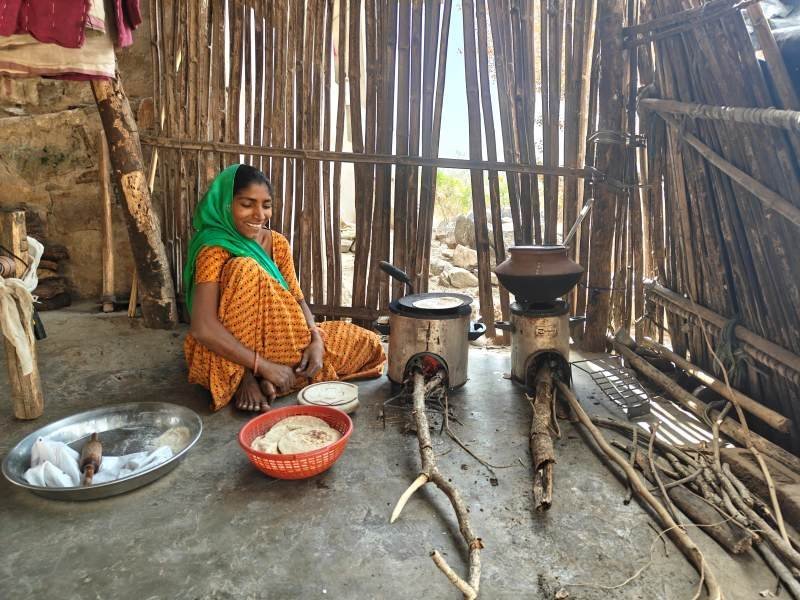
While women are experiencing significant health and livelihood benefits, climate mitigation is simultaneously advanced through the spread of renewable energy (solar) and the reduction of cooking-related emissions.
This win-win situation of combining several benefits has arisen from the efforts of Udaipur Urja (Energy) Initiative Producer Company Limited. This effort has its roots in several highly relevant experimental initiatives launched much earlier by Seva Mandir, a leading voluntary organization in Rajasthan. Once these efforts reached a certain stage, they gained an independent identity as a farmer producer group and eventually a company. and finally a company. However, Seva Mandir’s trusting relationship with many rural communities continues to be helpful for the Udaipur Urja Initiative to expand its work to more people in the region.
Udaipur Urja Initiative: Key Pillars & Impact
1. Clean Cooking Stoves
- Benefit: Reduced smoke, wood use, GHG emissions. Improved women’s health. Portable design.
- Types: ‘Jumbo’ & ‘Smart’ models.
- Cost: ₹500 (Subsidized) vs. ₹7000 (Market Price).
2. Solar Lighting Solutions
- Benefit: Safer night work (snake-bite protection), extended study hours for children, resilience during power failures.
- Forms: Kisan Torch, Inverter bulbs, Camp Portables, Rooftop Solar.
3. Livelihood Support
- Benefit: Significant income increase for rural women, fostering entrepreneurship.
- Sources: Monitoring emission reduction from stoves, selling solar lighting devices.
Overall Climate Mitigation Contributions
- Spread of Renewable Energy (Solar)
- Reduction of Cooking-Related Emissions
- Promotion of Tree-Planting
- Spreading Natural Farming & Processing
VISUALS BY THE RIFT
Several women involved in this effort expressed great enthusiasm when I spoke to them recently. Rajnish Kumar, Area Manager of Udaipur Urja Initiative said, “Many women are happy that they have emerged as successful rural entrepreneurs with possibilities of further progress.”
This initiative has further contributed to climate mitigation by promoting tree-planting, natural farming, and processing based on these methods, particularly for pulses. as well as processing based on this, particularly in the context of pulses. The farm produce and processing work also reduces the burden of fossil fuels in rural areas, while simultaneously providing nutritious and healthy food to consumers and increasing farmers’ returns for their produce. in rural areas while at the same time making available nutritious and healthy food to consumers, and also increasing the returns farmers can get for their produce.
Hence, Udaipur Urja is well on the path to advancing climate mitigation in ways that are well-integrated with creating new livelihoods, improving existing ones, enhancing women’s health, and providing better light sources suitable for rural and farm needs. Of course, the economic viability of the entire model depends largely on securing adequate carbon credits in return for reducing emissions. In particular, this is how it becomes possible to provide stoves with lower smoke and wood-use to rural households at a very low price, while also providing employment based on emission reduction monitoring to women, generally from the same communities.
There has been considerable debate on economically efficient ways of taking forward climate mitigation. In this task, a significant role has been given to carbon credits, but it must be acknowledged that some carbon credit models have also raised important doubts and objections. Therefore, one must be selective and careful regarding which models can be trusted and accepted. However, the Udaipur Urja Initiative model appears, by all available indications, to be particularly useful, and with adequate support and due caution, it can expand further to bring its benefits to more people in remote villages.
Disclaimer:The views and opinions expressed in this article are those of the author(s) and do not necessarily reflect the official policy or position of The Rift.
*Rural DevelopmentCarbon CreditsClean CookingClimate MitigationRajasthanSolar EnergySustainable LivelihoodsWomen Empowerment