Opening The Rift
therift
© 2026 The Rift. All Rights Reserved.
Rooted in the Soil, Yet Nameless on the Land: The Invisible Struggle of Women Farmers
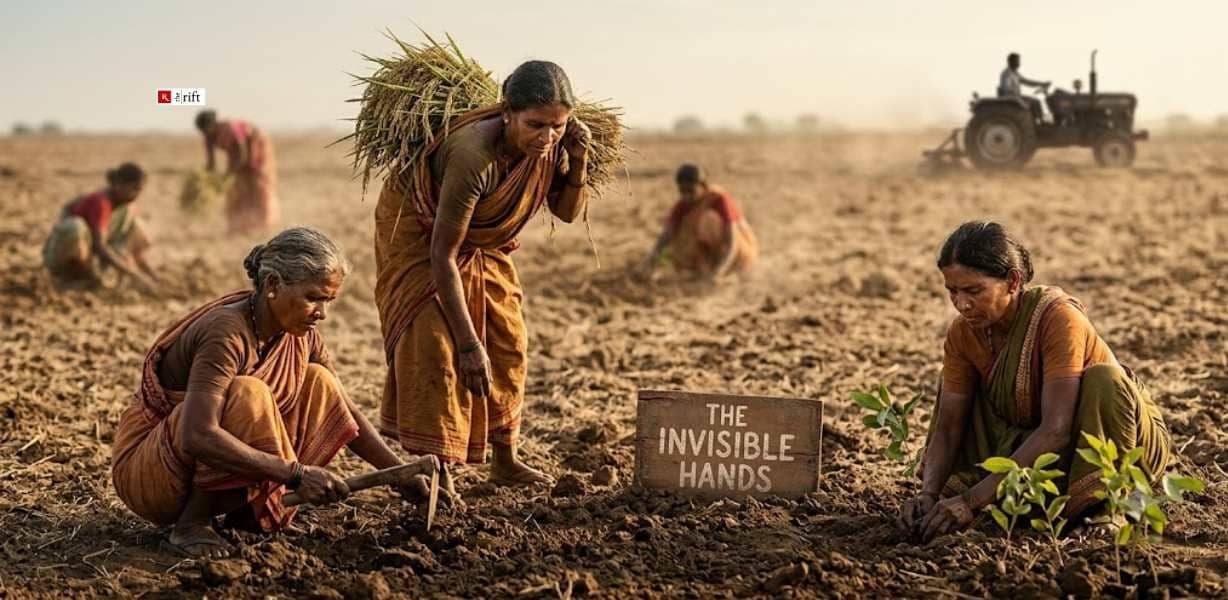
She sows seeds, pulls weeds, picks cotton, tends to livestock, stores grain, yet her identity remains confined to that of a ‘labourer’ or a ‘helper in the family.

Key Takeaways
1 of 3
Automatically generated. Read full article for complete context.
When the word “farmer” is spoken, what image comes to mind? For most people, a man appears before their eyes holding a plough, gazing hopefully at the sky. This mental image is so deeply ingrained that we forget to call a woman “farmer” even when she toils in the fields day and night. She sows seeds, pulls weeds, picks cotton, tends to livestock, stores grain, yet her identity remains confined to that of a “labourer” or a “helper in the family.” This is not merely a social oversight, it is a deep, long-standing injustice that has continued for decades, and the price for it is being paid by the nation’s very food security.
Anthropologists tell us that the origins of agricultural civilisation were, at their very source, discovered by women’s hands. Thousands of years ago, it was women who identified, stored, sowed, and nurtured seeds and crops, discovering and developing all of these practices. Today, crores of women in India labour in the fields standing on the shoulders of that very heritage. In rural India, nearly 80 percent of women work in agriculture and they perform approximately 70 percent of all agricultural tasks. Their share in crop production is 75 percent, in horticulture 79 percent, while in animal husbandry and fisheries this proportion reaches as high as 95 percent.
According to the Periodic Labour Force Survey of 2024, women’s share in India’s agricultural workforce has now exceeded 42 percent. In 2017, this figure was a mere 24.8 percent, meaning that in the past seven to eight years, the number of women labouring in the fields has nearly doubled. But this rising proportion does not mean they have gained recognition. On the contrary, responsibility kept increasing while identity remained at zero.
What do they receive in return for this enormous contribution? Only 12.8 percent of the land in the country stands in their names, and nearly 50 percent of women labour in the fields without any remuneration. Over the past eight years, the number of women working without pay has risen from 2.36 crore to a staggering 5.91 crore. This figure is not merely alarming, it is a national disgrace. In Maharashtra, this picture is even starker. As many as 88.46 percent of rural women in the state work in the agricultural sector, the highest in the country. This means that virtually every rural woman in Maharashtra toils in the fields, yet more than ninety percent of them do not have even an inch of land in their names.
According to a survey by the Indian Council of Agricultural Research (ICAR) conducted across nine states, women perform nearly 75 percent of agricultural work: sowing, weeding, harvesting, caring for livestock, processing grain, preserving seeds, everything. Yet they hold less than 14 percent of the land. In the Agricultural Census of 2015-16, this figure stood at 13.87 percent, and even a decade later it remains virtually unchanged. This means policies come, speeches are made, announcements are proclaimed, but land ownership rights never reach their hands. Even in Telangana, which has the best situation in South India, women hold only 21.5 percent of the land. In the western, central, and eastern states, this proportion falls below 13 percent.
Without land, there is no 7/12 extract, and without a 7/12 extract, the doors of government schemes are shut. This is a vicious cycle in which crores of women are trapped. Among the 9.35 crore beneficiaries registered under PM-KISAN, only 2.15 crore are women, meaning that for every five farmers, only one woman can avail herself of this scheme’s benefits. To take out crop insurance, a land extract is required; to seek a bank loan, a 7/12 is needed; to receive government assistance, name registration is necessary, and in all these conditions, women are disqualified at the very outset. Banks demand a man’s signature when giving loans, insurance schemes require a land certificate for registration, and access to market price information requires a network of connections. At every one of these points, women are systematically blocked.
The gender gap in wages is yet another wound upon a wound. According to a report by the FAO, women working for wages in the agricultural sector earn only 78 paise for every one rupee earned by men. In India, women agricultural labourers receive merely 200 rupees per day. Whether it is the scorching heat of summer, the mud of the monsoon, or the freezing early mornings of winter, she is always present, yet her worth is always undervalued. Moreover, even among the 13 to 14 percent of women who have agricultural land in their names, only half of them actually receive income from farming. The labour of the rest is valued at zero.
A.R. Vasavi, a social anthropologist from Karnataka, has clearly explained this gender-based division of agricultural work. Men perform tasks such as ploughing, sowing, and spraying, while women perform the more laborious work such as harvesting and animal husbandry. Since Independence, tractors, irrigation systems, and agricultural technology, all of it developed to reduce men’s labour. No technology was developed for the tasks that fall to women’s lot, sowing seeds, weeding, picking cotton. Because women perform this work, and women’s labour is, even today in society, considered as something that “does not exist.”
Soma K.P., the founder of the Mahila Kisan Adhikar Manch, known as MAKAAM, has recorded an important observation. Even when men leave their villages in search of work and go to cities, land ownership rights and agricultural decisions often remain in their hands. This means that while the man of the household labours in the city, the woman singlehandedly manages the farm, yet there is no provision for calling her a “farmer.” When a crop burns, when drought strikes, government assistance goes in the name of that man who may be sitting in the city. A widowed woman may maintain the farm after her husband’s death, but government assistance must not reach her. How long will this injustice continue?
Women work an average of 14 hours per day, combining household and agricultural work. During harvest season, this rises to 16 hours. The value of this labour is recorded nowhere in the economy. The unpaid domestic labour of women and girls worldwide contributes at least 10.8 lakh crore dollars to the global economy, yet this labour receives neither wages nor dignity. Women’s agricultural labour is so deeply intertwined with household, seasonal, and care work that even surveys fail to capture it properly, and as a result, their true contribution is never measured in an appropriate manner.
To this crisis, the burden of climate change has now been added. Farming families led by women suffer losses of 37 billion dollars annually due to heat stress and 16 billion dollars due to flood disasters. For every one degree Celsius rise in temperature, the total income of women-led households falls by 34 percent compared to male-led households. A study on paddy farmers in Palakkad district of Kerala revealed that women farmers face skin diseases, heat stroke, and waterborne illnesses due to the intensity of the sun. When the ill effects of climate change descend upon the fields, the greatest burden falls on women, because they have neither the means of protection, nor technology, nor insurance coverage. According to a World Bank report, the productivity of women farmers is 20 to 30 percent lower than that of men, but the reason for this is not their lack of skill, but rather the systematic exclusion of women from irrigation technology and agricultural extension services.
In India, the Hindu Succession (Amendment) Act, which grants women equal rights in land, came into force in 2005. Both married and unmarried daughters were given rights in ancestral property. But a law existing does not mean it is implemented in practice. Social pressure, family bonds, the fear that “our land will go to outsiders,” because of all of these, women even today relinquish their rights, or are compelled to do so. Even when land stands in a woman’s name, that land is smaller in size and of inferior quality compared to land held by men. Prof. M.S. Swaminathan had introduced the “Women Farmer Rights Bill” in the Rajya Sabha in 2012, which included a provision for issuing a “Women Farmer Certificate.” But this bill was struck down in April 2013. The Mahila Kisan Adhikar Manch, the Gorakhpur Environmental Action Group, and many other organisations raised their voices for this demand for years, but it reached the ears of policymakers little.
The United Nations has declared 2026 as the “International Year of Women Farmers.” Maximo Torero, the Chief Economist of the Food and Agriculture Organisation, has stated that the progress made over the past decade towards women’s empowerment has stalled and the cost of inaction is enormous. The objective of this year is to implement equitable policies for women farmers on four pillars: land ownership, access to credit, technology, and training. Against this backdrop, a ray of hope has emerged from Maharashtra. Chief Minister Devendra Fadnavis has announced that the “Maharashtra Women Farmer Empowerment Bill, 2026” will be introduced in the upcoming monsoon session. Through this bill, women will be granted legal recognition as independent farmers, and their access to credit, technology, markets, and government services will be ensured.
Fadnavis stated that women’s contribution to Maharashtra’s agricultural sector is more than 81 percent, yet because most agricultural policies are male-centric and the benefits of schemes are linked to land ownership, a large number of women are deprived of these facilities. The scope of this bill will include landless women farmers, tenant farmers, agricultural labourers, livestock keepers, and migrant agricultural workers, all of them. This bill could prove to be a historic step for Maharashtra because, for the first time, even without a 7/12 land extract, a woman will receive legal recognition as a “farmer.” And if women receive independent legal recognition as farmers even without a land extract, it will become possible for them to access institutional credit, water rights, and insurance coverage. Because in families affected by farmer suicides, it is women who bear the burden of the household, for them to receive a farmer certificate is not merely justice, it is a condition of survival.
Disclaimer:The views and opinions expressed in this article are those of the author(s) and do not necessarily reflect the official policy or position of The Rift.