Opening The Rift
therift
© 2026 The Rift. All Rights Reserved.
Weaponization of Digital Data: State Excesses, Private Defense, and Protest Surveillance
The uncritical adoption of mass digital surveillance and police impunity threatens to replace accountability with fear, inducing a destructive social fracture.

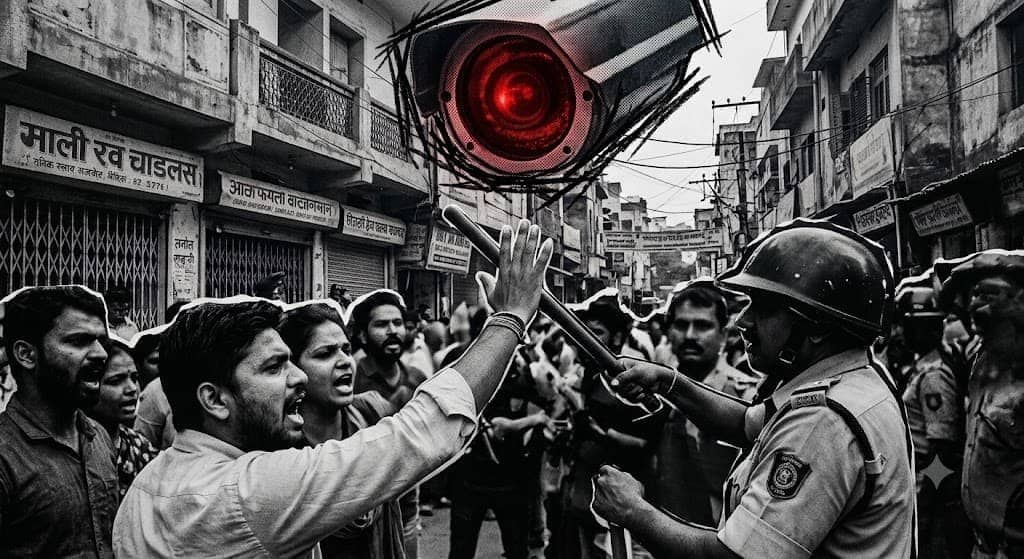
The increasing use of digital data for state surveillance and control raises concerns about privacy and civil liberties (Representative Image)
Key Takeaways
1 of 3
Automatically generated. Read full article for complete context.
The Wire reports that a large amount of surveillance footage was taken by the Delhi Police. Such data can be misused to profile individuals and violate their Constitutional rights.
The intersection of modern digital surveillance infrastructure, law enforcement accountability, and constitutional rights represents a legal and socio-political challenge of contemporary governance in democracies.
Recent events, notably captured in public discourse and investigative analyses surrounding youth-led protests (such as the demonstrations analyzed in media reports on state-monitoring mechanisms at Jantar Mantar), highlight a troubling paradox: while the state increasingly adopts advanced technological apparatus: including automated facial recognition systems (AFRSAutomated Facial Recognition SystemsTechnology used to identify or verify a person from a digital image or a video frame by analyzing and comparing patterns based on the person’s facial features.), high-definition mobile surveillance units, and unverified digital data collection, all under the guise of public safety, transparency and adherence to constitutional due process are frequently compromised.
Three critical dimensions of this phenomenon intersect :
Critical Dimensions of State Surveillance & Rights
1
Forensic Access Mandate
Preserving comprehensive forensic access to all state and civilian footage for accountability.
2
Legal Framework for Overreach
Governing state overreach and unauthorized mass biometric surveillance deployment.
3
Private Defense Recognition
Protecting civilian responses to unprovoked law enforcement violence as a valid right.
VISUALS BY THE RIFT
- The imperative of preserving and mandating comprehensive forensic access to all state and civilian-generated video footage to identify rogue elements and hold law enforcement personnel accountable for excessive use of force, assaults, and battery.
- The legal framework governing state overreach and the unauthorized deployment of mass biometric surveillance.
- The jurisprudential recognition that where civilian protestors respond to unwarranted, unprovoked violence initiated by law enforcement, their actions must be constitutionally and legally protected as a valid exercise of the right of private defense.
Weaponization of Digital Data : Forensic Access as a Safeguard Against State Excess
In an era where public demonstrations are systematically met with high-density surveillance : ranging from stationary municipal CCTV networks to mobile AI-powered police vans and drones : the evidentiary asymmetry between the state and the individual is staggering.
Law enforcement agencies routinely aggregate vast digital archives of protesters’ facial geometry, spatial trajectories, and biometric identifiers, often operating in a legislative vacuum, without explicit statutory backing or standard operating procedures (SOPsStandard Operating ProceduresA set of step-by-step instructions compiled by an organization to help workers carry out routine operations.).
To counter the institutional opacity that frequently shields state actors from accountability, comprehensive forensic access to all raw audio-visual footage must be mandated and made available to independent forensic specialists, human rights investigators, and judicial commissions.
Forensic Imperatives
Chain of Custody and Immutability : Digital footage collected by both state authorities and independent observers must be subjected to rigorous forensic authentication to prevent tampering, selective editing, or selective data scrubbing (such as the administrative takedown of critical social media archives).
Identification of Rogue Elements and Excesses : Forensic video analysis enables experts to isolate timestamps, map spatial coordinates, and perform frame-by-frame enhancement to identify specific law enforcement personnel guilty of unlawful baton charges (lathi-charge), tear gas misuse, deployment of pellet guns against non-violent assemblies, and arbitrary physical battery.
Differentiating Provocation from Compliance : Forensic reconstruction of protest footage provides an objective chronological record, decisively separating peaceful assembly from isolated acts of disruption, thereby dismantling blanket, generalized First Information Reports (FIRs) filed against protestors en masse.
Legal Vacuum leads to Violation of Constitutional Norms
The deployment of automated facial recognition and mass biometric harvesting during public assemblies directly challenges the foundational jurisprudence established by the Supreme Court in landmark rulings such as K.S. Puttaswamy v. Union of IndiaLandmark Privacy JudgmentA 2017 decision by the Supreme Court of India that unanimously affirmed the right to privacy as a fundamental right under the Indian Constitution., which established privacy as a fundamental right.
Under constitutional scrutiny, any state action that infringes upon personal liberty and privacy must satisfy a threefold test:
Legality : It must be backed by a clear, transparent, and specific statutory framework enacted by the legislature.
Legitimate Aim : It must pursue a compelling state interest.
Proportionality : The measures adopted must be proportionate to the objective sought, avoiding overbroad mass surveillance of peaceful citizens exercising democratic dissent.
As legal experts and advocacy organizations (as the Internet Freedom Foundation) have consistently noted, the routine vacuum of statutory authority governing police surveillance technologies : coupled with opaque procurement from private vendors and unconstitutional retention of biometric data : turns public spaces into an arena of pervasive, perpetual watch. When the state utilizes such tools not for targeted criminal investigations based on probable cause, but for blanket chilling and profiling of political dissenters, it inflicts systemic damage on the democratic fabric.
Private Defense in the Face of Provocation
A cornerstone of criminal jurisprudence, enshrined in the IPC/BNSIndian Penal Code / Bharatiya Nyaya SanhitaThe Indian Penal Code (IPC) is the main criminal code of India. The Bharatiya Nyaya Sanhita (BNS) is a proposed replacement for the IPC, enacted in 2023, aiming to modernize criminal law. and parallel legal systems globally is the Right of Private Defense (Sections 96 to 106 of the IPC and analogous provisions of BNS 2023). This principle recognizes that an individual possesses an inherent, natural right to defend their body and property against unlawful aggression.
Application to Initiated Violence
While law enforcement agencies possess statutory powers to maintain public order, those powers are strictly circumscribed by law.
When police or security personnel initiate unprovoked violence, deploy lethal or semi-lethal munitions (such as tear gas, baton charges, or pellet guns) against a peaceful assembly, or commit arbitrary assaults, their actions transcend legal authority and constitute unlawful aggression.
Unwarranted Provocation : Where protestors : who are gathered for legitimate grievances (such as administrative accountability or systemic corruption) : suddenly face aggressive, unprovoked physical attacks by state machinery, the character of the encounter changes.
Proportional Counter-Action : If protestors respond physically to imminent threats of grievous hurt or severe battery initiated unlawfully by police personnel, such defensive reactions cannot be summarily criminalized as rioting or assault against public servants.
Legal Protection: Jurisprudentially, where the state acts as the aggressor outside the bounds of lawful procedure, a citizen’s immediate, necessary, and proportionate physical response to protect themselves or fellow demonstrators from unwarranted bodily harm must be legally recognized and upheld as a valid exercise of the right of private defense.
The integrity of a democratic society depends entirely on its willingness to subject both state power and civic dissent to the rule of law.
The uncritical adoption of mass digital surveillance and police impunity threatens to replace accountability with fear, inducing a destructive social fracture and brain drain among young citizens.
To restore justice, raw surveillance and protest footage must not remain the exclusive, weaponized monopoly of the state. Instead, it must be opened to independent forensic experts to prosecute police excesses and rogue elements.
Simultaneously, courts and legal systems must robustly uphold the right of private defense for citizens who find themselves compelled to protect their bodily integrity against unlawful, unprovoked violence initiated by state authorities.
Jai Hind
Disclaimer:The views and opinions expressed in this article are those of the author(s) and do not necessarily reflect the official policy or position of The Rift.