Opening The Rift
therift
© 2026 The Rift. All Rights Reserved.
How Sunlight Changed a Destiny: Solar Energy Brings Self-Reliance to a Tribal Family
A household that was, until a few years ago, an ordinary farming family now stands as a remarkable example of self-reliance built on solar power.

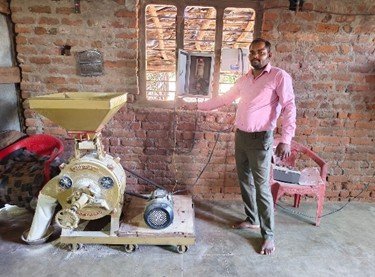
Praveen Kumar Garasia beside the solar-powered flour mill he set up in Jher Moti, which now serves his entire village.
Key Takeaways
1 of 3
“A household that was, until a few years ago, an ordinary farming family now stands as a remarkable example of self-reliance built on solar power.”
Automatically generated. Read full article for complete context.
In the remote village of Jher Moti in Banswara district, the first light of morning no longer falls only on quiet fields. These days it arrives with a new sound rising from the village, the hum of a flour mill running, a sound this place had never heard before. That hum carries the story of Praveen Kumar Garasia’s hard work, patience, and foresight, a man who reshaped his family’s fortunes with his own hands. A household that was, until a few years ago, an ordinary farming family now stands as a remarkable example of self-reliance built on solar power.
Banswara district is largely a tribal region, and its hilly terrain has always made it difficult to bring in basic infrastructure. Electricity lines often arrive late, and where they do reach, the supply is unreliable. In the absence of dependable power, starting even a small enterprise becomes an uphill task, and for years people here simply assumed that farming was the only steady source of income available to them. Praveen Kumar Garasia broke that assumption. His village had no facility for grinding grain, which meant women had to travel long distances just to have their wheat milled. He did not face this struggle alone; his wife, Guddi Garasia, stood shoulder to shoulder with him throughout the journey. The couple had four children to raise: Baliraj in the sixth grade, Mohini in the fifth, Rajmohini in the third, and their youngest, Azad, just four years old.
Change began when Praveen Kumar came into contact with VaagdharaNGO for Tribal DevelopmentA non-governmental organization (NGO) that works across the tribal belts of Rajasthan, Madhya Pradesh, and Gujarat, focusing on empowering rural families towards self-sufficiency through community participation. and joined its Gram SwarajVillage Self-Rule ConceptAn Indian concept advocating for village self-governance and self-sufficiency, where villages are empowered to manage their own affairs and resources, often associated with Mahatma Gandhi’s philosophy. group. Vaagdhara works across the tribal belts of Rajasthan, Madhya Pradesh, and Gujarat, helping tribal rural families move toward self-sufficiency through community participation under its Swaraj modelSelf-Sufficiency FrameworkA development framework based on the principles of self-rule and self-reliance, emphasizing local control, community participation, and sustainable practices to achieve economic and social independence.. What started as simple attendance at the group’s regular meetings gradually began to reshape how he thought. Through these sessions, he learned about the possibilities of solar energy, new avenues of livelihood, and government schemes that had previously been beyond his reach. Steady guidance from the organisation’s field workers slowly built his conviction that a thoughtful use of solar power could genuinely transform his family’s circumstances.
That conviction pushed him toward a decision that would go on to reshape his entire economic life. Trusting the guidance he had received, he decided to set up a flour mill in his village powered by a solar-based converter system. The mill runs entirely on solar energy, so there are no heavy electricity bills to pay and no dependence on costly fuels like diesel. Compared with the traditional diesel-run mills of the region, this system, once installed, keeps working without any major recurring expense, making it both economical and environmentally sound.
As soon as the mill began operating, villagers who once travelled kilometres to have their grain ground found the facility right at their doorstep. For Praveen Kumar, the mill stopped being merely a business venture; it became a means of meeting a shared need of the entire village, and that steady demand turned into a reliable, lasting source of income. Today, the mill earns him roughly five hundred to seven hundred rupees a day. To reduce this change to economic figures alone, though, would be unfair to the real transformation that has taken place within this household. A father who once lay awake worrying about next month’s expenses can now focus on his children’s education. Guddi Garasia, who earlier shouldered the double burden of home and field alone, is now equally able to devote attention to her children’s schooling and future. School bags, books, and the small everyday needs that once strained the family budget are now met with ease, thanks to this steady income.
Transformation: Before & After Solar Adoption
Before Solar
- ✗No local grain grinding facility, long travel for women.
- ✗Persistent irrigation troubles for farming.
- ✗Financial worries, strained family budget.
After Solar
- ✓Solar-powered flour mill at village doorstep.
- ✓Solar pump resolves irrigation, supplies neighbors.
- ✓Steady income, focus on children’s education and future.
VISUALS BY THE RIFT
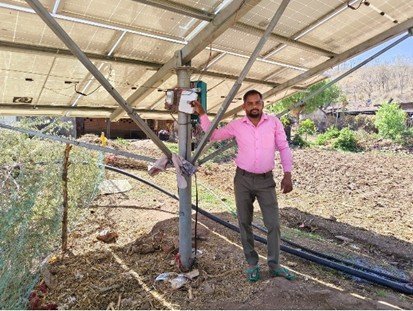
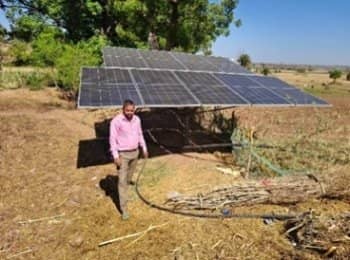
Praveen Kumar did not stop there. Encouraged by this success, he resolved to bring solar energy into his farming as well and installed a solar pump in his field, which has all but eliminated his long-standing irrigation troubles. He is now able to water his own fields on time, and he also supplies water to neighbouring farmers, earning extra income in return. Visit Jher Moti today, and Praveen Kumar Garasia’s name no longer stands merely for a successful farmer. His efforts also highlight the role Vaagdhara continues to play in empowering tribal rural communities, and they show that with the right information, the right guidance, and support offered at the right time, even an ordinary family holds the capacity to change its own circumstances.
Perhaps the most striking part of this story is that Praveen Kumar did not keep his success to himself. The grinding hardship he had once endured personally, he went on to resolve for the whole village, and having solved his own irrigation problem, he extended that same water to the fields of neighbouring farmers as well. This is, in the end, the truest mark of any social change: the moment personal progress becomes bound up with the well-being of the wider community.
Disclaimer:The views and opinions expressed in this article are those of the author(s) and do not necessarily reflect the official policy or position of The Rift.