Opening The Rift
therift
© 2026 The Rift. All Rights Reserved.
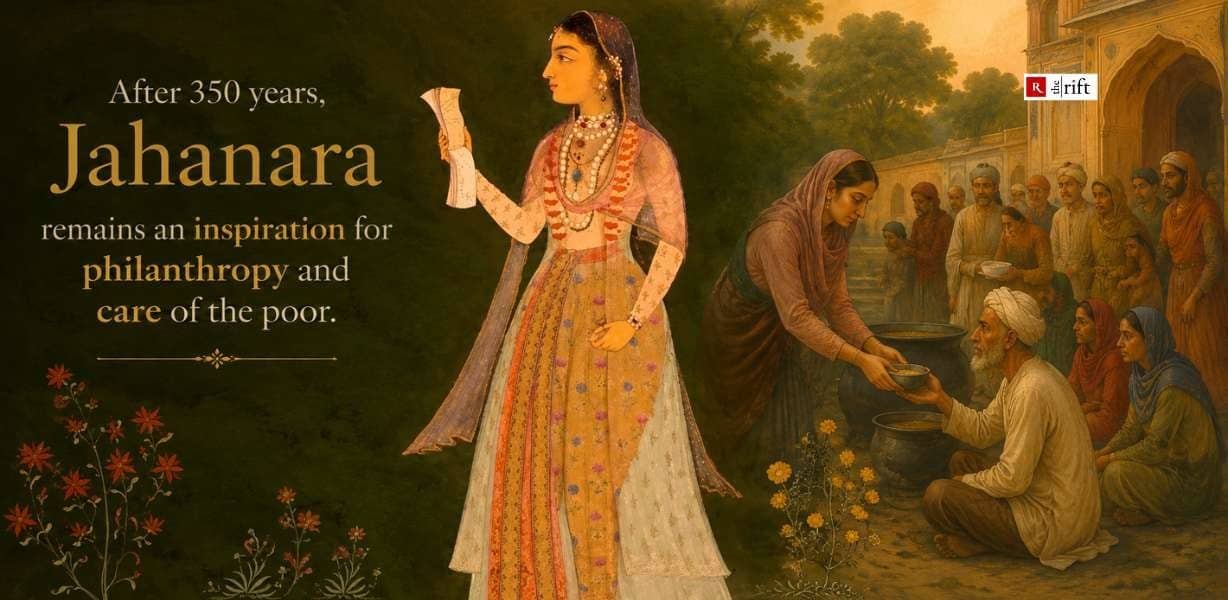
After 350 years, Jahanara remains an inspiration for philanthropy and care of the poor
Princess Jahanara is almost a unique character in the Mughal Dynasty who devoted most of her time, efforts and wealth to reducing the distress and suffering of others.

Key Takeaways
1 of 3
Automatically generated. Read full article for complete context.
Philanthropy is one of the best pursuits of human life, and several philanthropists have contributed enormously in very significant ways to making the world a more caring place. Unfortunately, however, this cannot be said for all of them as some philanthropists have also used these activities as a cover for various kinds of dubious and even harmful activities. In these conditions it is helpful to remember one of the greatest philanthropists of all times whose contributions in this respect despite being very important are seldom recalled and in fact have been almost forgotten. This writer hopes that by recalling her contributions here this neglect can be at least partially overcome, and perhaps can help to pave the way for a wider recognition and even the naming of some big philanthropy initiative so that the great contributions of the past are still remembered by people.
The case for this becomes even stronger because the philanthropist whom we are trying to remember here was at the same time also a great scholar, an author, an architect and in addition her name should also be considered in the context of the invaluable cause of promoting inter-faith harmony which has become even more important now.
Our reference here is to the great contributions made by Jahanara (1614-81) daughter of Mughal emperor Shah Jahan who built the Taj Mahal. It is an indication of her scholarship and maturity at an early age that when her mother Mumtaz Mahal died in 1631, several of her mother’s royal responsibilities were transferred to Jahanara at the age of only 17. She fulfilled her responsibilities very well, apart from taking good care of her father and younger brothers and sisters.
In times when royalty was characterized by the craze for luxury and constant intrigues for power, Princess Jahanara is almost a unique character in the Mughal Dynasty who devoted most of her time, efforts and wealth to reducing the distress and suffering of others. While she was extremely devoted to her father, she also carved out an independent identity for herself in the context of her many sided achievements, an author and scholar, a leading member of a spiritual movement, a patron of various arts and scholarly pursuits and above all a philanthropist.
She was twice formally appointed the First Lady, the Padshah BegumPadshah BegumFirst Lady of the Mughal Empire., of the Mughal Empire at the peak of its vast spread, including most of South Asia as we know it today, for 37 long years.
Her first tenure as Padshah Begum was from 1631 to 1658 during the reign of her father Shahjahan. When her younger brother Aurangzeb grabbed the throne in a revolt and imprisoned their father, he also removed her as Padshah Begum as she had been very close to his rival brother Dara Shikoh, instead appointing her younger sister Roshnara who was greedy and ambitious.
Jahanara then devoted herself to serving her father in his last years. Shahjahan died in 1666. Later when Aurangzeb was fed up with the mischief and corruption of Roshanara, he again invited Jahanara to be the Padshah Begum from 1668 till her death in 1681, at the age of 67.
In her young and formative years Jahanara was closest to her brother Dara Shikoh and shared his passion for spiritual quests. Like Dara she too was drawn to the folds of Sufism, particularly the QuadiriyyaQuadiriyyaA prominent Sufi order. Sufi order. Mulla Shah said that she had advanced so much in this quest that she could be his successor, but the rules did not permit this.
An avid reader and a serious scholar, her writings were also related more to her spiritual explorations. She wrote the biography of Sheikh Moinuddin Chishti.
She was in charge of the empire’s charities and in this context she arranged for the distribution of a lot of funds and food to the needy at regular intervals and on several special occasions. These increased during drought and famine times. However her work as a supporter of charity was not confined to her duties as Padshah Begum as she also donated very generously from her personal income and wealth. These donations increased at the time of drought and famine, and Princess Jahanara was also involved in famine relief.
Jahanara was a great patron of arts and scholarship and donated generously to support artistic and scholarly work, apart from extending encouragement in other ways. She also devoted her talents to the designs of several buildings, including parts of Chandni Chowk, particularly the Caravan SeraiCaravan SeraiA historical roadside inn for travelers. which much later became the Town Hall Building with a clock tower emerging in place of the original pool. She contributed to the design of the Jama Masjid in Agra and a famous mosque and garden in Kashmir.
While she could access and control more wealth than almost any other woman in the vast empire, she herself made little personal use of this and instead used this for reducing the distress of others. It was due to this personal commitment of the topmost administrator of charity that led to much more sharing of wealth with the poor and the needy than was generally the case with most empires and royal families.
Jahanara was a strong supporter of equality of all citizens and publicly opposed Aurangazeb’s decision of a poll-tax on non-Muslims.
It is a strong indication of her deeply felt concerns that she desired this to be written on her tomb, there should be nothing except grass on my tomb as the poor can afford only grass. She asked that she be remembered as a fakiraFakiraAn ascetic who renounces material wealth., one who in deeper quests of life discards considerations of wealth and materialist goals.
It was due to her presence in the royalty that many workers and those toiling at lower levels in the durbar and royal household could hope for getting justice. She had a terrible accident in her younger days resulting in serious burn injuries. While there is more than one version of how she was injured, one credible version tells us that the dress of a dancing girl had caught fire and it was in the process of trying to save her that Jahanara sustained serious burn injuries herself. At one time there was serious risk to her life and it is an indication of the great affection in which she was held by people that a great pall of distress had spread far and wide in the vast kingdom with even the emperor finding it difficult to attend to essential royal tasks. Ultimately, after many learned doctors had failed to cure her, true to the deep concerns Jahanara had for the poorest, it was the ointment prepared by a page Arif Chela which cured the princess!
It will be a happy day indeed if India and the wider world can remember the many-sided contributions of Jahanara in better ways as these contributions have very high inspirational value.
Disclaimer:The views and opinions expressed in this article are those of the author(s) and do not necessarily reflect the official policy or position of The Rift.