Opening The Rift
therift
© 2026 The Rift. All Rights Reserved.
How Mahatma Gandhi’s Message of Non-Violence Reached Martin Luther King
“It may be through the Negroes that the unadulterated message of non-violence will be delivered to the world.”

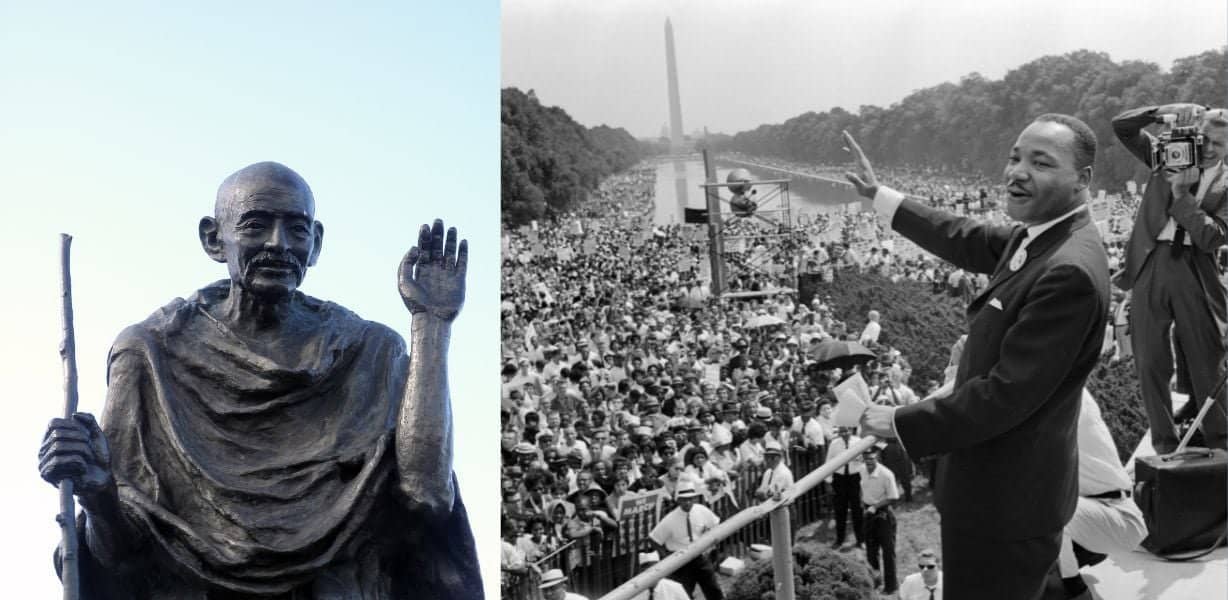
Mahatma Gandhi’s philosophy of non-violence influenced Martin Luther King Jr.’s civil rights movement (Representative Image)
Key Takeaways
1 of 3
“In fact, Mahatma Gandhi had foreseen the potential of the methods he pioneered for these struggles.”
Automatically generated. Read full article for complete context.
Mahatma Gandhi devoted his life to pioneering the path of non-violence for resisting injustice and social discrimination as well as for advancing the cause of securing freedom of India from oppressive colonial rule. He died in 1948.
Less than a decade after his death, Martin Luther King, the great civil rights leader of the USA’s Black communities, made very effective use of the learnings from Mahatma Gandhi regarding the path of nonviolence, initiating struggles for equality and dignity that captured the imagination of people far and wide and achieved significant success for justice.
In fact, Mahatma Gandhi had foreseen the potential of the methods he pioneered for these struggles. After extending a very warm welcome to a group of visitors from US Black communities visiting his camp at BardoliBardoli SatyagrahaA significant peasant movement led by Sardar Vallabhbhai Patel in 1928 in the Bardoli taluka of Gujarat, India, against increased land revenue. Gandhi visited the area and met with various groups there. in 1936, Gandhi offered them a message of hope. He told them, “It may be through the Negroes that the unadulterated message of non-violence will be delivered to the world.”
This proved substantially true when the civil rights movement led by Martin Luther KingMartin Luther King Jr.An American Baptist minister and activist who became the most visible spokesperson and leader in the Civil Rights Movement from 1955 until his assassination in 1968. achieved great success. Much later, too, the message of Mahatma Gandhi was used by an important peace worker inspired by Mahatma Gandhi to stop gang violence in his area of work in the USA.
Martin Luther King, time and again, acknowledged the great influence of Mahatma Gandhi on his work and movements. He said, “Mahatma Gandhi has done more than any other person in history to reveal that social problems can be resolved without resorting to primitive methods of violence…In our struggle against racial segregation in Montgomery, Alabama, I came to see at a very early stage that a synthesis of Gandhi’s method of nonviolence and the Christian ethic of love is the best weapon available to Negroes for this struggle for freedom and human dignity.”
In a letter written in 1957, King wrote, “I firmly believe that the Gandhian philosophy of nonviolent resistance is the only logical and moral approach to the solution of the race problem in the United States.”
Later, after visiting India in 1959, King wrote in another letter, “I left India more convinced than ever before that the method of nonviolent resistance is the most potent weapon available to oppressed people in their struggle for freedom and dignity. In fact, there is no other lasting way. I have returned to America with a greater determination to achieve freedom for my people through nonviolent means.”
Many Americans, particularly from Black communities, had been preparing the ground for spreading important learnings from Mahatma Gandhi’s struggles and experiments. As early as the 1920s, Marcus M. Garvey of the Universal Negro Improvement AssociationUniversal Negro Improvement Association and African Communities League (UNIA-ACL)A Black nationalist fraternal organization founded by Marcus Garvey in 1914, promoting Black economic independence and self-determination. presented struggles in India’s freedom movement as an example from which much can be learned. Mahatma Gandhi’s struggles against untouchability were covered by several African-American newspapers and magazines. In 1929 the famous Black philosopher W.E.B. Du Bois published a letter from Gandhi in The Crisis, a publication of the National Association for the Advancement of Colored PeopleNational Association for the Advancement of Colored People (NAACP)A civil rights organization in the United States, formed in 1909 as a bi-racial endeavor to advance justice for African Americans.. This was widely reprinted and circulated, indicating the responsiveness of people.
Later, many other Black leaders like Adam Clayton Powell, A. Philip Randolph, and E.D. Nixon helped to establish the relevance of Gandhi-led movements for American situations.
There was considerable exchange of letters between Black leaders from the USA and associates of Mahatma Gandhi in India followed in some cases by visits and meetings. Morehouse College President Benjamin Mays, who had personally met Gandhi, introduced several of his ideas to a young Martin Luther King. Mordecai Wyatt Johnson, President of Howard University, visited India in 1949 to meet several associates of Gandhi and proved to be an important link for carrying Gandhian ideas to the Black communities in the USA and more specifically to King himself.
Reverend James M. Lawson was influenced by the ideas of nonviolent resistance to injustice early in life and read Gandhi extensively. In 1952 he visited India and held discussions with several associates of Gandhi, including Prime Minister Jawaharlal NehruJawaharlal NehruThe first Prime Minister of India (1947–1964) and a central figure in Indian politics before and after independence. He was a close associate of Mahatma Gandhi.. Back in the USA, Lawson conducted workshops on nonviolence attended enthusiastically by many civil rights activists, including King.
Several other names can be added. what is clear is that many leading members of Black communities in the USA had been looking keenly at Mahatma Gandhi’s ideas and struggles regarding nonviolent resistance, and the continuing contributions made by them to spreading this information and the ideas based on them helped to prepare the ground in which the subsequent non-violent struggles of the civil rights movement led by Martin Luther King and his companions could grow their roots more easily.
It is particularly important in present times to remember this legacy, as the ideas and struggles of Mahatma Gandhi can again be of considerable importance in present times in the context of nonviolent resistance to injustice and violence. The ideas of Mahatma Gandhi are equally important for spreading the concept of nonviolence as a way of life. This can be very important for strengthening the peace movement.
Disclaimer:The views and opinions expressed in this article are those of the author(s) and do not necessarily reflect the official policy or position of The Rift.
*Nonviolent ResistanceCivil Rights MovementIndiaMahatma GandhiMartin Luther King Jr.Social JusticeUSA