Opening The Rift
therift
© 2026 The Rift. All Rights Reserved.
Liberations Movements must be judged according to their cause
To examine only the violence of the oppressed while erasing the violence of occupation is not morality; it is political selectivity masquerading as principle.

Key Takeaways
1 of 3
Automatically generated. Read full article for complete context.
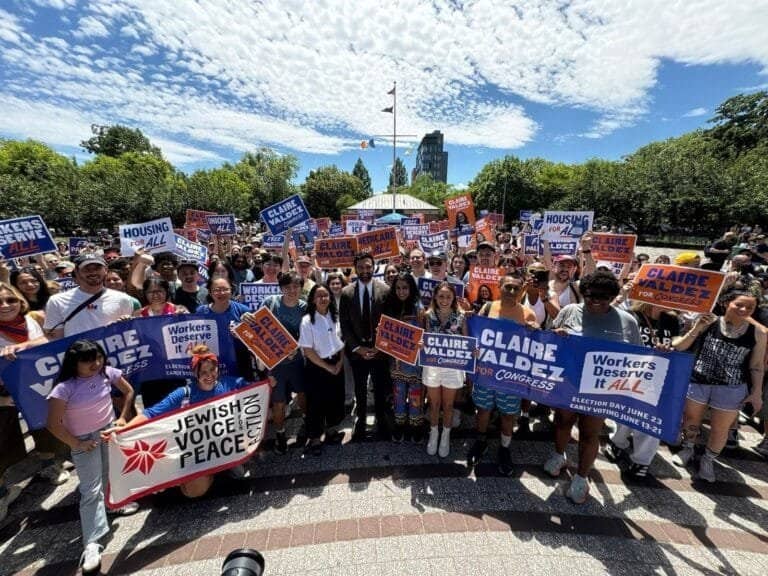
Jewish Voice for Peace (JVP) is the largest progressive Jewish anti-Zionist organization in the world. It is distinguished by the fact that its import is rooted in organizing grassroots, multiracial, cross-class, intergenerational movement of U.S. Jews into solidarity with the Palestinian freedom struggle, guided by a vision of justice, equality, and dignity for all people.
JVP draws its constituents from among those seeking a political home for Jews on the left in what it views as a morally perilous historical moment. It seeks to build a Jewish community with justice at its centre and calls on those wishing “to turn rage and grief into meaningful, strategic action” to join a movement grounded in solidarity, ethical responsibility, and collective belonging.
The JVP is highly controversial, and there is an irrational view advanced by several advocacy groups, political figures, and watchdogs that its actions and rhetoric align with extremism is advanced by several advocacy groups, political figures, and watchdogs.
In sharp contrast, JVP visualizes a world where all people – from the U.S. to Palestine – live in freedom, justice, equality, and dignity. The JVP is committed to Like generations of Jewish leftists JVP claims the right to fight for the liberation of all people through organizing, towards ultimately dismantling political structures that tolerate injustice and nurture life-sustaining spaces.
The Boycott, Divestment, and Sanctions (BDS Movement) is framed by its advocates as a non-violent, international civil rights effort modelled after the anti-apartheid movement in South Africa. However, many governments, institutions, and watchdog groups classify such calls as extremist, arguing that they unfairly single out the only Jewish state for destruction and frequently cross the line into antisemitism.
The application of labels such as “extremist” often depends upon the political and historical framework from which the conflict is interpreted. Those who view Zionism primarily as the legitimate expression of Jewish self-determination tend to regard anti-Zionist movements as existential threats. Conversely, those who prioritize Palestinian human rights and oppose systems of occupation, exclusion, or demographic domination frequently regard hardline Zionist policies as a form of structural extremism.
Jewish Voice for Peace (JVP) is viewed as an extremist organization by the United States government, the European Union, or Israel based on explicit measures of violence and illegality. Regulator organizations such as loosely JVP’s past collaboration and support for individuals belonging to the Popular Front for the Liberation of Palestine (PFLP), a U.S.-designated terrorist organization.
There are those organizations that charge JVP has alleged ties to terror financing. Critics argue that JVP’s primary goal is the dismantling of the State of Israel. The Anti-Defamation League (ADL) alleges that JVP is a radical anti-Zionist group that advocates for the total boycott of Israel and the eradication of Zionism.
The perception of such movements as extremist emerges from a deeper clash of historical narratives, competing understandings of self-determination, and unresolved tensions between legitimate political criticism and questions of communal or religious identity.
Many mainstream Jewish communities view Zionism as the legitimate movement for Jewish self-determination and national liberation in their ancestral homeland. Within this framework, movements that seek to boycott or dismantle Israel are seen as extremist, discriminatory, or antisemitic, because they deny Jews the same right to statehood that is granted to other groups.
Contrarywise, pro-Palestinian and anti-Zionist advocates view Zionism as an inherently exclusionary, settler-colonial ideology. From this perspective, Zionism inherently requires the displacement and subjugation of the indigenous Palestinian population to maintain a Jewish demographic majority. Organizations like Jewish Voice for Peace argue that opposing this system is a legitimate anti-racist stance, not an extremist one.
JVP has frequently been targeted as one that repetitively swings the blame for violence onto Israel, with some critics citing instances where the group has whitewashed or rationalized Palestinian militant attacks.
JVP, instead, characterises itself as grassroots, progressive organization working for “freedom, justice, equality, and dignity for all people”. They unequivocally assert that their activism is deeply rooted in Jewish traditions of justice, and, hence, call for closure of U.S. military aid to Israel. Notwithstanding political opposition, JVP confronts sustained political criticism from those who believe its campaigns intensify hostility toward Israel and blur the line between anti-Zionism and antisemitism.
Whether a movement is viewed as legitimate resistance or criminal violence is rarely determined by neutral moral standards alone. Perceptions are frequently shaped by geopolitical interests, historical memory, media narratives, and the unequal power of states to define legality and legitimacy within the international system. In international relations and law, the fundamental difference generally comes down to the goals and strategies employed. Supporters typically define these groups as legitimate actors fighting against military occupation, oppression, or systemic injustice. Their primary goal is often self-determination, liberation, or political change. They may use nonviolent resistance, strikes, boycotts, and civil disobedience, or armed methods directed exclusively at state military and occupying forces.
Colonial powers historically reserved for themselves the authority to define which violence was lawful and which resistance was criminal. That legacy continues to shape international discourse today, where the violence of powerful states is often normalized under the language of security, while the violence of the oppressed is isolated from its historical context and condemned in absolute terms. “By putting tribal allegiance to Israel over fundamental commitment to universal human rights, however, Zionist Jewish organizations in the US and the West in general consciously abet in propagating the racist, indeed anti-Semitic, myth that Israel speaks on behalf of the entire world Jewry and that it is entitled to do so. Reducing Jews to a monolithic group that thinks alike and that is automatically expected to ignore suffering by other humans when the oppressors are themselves Jewish is not only antisemitic it is categorically false and deceptive.” (Omar Barghouti (co-founder of Boycott, Divestment and Sanctions Movement), August 2011). Miko Peled (anti-Zionist activist), an Israeli-American activist, author, speaker, states how: “Zionism is a sign of dual loyalty at best, at worst you are actually paid agents working for a foreign, racist government.”
Not to digress, but to illustrate different forms of what is called extremism, one might wish to take the example of The African National Congress (ANC). The ANC was in many ways the backbone of the resistance against Apartheid. It began by using peaceful methods to oppose the system. The Sharpeville Massacre in 1960 – where many black peaceful demonstrators were shot in the back by police – was a powerful factor in the ANC decision to take up arms against the system. In 1964 Nelson Mandela – leader of the ANC’s armed wing – was sentenced to life imprisonment for terrorism. Margaret Thatcher, prime minister of Britain in the 1980s, called the ANC a terrorist organisation, and her spokesman famously said that anyone who believed that the ANC would ever form the government of South Africa was ‘living in a cuckoo land.’ Apartheid came to an end in 1994 and ANC formed the new government with Nelson Mandela as president.
Hamas emerged as a Palestinian Islamist-national movement shaped by decades of occupation, blockade, displacement, political fragmentation, and the collapse of meaningful diplomatic pathways. Its discourse draws upon both religious symbolism and nationalist aspirations rooted in Palestinian self-determination.
The European Union’s authority to define the political character of groups like Hamas stems from its role as an international governing body and its adherence to multilateral security frameworks. The EU officially designates Hamas as a terrorist organization, imposing sanctions and a strict “no contact” policy. However, this classification is intensely debated in international relations and post-colonial studies.
Critics, particularly from post-colonial perspectives, argue that Western powers have historically disqualified national liberation movements by labelling them terrorist or illegitimate, which undermines their anticolonial context. Conversely, the EU, along with several other international actors, justifies its designation by citing Hamas’s use of violence targeting civilians, its founding charters, and its refusal to recognize Israel’s right to exist.
This creates a stark divide in global perception: Supporters and various scholars view Hamas fundamentally as a nationalist and religious social movement. They argue that the group arose as a grassroots response to the prolonged Israeli occupation and performs essential social welfare services.
The EU, the United States, and several other allied nations legally classify the entirety of Hamas as a terrorist group, pointing to its militant wing and history of armed attacks. The friction between these two views reflects broader questions about who holds the legitimacy to define resistance and the legacy of colonial history in modern international law.
From a justice perspective the question must be asked: Who is Europe to define the political character of social movements (that Hamas essentially is) after having been a colonial entity for long periods in other parts of the world?
European colonizers utilized extreme violence and mass-scale resource extraction, fitting the definitions of invaders, terrorists, and looters. Their empires systematically used asymmetric warfare, massacres, and the erasure of indigenous cultures to conquer, control, and drain wealth from foreign territories.
European colonial expansion was sustained through military conquest, economic extraction, racial hierarchy, and systematic coercion across vast regions of the world. Contemporary critics therefore question the moral authority of former colonial powers to unilaterally define the legitimacy or illegitimacy of resistance movements in the post-colonial era. Colonizers frequently employed state-sponsored psychological and physical terror to subdue local populations. This included the use of concentration camps, public executions, engineered famines, and the destruction of civilian infrastructure to enforce compliance and crush rebellions.
Colonial rule was economically driven by the large-scale extraction and theft of natural and cultural resources, such as gold, diamonds, spices, and land. This systemic looting laid the groundwork for modern capitalist expansion in the West while deliberately under developing the colonies themselves.
While the colonizers justified these actions using ideologies of racial, religious, and cultural supremacy, historical analysis widely categorizes these imperial practices as systemic exploitation, violence, and robbery.
The argument that the ongoing war is unjust to Gazans is widely shared, though the view of Hamas’s role is deeply polarized. Human rights organizations and the international community generally focus on the devastating civilian toll of the conflict rather than the political framing of the militant group.
There are differing perspectives on Hamas’s Role. Within the framework of the advocacy view, some supporters and the group’s own charter describe Hamas as a national liberation movement and a governing authority acting in defense of Palestinian rights and statehood.
Many global bodies and rights groups—including designations by countries like the US, UK, and the EU – classify Hamas as a terrorist organization. Major organizations like Human Rights Watch have extensively documented and condemned the group’s actions on October 7, 2023, for deliberate killings of civilians, hostage-taking, and operating in densely populated areas.
Human Rights Watch highlights the situation of the Gazan population; international humanitarian agencies agree that the scale of the suffering is catastrophic. Reports from the United Nations highlight mass displacement, a severe humanitarian crisis, and heavy loss of civilian life. There is intense debate over accountability, with mounting international criticism and legal actions regarding the proportionality of Israel’s military response and the overall conduct of the war.
Political violence is rarely interpreted consistently across the international order. Armed actors supported by powerful states are often described as defenders of security, while movements arising from occupied or colonized populations are more readily criminalized, even when both employ violence. This asymmetry in political language remains central to contemporary debates on resistance, legitimacy, and international law. The debate often centres on whether violence is defined by its goals or by its methods:
Supporters label an armed group “freedom fighters” if they sympathize with the political goal (e.g., national liberation, ending oppression, or resisting an occupying force). Critics label the exact same group “terrorists” if they target civilians or non-combatants to achieve their political objectives.
Many international legal frameworks and moral philosophies, such as the International Committee of the Red Cross guidelines on international humanitarian law, reject the moral equivalency of this cliché. They argue that regardless of how righteous the underlying political cause may be, the intentional targeting of civilians is universally recognized as terrorism. Yet moral clarity becomes most difficult in situations marked by prolonged dispossession, occupation, siege, and collective trauma. The challenge before humanity is not to abandon ethical principles, but to apply them consistently — to states and non-state actors alike — without erasing the historical realities that give rise to resistance in the first place.
The essential question, therefore, is not whether resistance movements should be scrutinized. All political movements, states, armies, and liberation struggles must remain open to ethical and legal examination. The real question is whether the world applies the same moral standards to the powerful and the powerless alike.
History demonstrates that many movements once denounced as “terrorist” later emerged as legitimate representatives of oppressed peoples. From Algeria to South Africa, anti-colonial struggles were routinely criminalised before they were recognised. Colonial powers reserved for themselves the authority to define violence while concealing their own structural brutality behind the language of order, civilization, and security.
This does not mean that every act committed in the name of liberation becomes morally defensible. The deliberate targeting of civilians, hostage-taking, sectarian hatred, or indiscriminate violence cannot become acceptable merely because a cause is just. A people’s suffering does not automatically sanctify every method adopted in their struggle. But neither can states invoke “security” as a permanent license for occupation, siege, dispossession, collective punishment, and mass civilian destruction.
Liberation movements must therefore be judged first by the historical reality that produced them, second by the justice of their political aspirations, and finally by the ethical character of the means they employ. To examine only the violence of the oppressed while erasing the violence of occupation is not morality; it is political selectivity masquerading as principle.
The tragedy of Palestine is not only the cycle of violence. It is the refusal of much of the international order to confront the conditions that sustain that violence. Peace cannot emerge from domination. Justice cannot emerge from selective outrage. And history has repeatedly shown that when legitimate aspirations for dignity, equality, and self-determination are denied for generations, resistance in one form or another becomes inevitable.
The world may continue debating labels — extremist, terrorist, militant, radical, liberationist. But history asks a deeper question: who created the conditions in which such movements were born in the first place?
(This article was prompted by sharp criticism of a Jewish Peace and justice movement, unfairly categorized as extremist)
Disclaimer:The views and opinions expressed in this article are those of the author(s) and do not necessarily reflect the official policy or position of The Rift.
*Liberation MovementsAnti-ZionismBDSColonialismHamasHuman RightsInternational LawJewish Voice for PeacePalestine